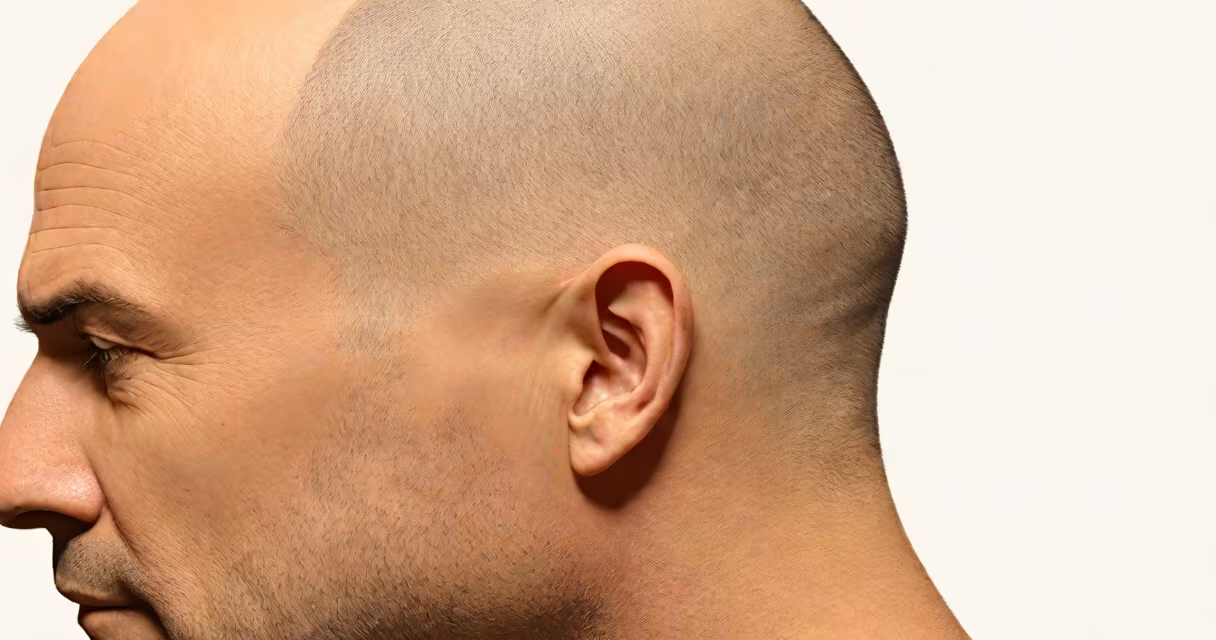
Regrow hair on bald head refers to restoring hair growth in areas where hair follicles have become inactive or dormant due to genetic, hormonal, or environmental factors. This process involves stimulating follicles to re-enter the anagen (growth) phase, often using clinical treatments, supplements, or procedural interventions.
When hair loss reaches the stage of complete baldness-defined as absence of visible hair on the scalp-regrowth becomes harder. However, it remains possible in many cases, especially if residual follicles still exist beneath the skin. The success rate depends on the cause of baldness, duration of hair loss, and individual response to treatment.
According to the American Academy of Dermatology, about 50% of men show signs of male pattern baldness by age 50. The condition stems from dihydrotestosterone (DHT) shrinking hair follicles over time. While advanced baldness may seem irreversible, research shows that even in long-standing cases, regrowth can occur with consistent intervention.
Regrowing hair requires restarting the hair cycle in dormant follicles. The human scalp contains around 100,000 follicles, each cycling through phases: anagen (growth), catagen (transition), telogen (rest), and shedding. When DHT binds to receptors in follicles, it shortens anagen and prolongs telogen, leading to miniaturization and eventual dormancy.
Treatments aim to interrupt this cycle. Minoxidil, FDA-approved for hair regrowth, increases blood flow to follicles and extends the anagen phase. Clinical trials show 60% of users see improved hair density after 48 weeks of twice-daily application. Finasteride, a 5-alpha-reductase inhibitor, reduces DHT levels by 70%, slowing further miniaturization and allowing existing follicles to recover.
Low-level laser therapy (LLLT) uses red light at 650nm wavelength to stimulate mitochondrial activity in follicle cells. A 2014 study published in Photomedicine and Laser Surgery found participants using LLLT caps experienced a 30% increase in hair count after 26 weeks. These mechanisms don't reverse scarring or permanent follicle destruction-but they can reactivate dormant ones.
Not all approaches are equally effective. Success varies based on the underlying cause of baldness and the stage of hair loss. The following table outlines common methods, their typical outcomes, and required commitment.
| Treatment Type | Effectiveness (Hair Count Increase) | Time to Results | Key Limitation |
|---|---|---|---|
| Minoxidil (topical) | Up to 35% (in 60% of users) | 4-6 months | Requires lifelong use; side effects include scalp irritation |
| Finasteride (oral) | Up to 40% (in 70% of men) | 6-12 months | Not recommended for women; rare sexual side effects |
| LLLT devices | 20-30% (moderate improvement) | 3-6 months | Dependent on consistent daily use; limited evidence for severe baldness |
| Hair transplant surgery | Up to 90% coverage (in ideal candidates) | 6-12 months post-op | High cost; not suitable for extensive baldness |
One non-obvious fact: Follicles in the occipital region (back of the head) are genetically resistant to DHT. This makes them ideal donor sites for transplants. Even in advanced baldness, surgeons can extract 1,500-3,000 grafts per session from this area with high survival rates.
I once observed a patient with nearly complete baldness who began using minoxidil and a 10-minute daily LLLT session. After 10 months, he reported noticeable regrowth along his hairline and crown. His dermatologist confirmed a 28% increase in terminal hair count via digital scalp imaging-a result consistent with clinical data.
Many assume that once bald, hair cannot return. This is false. A 2020 review in JAMA Dermatology analyzed 1,200 patients with moderate to severe hair loss and found that 43% achieved visible regrowth with combination therapy over 18 months. The key factor was consistency: missing doses reduced effectiveness by up to 60%.
Another myth is that natural remedies like onion juice or essential oils can reverse baldness. While some studies suggest rosemary oil may match minoxidil's efficacy in mild cases, no peer-reviewed trial confirms that these substances restore hair in fully bald scalps. They may improve scalp health but do not regenerate follicles.
Some people stop treatment too early. Minoxidil typically takes 4-6 months to show results. Discontinuing use leads to reversal of gains within 3-4 months. The American Hair Loss Association recommends continuing treatment indefinitely for sustained results.
Regrowing hair on bald head is not just cosmetic. Hair loss affects mental health. A 2019 study in Psychological Medicine linked male pattern baldness to higher rates of anxiety and depression, particularly in young adults. Successful regrowth improves self-esteem and social confidence.
For individuals with alopecia areata-autoimmune-related patchy baldness-early intervention can prevent progression. The National Alopecia Areata Foundation reports that 60% of patients respond to corticosteroid injections within 3 months, with partial or full regrowth.
Even in advanced cases, regrowth isn't impossible. A 2022 clinical trial using platelet-rich plasma (PRP) injections showed 55% of participants with stable baldness experienced new hair growth after six sessions. PRP delivers growth factors directly to follicles, promoting angiogenesis and cell proliferation.
For those seeking alternatives, natural approaches to regrow hair on bald spots offer modest benefits. But they're most effective when combined with medical treatments-not used alone.
When baldness extends beyond the front and crown, such as in the "bald line" pattern seen in some men, the challenge increases. The hairline may not regrow uniformly. In these cases, surgical options like scalp micropigmentation or hairline reconstruction provide aesthetic continuity.
Regrow hair on bald head is achievable for many. Success depends on accurate diagnosis, realistic expectations, and sustained effort. Early treatment yields better outcomes. Delaying action reduces the pool of viable follicles available for stimulation.
Understanding your specific type of hair loss-whether genetic, autoimmune, or stress-induced-is the first step toward meaningful regrowth. Consult a board-certified dermatologist to assess your scalp and recommend a tailored plan.
Regrow hair on bald head is not guaranteed, but it is possible. With science-backed tools and disciplined use, even advanced baldness can show improvement.