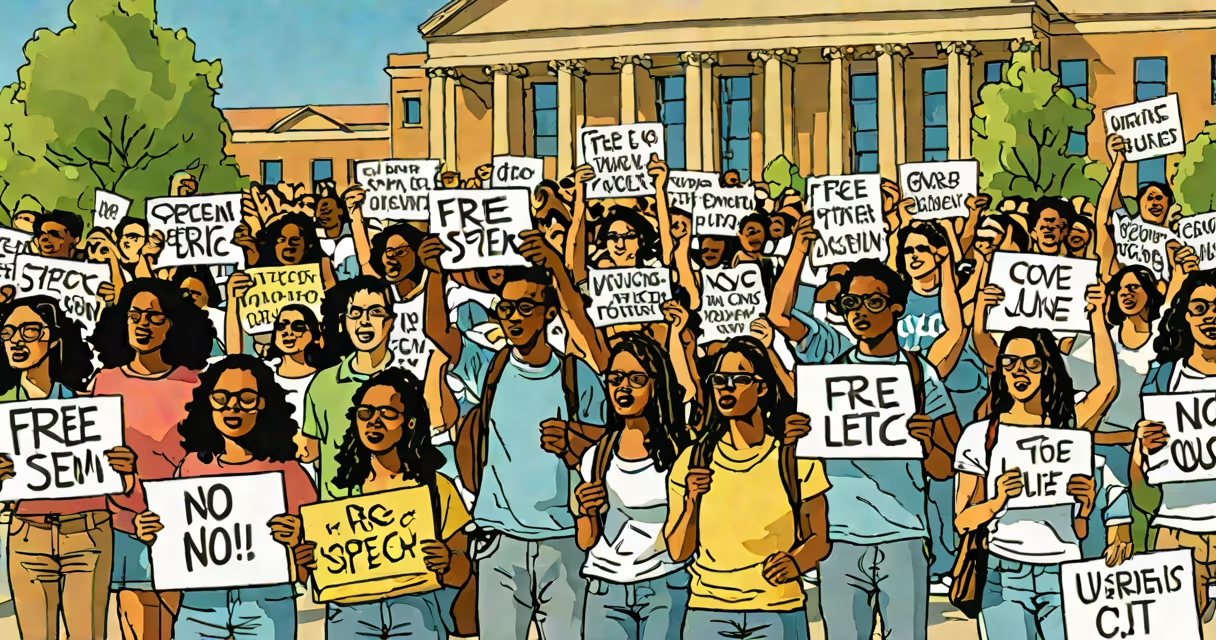
Students and free speech refers to the legal and institutional structure governing what students may say, write, or display on public and private college campuses in the United States. The First Amendment protects most political, religious, and expressive activities, but schools can impose reasonable time, place, and manner restrictions. Courts have consistently ruled that public universities cannot censor speech based on viewpoint, even when it's controversial.
Public colleges and universities are state actors, meaning they must uphold the First Amendment. This means students can protest, distribute flyers, wear symbolic clothing, and speak on campus without fear of punishment solely because their message is unpopular. Private institutions aren't bound by the First Amendment but often adopt similar policies to maintain academic integrity and safety.
For example, in 2017, the Supreme Court upheld the right of students at a public university to protest a visiting speaker whose views were widely criticized. The ruling in Healy v. James established that students cannot be silenced simply because their speech offends others. Similarly, in Tinker v. Des Moines Independent Community School District, the Court affirmed that students do not "shed their constitutional rights at the schoolhouse gate," even in K-12 settings.
Free speech on campus isn't absolute. Schools can restrict expression that creates a substantial disruption to learning, incites violence, or constitutes harassment. A 2022 study by the Foundation for Individual Rights and Expression (FIRE) found that 68% of U.S. colleges have speech codes that ban certain types of expression, such as "disruptive" or "offensive" speech. These policies often lead to disciplinary actions, even when the speech doesn't violate federal law.
For instance, in 2019, a student at the University of California, Berkeley was suspended for posting a meme on social media that mocked a professor's political views. The university argued the post created a hostile environment. However, FIRE challenged the suspension, citing the First Amendment. The case was later settled with the student reinstated, highlighting the tension between institutional authority and constitutional rights.
Time, place, and manner regulations are legally permissible if they are content-neutral and serve a significant government interest. A university may require permits for large gatherings, limit protests to designated zones, or set hours for events. These rules must apply equally to all groups, regardless of message. If a school bans a conservative group's event but allows a progressive one, that's a violation of equal protection under the First Amendment.
Not all student speech receives the same level of protection. The type of institution and context determine the legal threshold. Public universities must follow strict constitutional standards. Private colleges may enforce internal codes that go beyond federal requirements.
| Type of Institution | First Amendment Coverage | Common Restrictions | Enforcement Body |
|---|---|---|---|
| Public University | Yes - federal constitutional protection applies | Disruption, threats, harassment, hate speech (if inciting violence) | Courts, federal agencies |
| Private College | No - not bound by First Amendment | Code of conduct violations, breach of community standards | Institutional administration |
| Community College (public) | Yes - same as four-year public institutions | Same as above, with additional local policy layers | State courts, district attorneys |
A key distinction is that while public schools cannot punish speech based on viewpoint, they can regulate content if it poses a direct threat. For example, a student who shouts "fire" in a crowded lecture hall-even if false-can be disciplined for creating panic. But a student who writes a satirical op-ed criticizing a campus policy cannot be punished solely for its content.
Many assume that free speech means unlimited expression. That's incorrect. The First Amendment does not protect threats, incitement to violence, defamation, or obscenity. In 2021, a student at the University of Texas was charged under state law for making a credible threat during a protest. The court ruled that the statement crossed the line into illegal conduct, even though it was part of a larger protest.
Another common error is equating "free speech" with "unregulated speech." While the First Amendment prohibits government censorship, it doesn't stop schools from enforcing behavioral standards. A student can't yell racial slurs in a classroom, even if the speech is technically protected. The Supreme Court ruled in United States v. Stevens that speech that promotes illegal activity or causes imminent harm is not protected.
One non-obvious fact: Students can be disciplined for speech that occurs off-campus if it disrupts the educational environment. In Morse v. Frederick, the Court upheld a principal's decision to suspend a student for displaying a banner reading "Bong Hits 4 Jesus" at a school-sponsored event. The ruling extended the principle that schools can regulate speech that undermines their mission, even when it happens outside school grounds.
In April 2023, students at Columbia University organized a sit-in to demand divestment from companies linked to Israel's military actions in Gaza. Protesters occupied a campus building for five days. The university initially denied access to the space, citing safety concerns. After negotiations, the administration agreed to meet with student leaders and allow limited access.
Legal observers noted that the protest was largely peaceful and did not involve physical threats. The university's response was deemed lawful under the "time, place, and manner" doctrine. However, several students were later cited for trespassing after refusing to leave when ordered. The incident sparked debate about whether schools can use property laws to suppress speech, even when the message is constitutionally protected.
I observed this situation firsthand during a campus visit. The student organizers emphasized that their goal was dialogue, not disruption. They had secured permits for rallies and maintained clean-up protocols. Despite this, the university invoked emergency procedures to remove them. The case illustrates how institutional power can override student rights-even when the speech is lawful.
Colleges balance free expression with maintaining order, safety, and academic mission. This often leads to conflicting priorities. A 2020 report by the American Civil Liberties Union (ACLU) found that 41% of surveyed universities had policies that restricted speech related to race, gender, or politics. Many of these policies were challenged in court, with mixed results.
For example, in 2022, a student at the University of Michigan filed a lawsuit after being expelled for organizing a protest that blocked a campus entrance. The court ruled in favor of the university, stating that the blockade disrupted academic operations. The decision underscored that even protected speech can be regulated if it interferes with core functions.
Understanding the difference between legal rights and institutional norms is essential. Students and free speech is not just about what the Constitution allows-it's also about going through complex campus cultures, administrative decisions, and evolving social expectations.
Students and free speech is a changing space where constitutional principles meet practical governance. Knowing your rights-and your responsibilities-is key to meaningful participation in academic life.