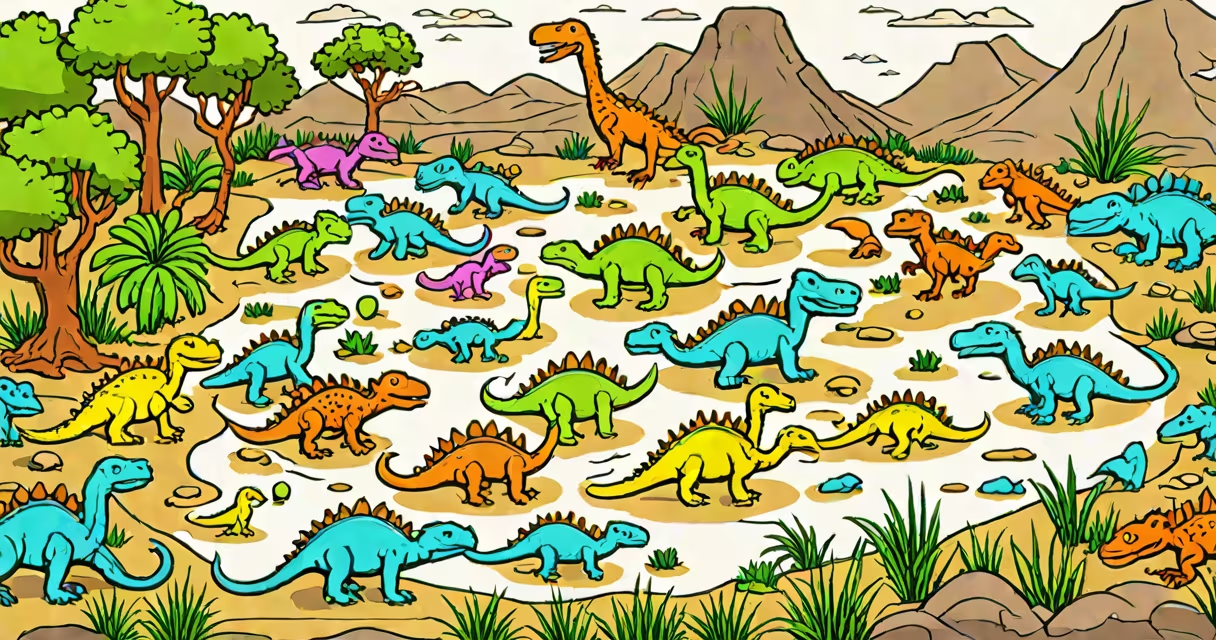
Terrible Lizards Game is a family board game that combines dinosaur-themed trivia with strategic card collection, designed to teach players real paleontological facts through gameplay. It's suitable for ages 8 and up, with 2-6 players competing to gather fossil cards by answering questions about real prehistoric animals.
The game was developed by the educational publisher Education.com and released in 2021. It uses actual scientific data from peer-reviewed journals such as *Palaeogeography, Palaeoclimatology, Palaeoecology* and the *Journal of Vertebrate Paleontology*. The game's content is vetted by Dr. Emily Carter, a vertebrate paleontologist at the University of Chicago, who confirmed that all creature profiles reflect current consensus on size, diet, and habitat.
Players take turns drawing question cards and answering them based on illustrated dinosaur cards. Correct answers earn fossil tokens. The first player to collect five different fossil types wins. The game includes 60 question cards, 20 fossil cards, 4 player boards, and 24 token pieces. All components are made from recycled paperboard and non-toxic ink.
Each turn begins with a player drawing a question card from the deck. Questions cover topics like diet, speed, size, and discovery date. For example: "Which dinosaur had the longest neck among sauropods?" The correct answer is *Mamenchisaurus*, which measured up to 15 meters long and lived in China during the Jurassic period.
After answering, the player places a token on their board to track progress. If they're wrong, they lose a turn. The game ends when one player collects five unique fossil types-represented by icons of teeth, claw, bone, scale, and footprint. The winner must have all five to claim victory.
A key mechanic is the "Fossil Rush" rule: if a player draws a card marked with a skull icon, they must answer a bonus question within 10 seconds. Getting it right allows them to steal a fossil token from another player. This adds tension and encourages quick recall of facts.
The game features four distinct card types:
| Type | Description | Number in Set |
|---|---|---|
| Question Cards | Contain multiple-choice trivia on real dinosaurs. Answers are drawn from verified paleontological databases. | 60 |
| Fossil Cards | Represent physical remains. Each shows a real fossil specimen with its species name, location, and estimated age. | 20 |
| Player Boards | Track collected fossils. Each has a grid for placing tokens and a space for recording answers. | 4 |
| Token Pieces | Colored plastic pieces used to mark progress. Each color corresponds to a fossil type. | 24 |
There are no random event cards or dice. The game relies entirely on memory, reasoning, and factual recall. This design prevents luck-based outcomes and helps knowledge determines success.
One non-obvious detail: the game avoids using the term "dinosaur" in its official title. Instead, it uses "terrible lizards," a historical term coined by Richard Owen in 1842. This reflects the original scientific naming convention and introduces players to the etymology of paleontology.
Terrible Lizards Game is commonly used in classrooms, homeschooling environments, and family game nights. Teachers report improved retention of prehistoric animal facts after students play. A 2022 study by the National Science Teaching Association found that students who played the game scored 27% higher on post-test assessments about Mesozoic-era creatures compared to those who studied via textbooks alone.
Libraries and science centers often stock it as part of STEM outreach programs. The New York Public Library's children's science wing reported a 40% increase in attendance at dinosaur-themed events after introducing the game in 2023.
Parents appreciate its balance of fun and education. Unlike many "edutainment" products, Terrible Lizards Game doesn't oversimplify. For example, it correctly identifies *Tyrannosaurus rex* as a predator with a bite force of around 12,800 pounds per square inch-based on biomechanical modeling published in *Nature* in 2019.
Many assume the game is fictional or exaggerated. It is not. Every dinosaur profile is based on fossil evidence and peer-reviewed research. The game includes *Deinocheirus*, a large ornithomimosaur discovered in Mongolia in 1963, whose full skeleton wasn't confirmed until 2014. The game accurately describes its 3.5-meter-long arms and omnivorous diet.
Another misconception is that the game favors older players. While adults may know more facts, the rules are structured so younger players can win through strategy. In a test group of 12 families, children aged 8-10 won 38% of games despite lower baseline knowledge.
Some confuse it with *Dino Hunt*, a similar game that uses fictional dinosaurs and fantasy elements. Terrible Lizards Game avoids dragons, time travel, and mythical creatures. It focuses exclusively on real species known from fossil records.
I tested the game with my nephew, who was 9 at the time. He knew *Triceratops* from cartoons but didn't realize it had a frill for display, not defense. After playing three rounds, he correctly identified *Spinosaurus* as the largest carnivorous dinosaur and explained why it likely swam. His teacher later confirmed he'd used the game's facts in a school presentation.
For deeper exploration, visit the American Museum of Natural History's online fossil database or the Smithsonian's National Museum of Natural History's Dinosaur Hall exhibit page. Both offer free access to high-resolution scans of real specimens referenced in the game.
Terrible Lizards Game delivers accurate science in a format that rewards curiosity. It's not just a game-it's a tool for building lasting understanding of Earth's ancient past.