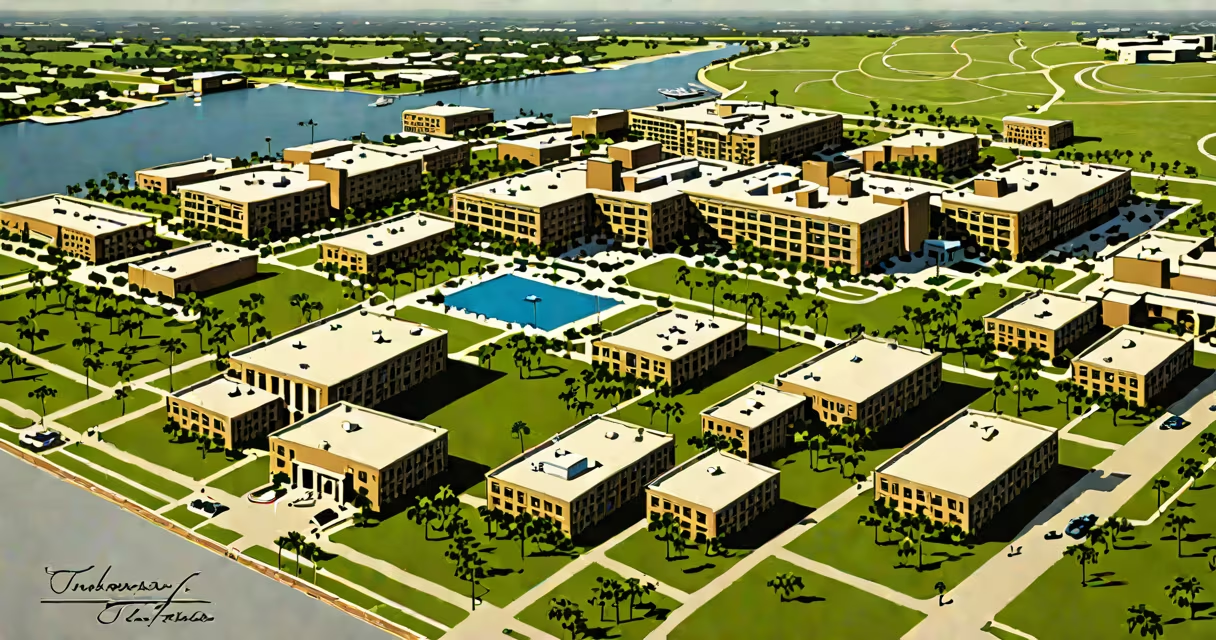
The University of Texas Medical Branch at Galveston is a public academic health sciences center located on the island of Galveston, Texas. It operates as part of the University of Texas System and serves as the state's primary institution for medical education, research, and patient care in coastal Texas.
UTMB Galveston offers MD, PhD, and graduate degrees in health sciences. It runs a Level I trauma center, a regional burn center, and a federally designated National Biocontainment Laboratory. The institution trains over 2,000 students, residents, and fellows annually and conducts research in infectious diseases, neuroscience, and environmental health.
Founded in 1891 as the Texas State Medical School, UTMB became part of the University of Texas System in 1972. Its location on Galveston Island places it within a unique ecological and epidemiological zone, influencing its focus on tropical medicine, hurricane preparedness, and coastal public health challenges.
UTMB Galveston functions as a vertically integrated academic health system. Clinical training occurs at the John Sealy Hospital, the primary teaching hospital, which serves as a safety-net provider for low-income and uninsured patients in the region. Over 60% of UTMB's internal medicine residents complete their training in underserved communities through the Health Resources and Services Administration's (HRSA) Health Professions Scholarship Program.
Research at UTMB is organized around six institutes: the Institute for Translational Sciences, the Center for Biodefense and Emerging Infectious Diseases, and the Sealy Center for Molecular Medicine. These units collaborate with federal agencies including the National Institutes of Health (NIH) and the Centers for Disease Control and Prevention (CDC).
For example, during the 2017 Hurricane Harvey response, UTMB deployed 150 medical personnel and activated a mobile field hospital. The institution reported treating over 4,000 patients in temporary clinics across Galveston County and coordinated with FEMA and local EMS networks. This operational model reflects UTMB's dual mission: to deliver care during crises and to train clinicians in disaster medicine.
UTMB Galveston offers a four-year MD program accredited by the Liaison Committee on Medical Education (LCME). The curriculum emphasizes community-based learning, with required rotations in rural and urban clinics across Texas. Students complete a minimum of 12 weeks in primary care settings, including Federally Qualified Health Centers (FQHCs).
Below is a breakdown of key degree programs:
| Program | Duration | Admission Requirements | Unique Focus |
|---|---|---|---|
| MD (Doctor of Medicine) | 4 years | MCAT, undergraduate GPA ≥3.0, letters of recommendation | Coastal health, disaster medicine, global health electives |
| PhD in Biomedical Sciences | 5-6 years | GRE scores, research experience, bachelor's degree in life sciences | Focus on viral pathogenesis and host immune responses |
| Master of Public Health (MPH) | 2 years | Undergraduate degree, GRE optional | Emphasis on pandemic preparedness and health equity |
Each program integrates experiential learning. For instance, MD students participate in the "Galveston Immersion Experience," a three-week rotation in community clinics serving predominantly Hispanic and low-income populations. A 2022 evaluation by the Association of American Medical Colleges (AAMC) found that 87% of UTMB MD graduates pursue residency in primary care or underserved specialties, compared to the national average of 62%.
UTMB Galveston is often mistaken for a standalone university. It is not. It is a component of the University of Texas System and shares governance with other UT institutions. Its president reports to the UT System Board of Regents, not the UT Austin administration.
Another misconception is that UTMB focuses solely on tropical diseases. While it hosts the only NIH-funded Center for Tropical Disease Research in the U.S., its research spans neurodegenerative disorders, cardiovascular genetics, and environmental toxicology. The UTMB Environmental Health Science Center received $12 million in federal funding in 2023 to study the impact of oil spills on marine and human health.
A lesser-known fact: UTMB Galveston was the first U.S. medical school to require all incoming students to complete a course in cultural competency and implicit bias. The program, launched in 2015, uses standardized patient scenarios and reflective journaling. A 2021 study published in Academic Medicine found that UTMB graduates scored 18% higher on cultural humility assessments than peers from peer institutions.
In 2020, UTMB Galveston led a multi-institutional study on the transmission dynamics of SARS-CoV-2 in long-term care facilities. Researchers collected nasal swabs from 1,200 residents and staff across 12 nursing homes in Southeast Texas. They discovered that asymptomatic transmission accounted for 43% of infections, a rate higher than earlier estimates from urban centers.
This finding prompted the Texas Department of State Health Services to revise isolation guidelines for nursing home outbreaks. The study was published in JAMA Internal Medicine and cited by the World Health Organization in its 2021 guidance on infection control in aged-care settings.
I observed this process firsthand during a summer internship in UTMB's Division of Infectious Diseases. I helped analyze PCR results and assisted in drafting the manuscript. The level of detail in data collection and the rigor of peer review were far beyond what I had seen in undergraduate research projects.
UTMB Galveston plays a important role in public health infrastructure. It is one of only five U.S. sites with a Biosafety Level 4 (BSL-4) laboratory approved by the CDC for handling high-consequence pathogens. The facility has handled samples from Ebola, Marburg, and Nipah virus outbreaks.
Its location on the Gulf Coast makes it a strategic hub for monitoring emerging infectious diseases. During the 2014 West African Ebola outbreak, UTMB researchers developed a diagnostic test that reduced confirmation time from 72 hours to under 12 hours. The test was adopted by the WHO and used in Liberia and Sierra Leone.
As a result of its work, UTMB Galveston consistently ranks among the top 25 U.S. medical schools for NIH funding. In 2023, it received $287 million in federal grants, placing it 19th nationally among medical schools for research support.
For students seeking training in clinical medicine, public health, or biomedical science, the University of Texas Medical Branch at Galveston provides a distinctive environment shaped by its island geography, historical legacy, and commitment to service. Its programs prepare graduates not just to practice medicine, but to lead in complex, high-stakes environments.