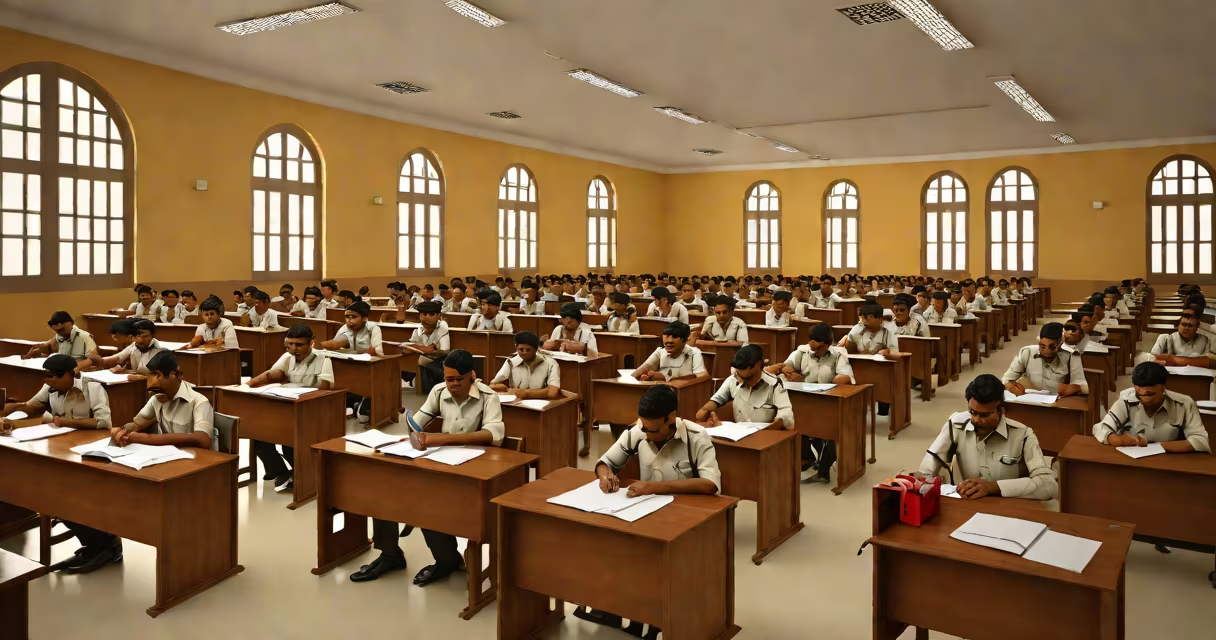
The Uttar Pradesh Education Service Selection is a competitive recruitment process conducted by the Uttar Pradesh Public Service Commission (UPPSC) to fill teaching positions in state government schools. It evaluates candidates through written exams and personal interviews based on subject expertise, pedagogical knowledge, and administrative aptitude.
This selection process is central to staffing government schools across Uttar Pradesh with qualified educators. It ensures transparency and merit-based appointments under the state's education policy structure. The UPPSC administers the exam annually, with results published on its official portal.
Eligibility requires a Bachelor of Education (B.Ed.) degree along with a relevant undergraduate qualification such as B.A., B.Sc., or B.Com. Candidates must also meet age limits-typically between 21 and 35 years-with relaxations for reserved categories. The selection process includes a preliminary written test, a main written examination, and a final interview round.
Candidates register online during the notification period announced by UPPSC. Registration opens via the official website uppsc.up.nic.in. Applications are verified for educational qualifications, category, and age. Only those meeting the criteria proceed to the next stage.
The preliminary exam consists of 150 multiple-choice questions covering general awareness, reasoning, and basic mathematics. It serves as a screening tool. A candidate must score above the cutoff to qualify for the main exam. The cutoff varies yearly based on the number of applicants and vacancies.
The main written exam includes two papers: one on educational theory and pedagogy, and another on the candidate's chosen subject (e.g., Mathematics, Science, Hindi). Each paper is 150 marks, with a duration of three hours. Answer scripts are evaluated by subject experts using standardized rubrics.
Positions are categorized by subject and level of instruction. For example:
| Subject | Level | Vacancies (approx.) | Exam Code |
|---|---|---|---|
| Mathematics | High School | 420 | UPES-MATH-2024 |
| Science (Physics/Chemistry) | High School | 360 | UPES-SCI-2024 |
| Hindi | Secondary | 280 | UPES-HIN-2024 |
| Geography | Higher Secondary | 150 | UPES-GEO-2024 |
Each subject has a separate syllabus aligned with the Uttar Pradesh Board of High School and Intermediate Education (UPBSE) curriculum. The syllabus is available on the UPPSC website and includes topics like learning theories, classroom management, and current educational reforms.
For the 2024 cycle, the UPPSC released 1,210 vacancies across 12 subjects. Of these, 30% were reserved for Scheduled Castes, 15% for Scheduled Tribes, and 27% for Other Backward Classes. The remaining 28% were open to all candidates.
Many assume the UPES selection is equivalent to the State Level Teacher Recruitment Exam (SLTRE) in other states. This is incorrect. While both recruit teachers, UPES is administered by UPPSC, whereas SLTREs are managed by individual state education departments. The UPES process includes a higher weightage on pedagogical theory compared to state-specific exams.
A frequent error is confusing the UPES selection with the Uttar Pradesh State Teacher Eligibility Test (UPSTET). UPSTET is a qualifying test for entry into the teacher recruitment pool. UPES is the actual selection process that follows UPSTET. A candidate must pass UPSTET before being eligible to apply for UPES.
Another misunderstanding is that the interview round is merely ceremonial. In reality, the interview accounts for 100 marks and assesses communication skills, subject mastery, and understanding of the state's education policy. In 2023, 12% of candidates who cleared the written exam failed the interview due to poor articulation of teaching methodologies.
In 2023, Priya Sharma, a B.Sc. graduate with a B.Ed. in Physics, applied for the UPES selection for high school physics teachers. She registered on June 15, 2023, and scored 87 out of 150 in the preliminary exam. Her score placed her in the top 15% of applicants.
She then appeared for the main exam on October 8, 2023. Her paper on pedagogy scored 92/100, and her subject paper scored 134/150. These scores gave her a total of 226 out of 300. She ranked 47th among 2,300 candidates.
During the interview, she was asked to explain how she would teach Newton's laws using real-life examples. She demonstrated a lesson plan involving car crashes and seatbelt safety. Her response earned her 88/100. She was selected and posted to a government school in Kanpur district.
I attended the UPES interview panel in Varanasi in 2022. The panel consisted of three members: one from the Department of Education, one from a university education faculty, and one from the UPPSC. Each candidate had 20 minutes. Questions focused on classroom challenges, inclusive education, and recent changes in the National Education Policy (NEP) 2020.
One candidate was asked to design a lesson on climate change for Class 9 students using local examples. He used the drying of the Ganges and changing monsoon patterns. His answer was praised for contextual relevance. The panel emphasized that practical application matters more than theoretical recall.
According to the UPPSC Annual Report 2023, 89% of selected candidates reported that the interview assessed their ability to adapt teaching methods to diverse classrooms. This aligns with findings from the National Council of Educational Research and Training (NCERT), which stresses context-aware pedagogy in Indian teacher training programs.
Notifications for the UPES selection are typically released in May or June. The preliminary exam is held in August, the main exam in October, and interviews in December. Final results are declared by February.
Official resources include the UPPSC website, the UP Education Department's circulars, and the NCERT's model curriculum documents. Candidates should also review past question papers from the last five years. The UPPSC releases a sample paper annually, which contains 25% of the actual exam content.
The Uttar Pradesh Education Service Selection is a structured, multi-stage process ensuring qualified educators enter public schools. It balances academic credentials with practical teaching ability. Success depends on thorough preparation, familiarity with the syllabus, and clear communication during the interview.