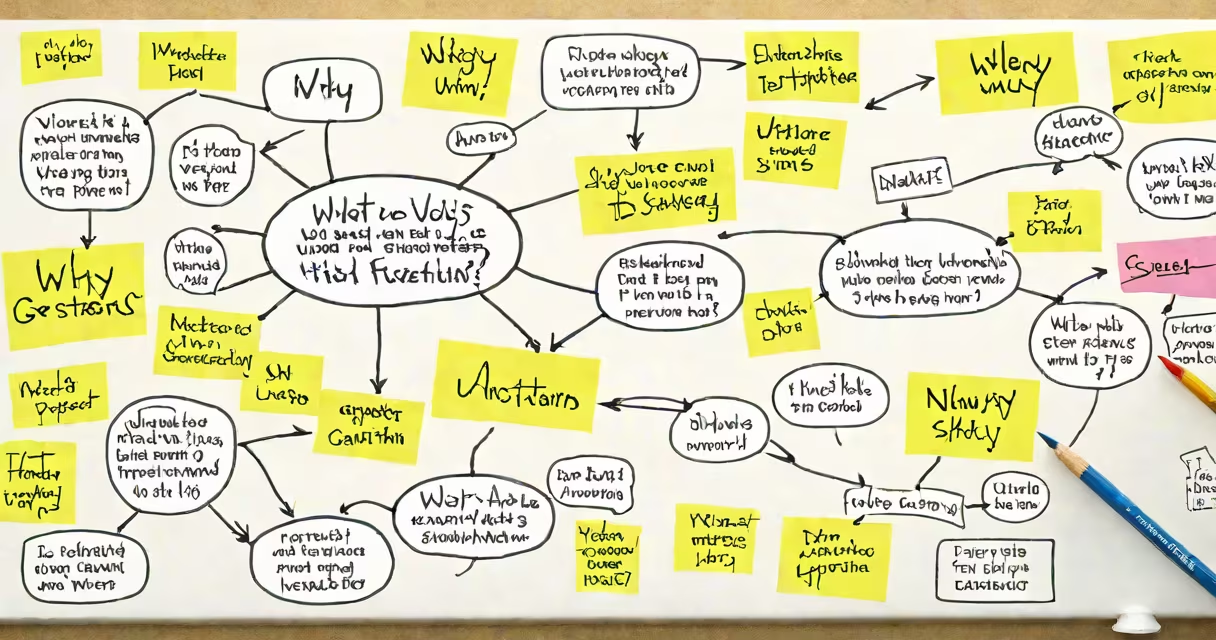
The 5 Whys questions is a problem-solving technique that identifies the root cause of an issue by asking "why" iteratively-typically five times-to move beyond surface symptoms and expose underlying systemic failures. This method originated in Toyota's production system and remains standard practice in engineering, quality control, and incident response.
Each "why" probes deeper into causality. The goal is not to assign blame but to reveal process gaps. For example, if a machine stops during production, the first "why" asks why it stopped. The answer leads to the next "why," and so on-until the fundamental failure is exposed. Most problems trace back to human error, design flaw, or inadequate procedure-not random malfunction.
Toyota's original implementation showed that most equipment failures stemmed from poor maintenance planning, not mechanical wear. By asking "why" five times, teams shifted focus from reactive fixes to preventive system design. The technique works because each layer of questioning exposes assumptions that go unchallenged in casual troubleshooting.
Start with a clear statement of the problem. Avoid vague descriptions like "things went wrong." Instead, define the event precisely: "The server crashed at 3:17 PM on Tuesday, causing a 45-minute outage." This specificity prevents drifting into unrelated causes.
Ask "why" the problem occurred. Accept the answer as fact-even if it seems obvious-and ask "why" again. Repeat until you reach a cause that cannot be broken down further. At that point, you've likely found the root cause. The fifth "why" often reveals a gap in training, a missing safety check, or a flawed policy.
For example: Problem: A delivery truck arrived late. 1. Why? Because the driver took a wrong turn. 2. Why? Because the navigation app displayed an incorrect route. 3. Why? Because the map data was outdated. 4. Why? Because the update process wasn't automated. 5. Why? Because the team didn't have a scheduled review cycle.
The root cause isn't the driver's mistake-it's the lack of a formal data verification process. Fixing the workflow prevents future errors, even if drivers make similar misjudgments.
The basic 5 Whys is linear, but real-world issues require flexibility. Teams adapt the method based on context:
| Approach | Use Case | When to Apply |
|---|---|---|
| Linear 5 Whys | Simple operational failures | When the chain of events is clear and sequential |
| Branching 5 Whys | Complex systems with multiple failure paths | When more than one factor contributed to the outcome |
| 5 Whys with Evidence | High-stakes environments (healthcare, aviation) | When decisions affect safety or compliance |
Branching 5 Whys allows multiple lines of inquiry. After the first "why," if several causes emerge, each gets its own chain. This avoids oversimplification. For instance, a hospital medication error might stem from both a misread label and a faulty barcode scanner. Both paths are explored independently.
Some organizations pair the 5 Whys with fishbone diagrams (Ishikawa) or fault tree analysis for complex cases. These tools map relationships between causes and outcomes. The 5 Whys remains valuable because it forces teams to articulate assumptions and test them against facts.
Many teams stop at the first plausible explanation. They treat the third "why" as sufficient. But stopping early misses deeper issues. One study found that 68% of root cause analyses failed because teams stopped asking "why" too soon-often due to time pressure or fear of implicating individuals.
Another error is treating the fifth "why" as a magic number. There's no rule that demands exactly five iterations. Some problems resolve in three steps; others take seven or eight. The number five is symbolic-not mandatory. The real measure is whether the answer points to a fixable system element.
A key misunderstanding is equating the 5 Whys with blame assignment. The method is not about finding who failed. It's about identifying where the system failed to prevent failure. When used correctly, it fosters accountability through process improvement, not punishment.
I once led a post-mortem on a website outage that affected 12,000 users. Initial reports blamed a developer's typo. After four "whys," we discovered the deployment process lacked peer review and automated testing. The typo wasn't the root cause-it was a symptom of a broken release protocol. We fixed the workflow, not the individual.
Originally developed by Sakichi Toyoda at Toyota, the 5 Whys became central to the Toyota Production System (TPS). It helped reduce defects and downtime by shifting focus from blaming workers to improving processes. Today, it's embedded in Lean and Six Sigma methodologies.
Software teams use it during sprint retrospectives to analyze bugs or deployment failures. A team at a fintech startup used the 5 Whys to trace a payment processing delay to a misconfigured API timeout setting. The fix was automated validation-preventing recurrence.
Healthcare providers apply it to patient safety incidents. The Institute for Healthcare Improvement (IHI) recommends the 5 Whys as part of its patient safety toolkit. One hospital reduced medication errors by 40% after implementing structured root cause analysis using the method.
Contrary to popular belief, the 5 Whys is not limited to technical problems. It applies to customer service breakdowns, supply chain delays, and even interpersonal conflicts in teams. The key is framing the problem objectively and avoiding emotional language.
The 5 Whys is not a substitute for data collection. It's a tool to interpret findings-not gather them. Without logs, metrics, or witness statements, the answers risk being speculative. Always pair the method with evidence.
It is not a replacement for statistical analysis. For large-scale issues, regression models or A/B testing offer stronger conclusions. The 5 Whys excels at qualitative insight, especially when data is incomplete or ambiguous.
It is not a decision-making structure. Once the root cause is identified, teams must choose a solution. The 5 Whys doesn't recommend actions-it reveals why something broke. Choosing the right fix requires separate evaluation.
Finally, it is not a one-time exercise. Organizations that embed the 5 Whys into their culture use it regularly-after incidents, during audits, and in new product reviews. Consistent use builds a habit of inquiry, reducing recurring failures.
Understanding the 5 Whys questions enables teams to move beyond quick fixes and build resilient systems. The method's power lies in its simplicity: ask why, then ask again. Keep going until the real cause emerges.