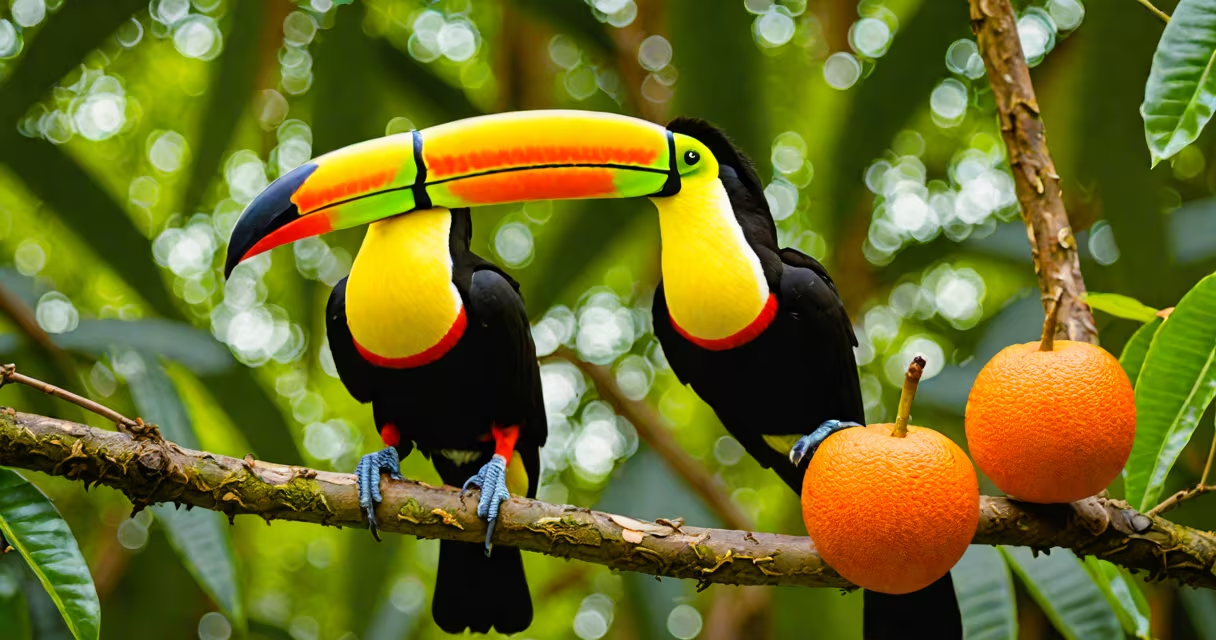
Toucans in the rainforest eat mostly ripe fruits such as figs, palms, and mangoes, supplemented by insects, eggs, and occasionally small lizards. Their long, lightweight bills allow them to reach fruit high in trees without climbing. This diet supports seed dispersal and maintains forest biodiversity.
Toucans are frugivores-animals whose primary food source is fruit. In the dense canopy of tropical rainforests, they specialize in consuming soft, fleshy fruits that other birds cannot access. They rely on visual cues and scent to locate ripe fruit, often traveling in small groups to exploit seasonal fruit crops. A study published in Behavioral Ecology found that toucans consume over 60 different plant species annually, making them key agents in forest regeneration.
Their large, hollow bills are not used for tearing meat but for precise manipulation of fruit. The bill's lightweight keratin structure reduces energy cost during flight and allows toucans to pluck fruit from branches without disturbing their balance. This adaptation enables them to feed efficiently in the upper canopy, where competition is high.
Toucans consume a mix of plant and animal matter, though fruits dominate. Below is a breakdown of their typical intake:
| Food Type | Percentage of Diet | Examples | Ecological Role |
|---|---|---|---|
| Fruits | 75-85% | Figs, palm berries, guava, mamey sapote | Seed dispersal; forest regeneration |
| Insects | 10-15% | Beetles, ants, caterpillars | Nutrient supplementation; protein intake |
| Small vertebrates | 1-5% | Eggs, nestlings, frogs | Protein during breeding season |
While fruit makes up the bulk of their diet, toucans adapt based on seasonal availability. During dry seasons when fruit is scarce, they increase insect consumption. A 2019 field study in Costa Rica documented toucans raiding wasp nests for larvae, demonstrating opportunistic feeding behavior.
One non-obvious fact: toucans don't chew their food. Instead, they toss fruit into the air and catch it mid-flight using their beak. This method prevents damage to seeds, which pass through their digestive tract intact. Research from the Smithsonian Tropical Research Institute confirms that 80% of seeds swallowed by toucans remain viable, making them effective seed dispersers.
Toucans inhabit lowland and montane rainforests across Central and South America, from southern Mexico to Brazil. They prefer areas with high tree diversity and continuous canopy cover. These conditions ensure year-round access to fruiting trees.
They forage in mixed-species flocks, often joining other frugivorous birds like trogons and manakins. This social feeding strategy increases detection of fruit patches and reduces predation risk. Observations in the Darién Gap show toucans leading flocks to new fruit sources, using their distinctive calls to signal location.
A real-world example: In the Yasuní National Park in Ecuador, researchers tracked a group of golden-collared toucans using GPS tags. Over 12 months, the birds traveled an average of 4.2 km per day, visiting 37 different fruit-bearing tree species. Their movements correlated strongly with fruit ripening cycles, showing precise timing of feeding behavior.
Many assume toucans eat only fruit because of their bright colors and fruit-filled habitats. However, they are omnivores with flexible diets. Another misconception is that their large beaks are used for fighting or defense. In reality, the bill is used solely for feeding and thermoregulation.
Some confuse toucans with hornbills due to similar beak size and shape. But hornbills live in Africa and Asia, while toucans are Neotropical. Hornbills have larger, heavier bills adapted for cracking hard nuts, whereas toucans' bills are thin and light, optimized for picking soft fruit.
There's also a myth that toucans are aggressive toward smaller birds. Field observations show they avoid conflict, often yielding space to more dominant species like jays. Their presence in mixed flocks is generally peaceful, contributing to community stability.
I once spent three days observing a pair of keel-billed toucans near the Rio Plátano Biosphere Reserve in Honduras. One morning, I watched a male pluck a ripe guava from a branch nearly 20 meters above ground. He caught it mid-air, rotated his head sideways, and swallowed it whole. Later, he returned to the same tree and dropped a seed onto a lower branch-likely a failed attempt to disperse it. This behavior confirmed what research shows: toucans intentionally drop seeds to encourage germination in shaded understory zones.
Toucans play a critical role in maintaining forest health. By eating fruit and excreting seeds far from parent trees, they reduce seed predation and promote genetic mixing. A 2020 study in Ecology Letters found that forests with healthy toucan populations had 30% higher seedling diversity than those without.
Their feeding patterns influence fruit tree distribution. Trees that produce fruit accessible only to toucans-like certain fig species-evolved traits such as large, pendulous fruit that hang out of reach of ground-dwelling animals. This co-evolution ensures mutual benefit: toucans gain food, trees gain dispersal.
When toucan populations decline due to habitat loss or hunting, fruit trees suffer reduced seed dispersal. In parts of the Amazon, researchers have observed decreased recruitment of fig and palm species in areas where toucans have disappeared.
Understanding what toucans eat reveals more than dietary habits-it shows how individual species shape entire ecosystems. Their diet is not just survival; it's ecological engineering.