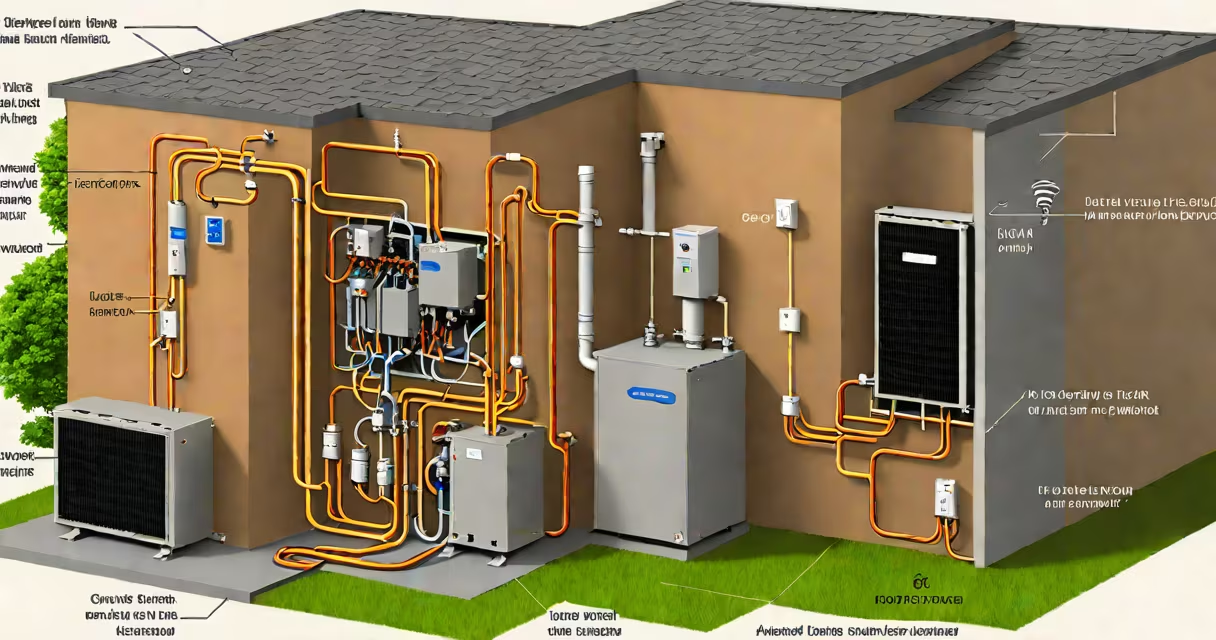
A heat pump system consists of two primary components: an outdoor condenser unit and an indoor air handler, linked by refrigerant lines. The outdoor unit resembles a large metal box with a fan and coils, typically mounted on a concrete pad near the foundation. The indoor unit is a wall-mounted or ceiling-mounted device that circulates conditioned air through ductwork or directly into rooms.
These systems operate by transferring heat rather than generating it. In winter, they extract warmth from outside air-even below freezing-and move it indoors. In summer, they reverse the process, pulling heat from inside and expelling it outdoors. This dual function replaces separate furnace and air conditioner setups.
Modern heat pumps often integrate with smart thermostats and zoning controls. A typical installation includes a power disconnect switch near the outdoor unit, copper refrigerant lines running between the indoor and outdoor units, and electrical wiring connecting to a dedicated circuit breaker panel.
The core mechanism relies on a refrigerant cycle powered by a compressor. When the system heats, the outdoor coil absorbs thermal energy from ambient air. The refrigerant vaporizes, travels through insulated lines to the indoor unit, and releases heat via a condenser coil. A blower then pushes warm air into living spaces.
Cooling mode reverses the flow. The indoor coil becomes cold, absorbing heat from room air. The refrigerant returns to the outdoor unit, where the compressor compresses it, raising its temperature so it can release heat into the environment. This process maintains efficiency even at temperatures as low as -15°C (5°F), depending on model specifications.
According to the U.S. Department of Energy, air-source heat pumps can deliver 2.5 to 3 times more heat energy than the electrical energy they consume. This coefficient of performance (COP) exceeds most electric resistance heaters and gas furnaces in efficiency terms.
Each part of a heat pump system has a distinct visual profile:
| Component | Appearance | Function |
|---|---|---|
| Outdoor Condenser Unit | Rectangular metal cabinet (60-100 cm tall), black or gray finish, with visible fan blades and copper tubing. Often sits on a concrete pad with drainage holes. | Releases or absorbs heat based on season. Contains compressor, fan, and outdoor coil. |
| Indoor Air Handler | Wall-mounted or ceiling-recessed box (30-60 cm wide), usually white or beige, with grilles for air intake and output. May have a small control panel. | Distributes conditioned air. Houses blower motor and indoor coil. |
| Refrigerant Lines | Two copper tubes (1/4" to 3/8" diameter), wrapped in insulation foam. One carries liquid refrigerant, the other vapor. | Transfers heat between indoor and outdoor units. Must be sealed and insulated to prevent energy loss. |
| Electrical Wiring | Thick insulated cables (10-12 gauge), routed through conduit or wall penetrations. Connected to disconnect switch and thermostat. | Supplies power to compressor, fans, and controls. Requires grounding and weatherproofing. |
For ductless mini-split systems, the indoor unit is smaller-about the size of a laptop-and mounts on a wall or ceiling. These models don't require ductwork and allow zoned temperature control. The outdoor unit remains similar in appearance but may be slightly larger due to higher capacity.
Many people mistake heat pump systems for traditional air conditioners. While both use refrigeration cycles, heat pumps provide heating to cooling. An AC unit cannot reverse its cycle effectively below 10°C (50°F), whereas modern heat pumps maintain efficiency down to -15°C (5°F).
Another confusion arises around noise levels. The outdoor unit emits a humming sound during operation-typically 50-60 decibels at 1 meter distance. This is comparable to a quiet conversation. Some models feature variable-speed compressors and fans that reduce noise compared to older units.
One overlooked detail: refrigerant lines must be properly sized and insulated. Poorly installed lines lead to refrigerant migration, reduced efficiency, and potential system failure. The International Association of Plumbing and Mechanical Officials (IAPMO) requires that all refrigerant piping be sealed and tested for leaks before startup.
In a 2020 retrofit project in Portland, Oregon, a homeowner replaced a 15-year-old gas furnace and central AC with a ductless mini-split heat pump system. The outdoor unit measured 1.2 meters high and 0.8 meters wide, mounted on a concrete pad 1.5 meters from the house wall. The indoor unit was a 30 cm wide, 15 cm deep wall-mounted model placed above a living room sofa.
Two copper refrigerant lines-each 1 inch in diameter-ran through a 1-inch hole drilled through the exterior wall. Insulation was applied over the entire run. The system included a Wi-Fi-enabled thermostat and a remote control with scheduling features. Over one winter, the homeowner reported consistent indoor temperatures between 20-22°C (68-72°F) with monthly electricity bills averaging $65, down from $110 under the old gas system.
I've seen several installations where the refrigerant lines were improperly routed through un-insulated attic space. This caused frost formation and reduced system performance. Always ensure lines are enclosed in proper insulation and protected from direct sunlight or moisture exposure.
A heat pump system is not the same as a geothermal system, which uses underground loops to exchange heat. Geothermal systems require drilling and are far more expensive to install. They're also less common in single-family homes due to site constraints.
It's also not a standard furnace. Gas furnaces burn fuel to generate heat. Heat pumps move existing heat using electricity. The absence of combustion makes heat pumps safer and more environmentally friendly, especially when paired with solar panels.
While the skeletal system of the human body provides structural support, a heat pump system's structure is functional-its design prioritizes airflow, refrigerant flow, and energy transfer. Similarly, the iPhone 6's sleek form factor contrasts with the utilitarian appearance of a heat pump, yet both serve complex functions hidden beneath their surfaces.
Understanding what a heat pump system looks like helps homeowners make informed decisions about comfort, efficiency, and long-term savings. Its layout is standardized across brands-Carrier, Trane, Mitsubishi, and Lennox-all follow the same physical principles and component arrangement.