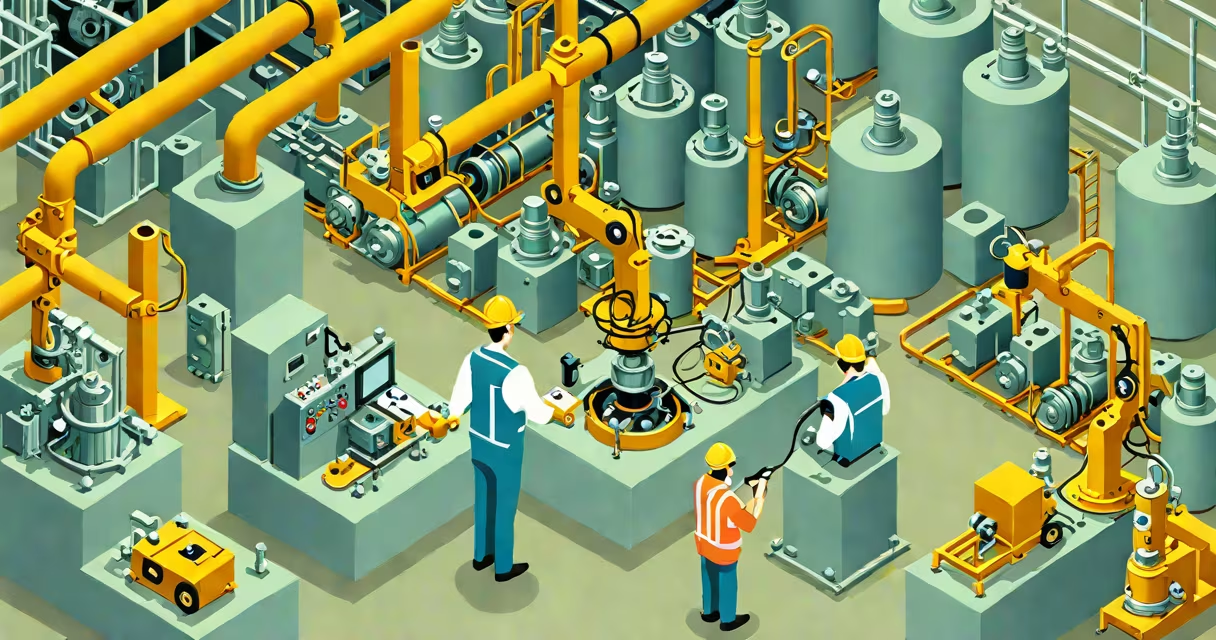
Mechanical technicians install, maintain, troubleshoot, and repair mechanical systems and equipment in industrial, manufacturing, and energy environments. They apply technical knowledge to keep machines running efficiently and safely.
These professionals work with pumps, compressors, conveyors, turbines, and automated production lines. Their role bridges design and operation-translating blueprints into functional systems and diagnosing failures when they occur. Most positions require a high school diploma and technical certification, though some roles demand an associate degree in mechanical technology or a related field.
The U.S. Bureau of Labor Statistics reports that mechanical technicians earned a median annual wage of $56,480 in 2022, with employment projected to grow 6% through 2032-faster than average for all occupations. This growth stems from increasing automation in manufacturing and the need for skilled workers to service complex machinery.
Technicians begin by reviewing schematics, maintenance logs, and operational manuals. They use hand tools, precision measuring instruments, and computerized diagnostic software to assess machine performance. When a system fails, they isolate the fault-often by checking hydraulic pressure, electrical continuity, or bearing wear.
For example, a technician at a food processing plant might discover that a conveyor belt repeatedly stalls during peak production. After shutting down the system safely, they inspect the drive motor's output shaft and find misalignment due to worn couplings. Replacing the coupling and realigning the motor restores full function within four hours-minimizing downtime and preserving product output.
Many technicians follow preventive maintenance schedules based on manufacturer guidelines. They lubricate moving parts, replace filters, calibrate sensors, and test emergency shutdown systems. These routine checks prevent breakdowns and extend equipment life by up to 30%, according to the American Society of Mechanical Engineers (ASME).
Specializations exist across industries. The most common categories include:
| Type | Typical Work Environment | Key Tasks | Required Skills |
|---|---|---|---|
| Industrial Maintenance | Manufacturing plants, refineries | Repairing assembly lines, replacing worn gears, aligning motors | Blueprint reading, torque wrench use, vibration analysis |
| Power Plant Support | Nuclear, fossil fuel, or renewable energy stations | Inspecting steam turbines, monitoring cooling systems, servicing pumps | Familiarity with ASME codes, lockout/tagout procedures |
| Automotive Service | Dealerships, fleet maintenance centers | Diagnosing engine issues, replacing transmissions, testing braking systems | Use of OBD-II scanners, ASE certification preferred |
| Research & Development Support | Engineering labs, aerospace firms | Assembling prototypes, testing component durability under stress | Experience with CAD models, material testing equipment |
Each role demands specific training. For instance, a technician working on offshore oil rig equipment must complete safety certifications such as OSHA's Hazard Communication Standard and the National Fire Protection Association's NFPA 70E for electrical safety.
People often confuse mechanical technicians with mechanical engineers. While both deal with machines, their responsibilities differ sharply. Engineers design systems using physics, mathematics, and simulation tools. Technicians implement, maintain, and repair those designs in real-world conditions.
For example, a mechanical engineer might develop a new gear train for a wind turbine. A technician then installs it, ensures proper alignment, monitors wear patterns over time, and replaces components before failure occurs. The engineer creates the solution; the technician sustains it.
A less obvious difference lies in education and licensing. Engineers typically hold bachelor's degrees and may be licensed as Professional Engineers (PEs). Technicians usually earn certificates or associate degrees and are certified in specific tools or systems-such as Siemens PLC programming or ISO 9001 quality standards-but do not hold professional engineering licenses.
Another misconception is that technicians only fix broken equipment. In reality, they spend nearly half their time performing preventative checks. A study by the Society of Maintenance and Reliability Professionals (SMRP) found that 47% of a technician's weekly hours are spent on scheduled maintenance rather than reactive repairs.
I once worked alongside a mechanical technician at a paper mill in Wisconsin. His shift began at 6 a.m. He walked the production floor, checking vibration levels on a 200-horsepower roller press. Using a handheld vibration analyzer, he detected abnormal frequencies in the drive shaft. He shut down the line, removed the guard, and found a cracked coupling bolt-a defect invisible to the naked eye.
He replaced the bolt, realigned the shaft using laser alignment tools, and restarted the system. The entire process took 90 minutes. Without his intervention, the machine would have failed later that day, causing a $12,000 loss in production and potential safety risks. That single action prevented a major incident.
This experience reinforced that mechanical technicians aren't just "fix-it" people-they're frontline guardians of operational integrity.
Some mechanical technicians advance into supervisory roles, managing teams of five to ten workers. Others specialize in areas like robotics integration or predictive maintenance using AI-driven analytics. With additional training, they may transition into roles such as reliability engineer or controls technician.
Understanding what a mechanical technician does clarifies their critical role in keeping industry moving. They are not behind-the-scenes helpers but essential contributors to efficiency, safety, and productivity across sectors.