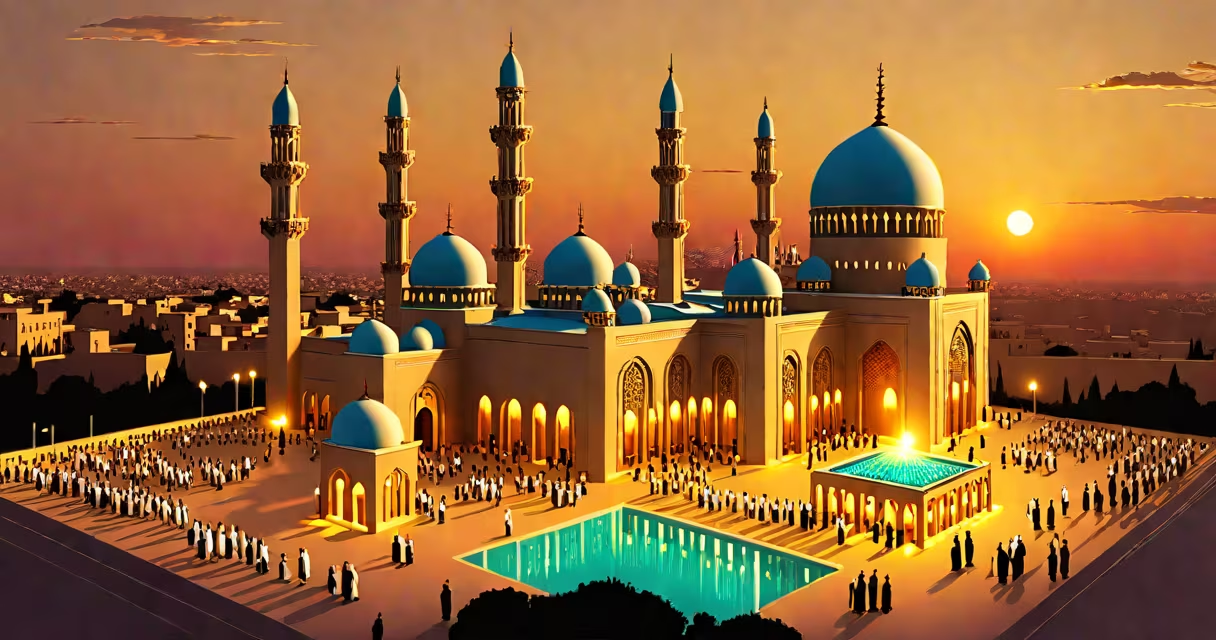
During Ramadan, you can eat after sunset at iftar and before dawn at suhoor. These times are determined by the Islamic lunar calendar and local prayer schedules, not the Gregorian calendar.
Fasting in Ramadan begins at fajr (dawn) and ends at maghrib (sunset). The first meal of the day, suhoor, is eaten just before fajr. The second meal, iftar, is consumed immediately after maghrib. Both times are calculated using astronomical data tied to your geographic location.
The Prophet Muhammad (PBUH) said, "Eat suhoor, for there is blessing in it" (Sahih al-Bukhari 1849). This practice is rooted in Islamic tradition and emphasizes spiritual discipline through structured timing. The exact time varies daily throughout Ramadan due to Earth's orbit and seasonal shifts.
Islamic prayer times are based on the position of the sun relative to the horizon. Fajr begins when the first light appears in the east, and maghrib starts when the sun disappears below the horizon. These moments differ by city and season.
For example, in Istanbul, Turkey, fajr may begin at 4:37 AM and maghrib at 7:12 PM during Ramadan in June. In contrast, in Toronto, Canada, fajr is around 5:15 AM and maghrib at 8:45 PM. These differences reflect latitude and solar declination.
Many mosques and apps use the Umm al-Qura University method (Saudi Arabia) or the Muslim World League standard. These models define fajr as 18 degrees before sunrise and maghrib as 1.5 degrees below the horizon. Using these criteria ensures consistency across regions.
While most Muslims follow the same core structure, regional variations exist. Some communities adjust timings based on local moon sightings, while others rely on astronomical calculations.
| Method | Based On | Use Case |
|---|---|---|
| Lunar sighting | Visual moon observation | Traditional, varies by country |
| Astronomical calculation | Mathematical models | Standardized, used in apps and calendars |
| Regional authority | National religious bodies | Country-specific rulings (e.g., Egypt's Al-Azhar) |
Some countries, like Iran and Pakistan, follow the lunar sighting method. This means if the new moon isn't visible on the 29th day of Sha'ban, Ramadan starts the next day. Other nations, including the UK and USA, often adopt astronomical calculations for uniformity.
One common mistake is assuming iftar happens at sunset. In reality, it occurs after the sun has fully set and the sky is dark enough to see stars. Delaying iftar until then prevents breaking the fast too early, which invalidates the act.
Many assume fasting starts at midnight or aligns with the calendar day. This is incorrect. Fasting begins at fajr, which can occur as early as 4:30 AM in northern latitudes during summer months.
Another error is thinking that eating before dawn is optional. The Quran states: "Eat and drink until the white thread of dawn becomes distinct to you from the black thread [of night]" (Quran 2:187). This verse defines suhoor as a required part of the fast.
Some people believe they can skip suhoor if they're tired. However, the Prophet Muhammad (PBUH) emphasized its importance. He said, "The people will remain in good health as long as they eat suhoor" (Sunan Ibn Majah 1689).
A lesser-known fact: the time between fajr and sunrise is shorter than many expect. In cities near the equator, this gap lasts only 20-30 minutes. In high-latitude areas like Oslo, Norway, it can stretch to 45 minutes during winter. This affects how much time is available for suhoor.
Consider a person living in Riyadh, Saudi Arabia, during Ramadan in April. The local prayer schedule shows:
At 4:30 AM, the individual eats a meal of dates, yogurt, and whole wheat bread. They finish by 4:45 AM. After fajr prayer, they begin fasting. At 7:05 PM, they break the fast with dates and water, following the Sunnah.
This routine repeats daily for 30 days. The timing shifts slightly each day due to the lunar calendar, advancing about 10 minutes earlier each year.
Breaking the fast with dates and water is recommended. The Prophet Muhammad (PBUH) broke his fast with dates, then prayed maghrib before eating a full meal (Sahih al-Bukhari 1956).
Overeating at iftar leads to discomfort and disrupts digestion. Health experts recommend starting with small portions. A study published in the Journal of Clinical Medicine found that Ramadan fasters who ate slowly had better blood sugar control (2022, DOI:10.3390/jcm11061678).
High-sugar foods like pastries and sugary drinks cause rapid glucose spikes. Instead, opt for complex carbohydrates, lean protein, and vegetables. For example, a balanced iftar might include grilled chicken, quinoa, cucumber salad, and a small piece of fruit.
One personal observation: during my first Ramadan in Cairo, I underestimated the heat. I broke my fast at 7:00 PM but felt dizzy by 7:30 PM. I learned that hydration matters as much as food. Drinking water slowly during iftar prevents dehydration and supports recovery.
You can eat for Ramadan at suhoor before fajr and at iftar after maghrib. These times are specific to your location and change daily. They are not fixed to the Gregorian calendar or clock time.
Using a trusted prayer app or checking with your local mosque ensures accuracy. Always break your fast with dates and water, then eat a balanced meal. Avoid rushing through iftar to prevent digestive issues.
Understanding when you can eat for Ramadan is essential for maintaining both physical health and spiritual discipline. The timing is not arbitrary-it follows centuries-old tradition grounded in observable natural phenomena.