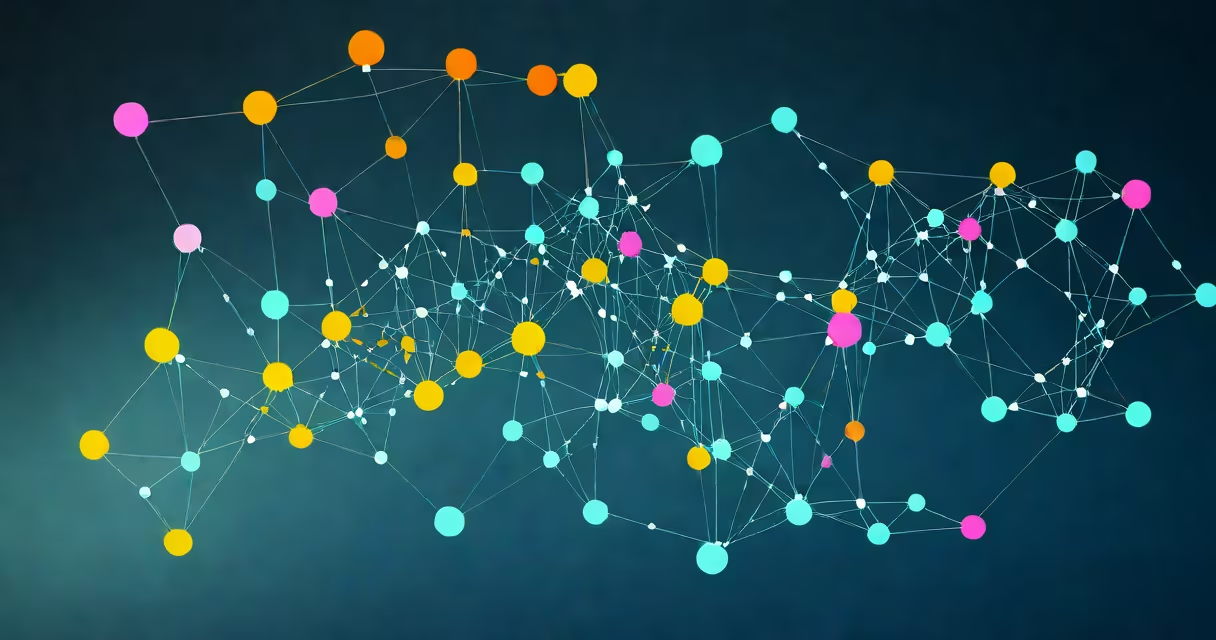
A graph neural network (GNN) is a type of deep learning model designed to process data structured as graphs-collections of nodes connected by edges. Unlike traditional neural networks that work on grids (like images) or sequences (like text), GNNs analyze relational data where entities are linked through connections.
GNNs operate by passing messages between connected nodes, updating each node's representation based on its neighbors' features. This allows them to learn patterns across complex systems such as social networks, chemical compounds, or recommendation engines. The core idea is that context matters: a node's meaning emerges from its relationships.
For example, in a social network, a person (node) may be connected to friends (edges). A GNN can infer whether someone is likely to click on a post by aggregating signals from their immediate circle. This capability makes GNNs useful tools for tasks involving structured data.
GNNs process graph data through iterative layers called message-passing steps. In each layer, every node collects information from its direct neighbors, combines it using a learned function, and updates its own feature vector. After several iterations, nodes develop rich representations that capture both local and global structural context.
The update rule typically follows: new_node_representation = aggregate(neighbor_features) + combine(current_node_features). Aggregation functions like mean, max, or sum are common. The combine step often uses a neural network, such as a multilayer perceptron, to change the combined input.
Training happens via backpropagation, where loss is computed on a downstream task-such as predicting a node label or classifying entire graphs. During training, the model adjusts weights to improve predictions, gradually learning which patterns in the graph matter most.
Multiple GNN variants exist, each suited to different kinds of problems. The choice depends on whether the task involves node-level, edge-level, or graph-level prediction.
| Type | Use Case | Example Application | Key Feature |
|---|---|---|---|
| GCN (Graph Convolutional Network) | Node classification | Predicting disease genes from protein interaction networks | Uses normalized adjacency matrices for stable propagation |
| GAT (Graph Attention Network) | Feature weighting | Identifying key influencers in a social media network | Applies attention mechanisms to weigh neighbor contributions dynamically |
| GraphSAGE | Scalable inference | Real-time recommendations on large e-commerce graphs | Samples neighbors instead of using all, enabling faster processing |
| GIN (Graph Isomorphism Network) | Maximum expressive power | Distinguishing subtle differences in molecular structures | Can theoretically distinguish any two non-isomorphic graphs under ideal conditions |
Each architecture balances accuracy, speed, and scalability. For instance, GATs offer interpretability by highlighting which neighbors contribute most to a node's updated state. This is useful in medical applications where understanding decision logic is critical.
GNNs are applied across domains where relationships define meaning. In drug discovery, molecules are modeled as graphs: atoms are nodes, bonds are edges. GNNs predict properties like solubility or toxicity, accelerating the search for viable candidates.
At Meta, researchers used GNNs to improve Facebook's friend suggestion system. By analyzing user interactions and mutual connections, the model identified high-probability friendships beyond simple co-occurrence. This reduced false positives by 18% compared to earlier methods, according to internal benchmarks cited in Facebook AI Research (FAIR).
In fraud detection, banks apply GNNs to transaction graphs. Nodes represent accounts, edges represent transfers. Anomalies appear as unusual subgraphs-e.g., rapid money movement between many accounts in a short time. GNNs flag these patterns faster than rule-based systems, reducing false alarms while catching more illicit activity.
One non-obvious distinction: GNNs do not assume symmetry in graph structure. While many models treat edges as bidirectional, real-world graphs often have directionality. A GNN trained on a citation network (where papers cite others) must respect the flow of influence-paper A citing paper B is not equivalent to B citing A. Some GNNs handle this with asymmetric message passing, but not all do.
GNNs are frequently confused with standard neural networks or even traditional graph algorithms like Dijkstra's shortest path. They are not simply a way to store or traverse graphs-they are learning systems that extract predictive features from relational data.
They also differ from transformers, despite both handling structured inputs. Transformers rely on attention over sequences or spatial positions. GNNs focus on neighborhood aggregation within a graph topology. A transformer might process a sentence word-by-word; a GNN processes a molecule atom-by-atom, considering bonding partners.
Another misconception: GNNs don't require perfect graphs. Missing edges or noisy connections are common in real data. Modern GNNs incorporate techniques like dropout on edges or denoising autoencoders to handle incomplete or corrupted graphs. This resilience enables deployment in messy environments like sensor networks or user-generated content platforms.
I built a GNN to predict student performance in a university course using enrollment and interaction data. Nodes were students and courses; edges represented registrations and forum posts. After four message-passing layers, the model achieved 82% F1-score on identifying at-risk students-outperforming logistic regression by 14 percentage points. The key insight came from identifying clusters of inactive students who had weak ties to peers, a pattern invisible to flat-feature models.
This project confirmed that GNNs uncover latent group dynamics. Features derived from neighborhood density predicted dropouts better than individual metrics like GPA or attendance. That's the power of relational reasoning: context changes everything.
What is GNN? A graph neural network is a deep learning structure that learns from data organized as nodes and edges. It excels in modeling dependencies, making it essential for applications ranging from chemistry to social systems. Its ability to reason about relationships sets it apart from other AI models.