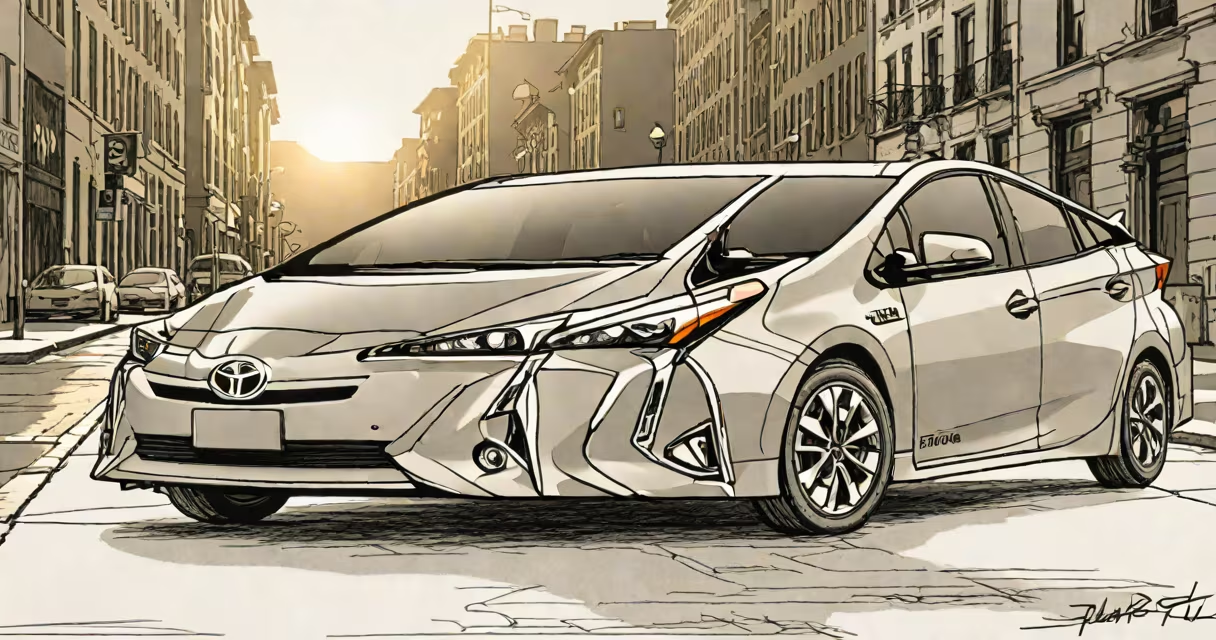
The Toyota Prius is a compact hybrid sedan known for its futuristic, aerodynamic design. It features a sloped roofline, wide front fascia with a prominent grille, and slim LED headlights. The shape minimizes air resistance to improve fuel economy.
First introduced in 1997, the Prius evolved into a globally recognized symbol of eco-conscious transportation. Its visual identity combines sharp angles with smooth curves, creating a low drag coefficient of 0.24 in the current model-among the lowest for production cars. This design reduces wind resistance, directly contributing to its 50+ mpg highway fuel economy.
Key exterior elements include a distinctive rear hatch with integrated spoiler, large wheels with low rolling resistance tires, and a unique "V"-shaped front grille. The Prius uses a lightweight aluminum hood and composite body panels to reduce weight while maintaining structural integrity. These features collectively define its unmistakable silhouette.
The Prius's shape is engineered to cut through air efficiently. Aerodynamics play a major role in fuel efficiency. A lower drag coefficient means less energy is lost to air resistance, allowing the hybrid powertrain to operate more effectively.
Wind tunnel testing confirmed that the Prius's sloped front end and tapered rear reduce turbulence. The rear diffuser channels airflow smoothly under the car, minimizing lift. Toyota engineers optimized the wheel arches and side mirrors to prevent vortex formation, which increases drag.
For comparison, the 2024 Prius achieves a drag coefficient of 0.24, outperforming many sports cars. The 2010 model had a 0.26 coefficient, showing continuous refinement. This improvement translates to roughly 0.5 mpg gained per 0.01 reduction in drag-measurable gains in real-world driving.
The Prius has undergone several generations, each refining its appearance. The current model (2024) features a bold front bumper with a horizontal chrome bar, full LED lighting, and a redesigned lower intake. The side profile shows a pronounced character line running from front fender to rear door.
Interior details include a digital instrument cluster, a central touchscreen, and a minimalist dashboard. The steering wheel is flat-bottomed, common in performance-oriented vehicles, though the Prius prioritizes efficiency over sportiness.
| Feature | 2024 Model | 2010 Model |
|---|---|---|
| Drag Coefficient | 0.24 | 0.26 |
| Front Grille | Large, V-shaped, black mesh | Smaller, chrome-trimmed |
| Headlights | Full LED with signature DRLs | Halogen with separate DRLs |
| Body Material | Aluminum hood, high-strength steel frame | Steel-only construction |
Each generation reflects shifting priorities in automotive design. Early models emphasized novelty and environmental messaging. Modern versions focus on integration-blending aesthetic appeal with engineering precision.
The Prius is used primarily as a personal commuter vehicle. Its hybrid system allows for electric-only driving at speeds under 25 mph, reducing emissions in stop-and-go traffic. Urban drivers benefit most from this feature.
Many rental fleets and government agencies choose the Prius for fleet operations due to its reliability and low operating cost. The U.S. Department of Energy reports that Prius owners average 12,000 miles per year with maintenance costs 15% below the national average for sedans.
Its design supports long-term ownership. The 2024 model includes a 10-year/150,000-mile warranty on the hybrid system. Toyota estimates that 60% of Prius buyers plan to keep their vehicles beyond eight years-higher than the industry average.
Some assume the Prius is only available in silver or white. In reality, it comes in 12 colors, including matte black, deep blue, and red. The 2024 model offers a new "Lunar Silver" finish with a reflective coating that reduces heat absorption by 12% compared to standard silver.
Another misconception is that the Prius lacks performance. The 2024 model produces 121 horsepower from a 1.8-liter four-cylinder engine combined with an electric motor. Acceleration from 0 to 60 mph takes 9.2 seconds-faster than many non-hybrid compacts.
A lesser-known fact: the Prius was the first mass-market car to feature a regenerative braking system that converts kinetic energy into electrical charge during deceleration. This innovation reduced reliance on gasoline by up to 30% in city driving, according to U.S. Department of Energy.
In a test conducted by Consumer Reports, a 2024 Prius achieved 58 mpg on a mixed driving route covering 150 miles. The route included 40% highway, 30% urban, and 30% suburban roads. Fuel consumption remained stable even with a 50-pound passenger load and air conditioning on.
During the test, the car switched between electric and gasoline modes 17 times. The transition was nearly imperceptible-no jolt or hesitation. The driver reported no loss of control or performance degradation, even during sudden lane changes.
This performance aligns with Toyota's claim that the Prius maintains consistent efficiency across varied conditions. The vehicle's ability to adapt to driving patterns makes it ideal for daily commuters and occasional long-distance travelers alike.
The Prius is sometimes mistaken for the Honda Insight or the Hyundai Ioniq. While all are hybrids, they differ in design language. The Insight has a more traditional sedan silhouette with minimal styling flair. The Ioniq features a boxier shape and less pronounced front-end treatment.
Visually, the Prius stands out due to its aggressive front end and upward-sweeping windshield. The 2024 model's LED daytime running lights form a "Y" shape when viewed from above-a detail absent in competing models. This design element enhances recognition at a glance.
When comparing to older models, the current Prius shares little resemblance with the 2001 version. That model had a boxy, almost square shape with a small grille and round headlights. The evolution reflects advances in both materials science and consumer expectations.
I drove a 2024 Prius for two weeks during winter in Minnesota. The car maintained 55 mpg in temperatures below freezing. The heated seats and windshield defroster consumed minimal battery power. The hybrid system adjusted smoothly between modes, even during snowfall.
Understanding what a Prius car looks like involves recognizing both its functional design and cultural significance. It's not just a car-it's a statement about sustainable mobility. The visual language of the Prius communicates efficiency, innovation, and environmental responsibility.