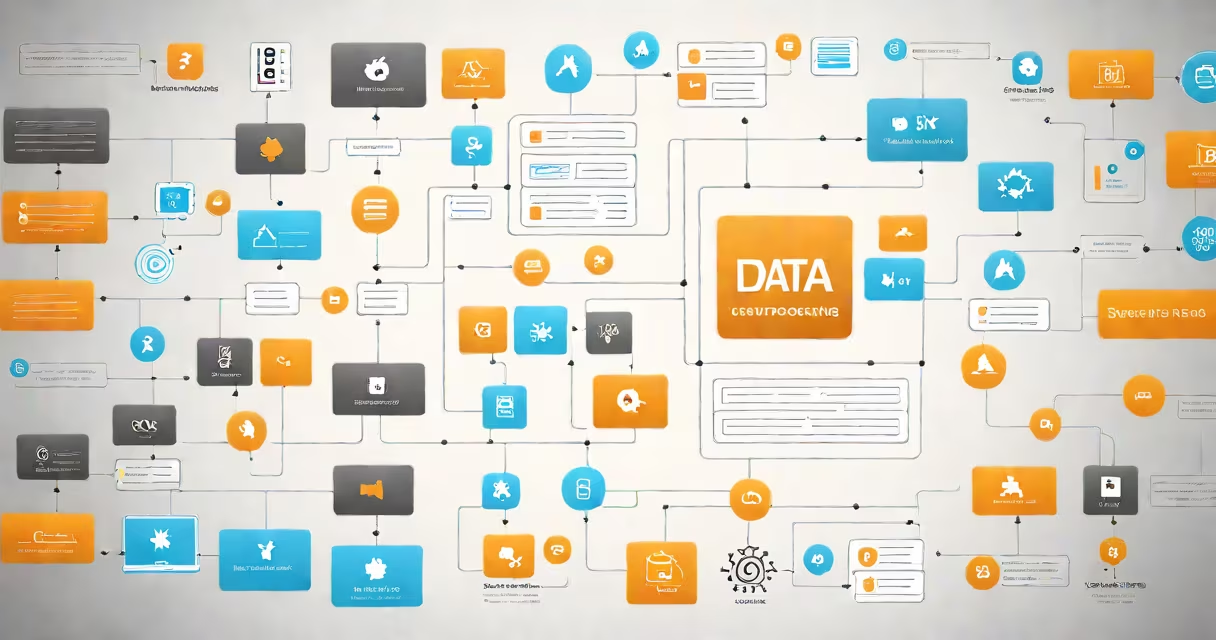
Data processing means transforming raw data into structured, usable information through automated or manual steps. It includes collecting, validating, organizing, analyzing, and storing data to support decisions. This process powers everything from weather forecasts to online shopping recommendations.
At its core, data processing turns unstructured inputs-like sensor readings, form entries, or click logs-into insights. For example, a retail store collects daily sales figures. The system checks for errors (e.g., negative quantities), groups transactions by product category, calculates totals, and generates a report. That report is processed data.
The term applies across industries. A hospital processes patient records to track treatment outcomes. A bank processes transaction logs to flag fraud. Even social media platforms process user interactions to recommend content. Without data processing, raw data remains useless.
Data processing follows a sequence: input, processing, output, and storage. Input involves gathering data from sources such as keyboards, sensors, or databases. Processing performs actions like filtering, sorting, aggregating, or applying algorithms. Output delivers results-reports, alerts, or dashboards. Storage preserves data for future use.
Modern systems automate most steps. A web application captures user sign-ups via a form. The server validates email formats, checks for duplicates, encrypts passwords, and saves the record. This entire cycle completes in under half a second. Manual processing still exists-like entering inventory counts by hand-but it's rare in large-scale operations.
Processing speed depends on volume and complexity. A spreadsheet with 100 rows takes milliseconds to sort. Processing a terabyte of video footage may take hours. High-frequency trading systems analyze market data in microseconds to execute trades faster than human reaction time.
There are four primary models: batch, real-time, stream, and distributed processing. Each suits different needs based on timing, scale, and accuracy requirements.
| Type | When Used | Example | Latency |
|---|---|---|---|
| Batch | Large volumes with no time sensitivity | Daily payroll calculations | Minutes to hours |
| Real-Time | Immediate response needed | ATM withdrawal verification | Less than 1 second |
| Stream | Continuous data flow | Live traffic monitoring from GPS devices | Milliseconds |
| Distributed | Massive datasets across multiple machines | Search engine indexing billions of web pages | Seconds to minutes |
Batch processing handles tasks like monthly billing or tax filings. It runs overnight to avoid disrupting users. Real-time systems respond instantly-such as credit card authorization during checkout. Stream processing manages continuous flows, like monitoring network traffic for anomalies. Distributed processing splits work across clusters, enabling tools like Apache Spark to analyze petabytes of data.
A common mistake is assuming all data processing requires live updates. Many business reports are generated once a week using batch methods. The choice depends on urgency, cost, and infrastructure.
Data processing supports decision-making in nearly every sector. In healthcare, systems process patient vitals to detect early signs of sepsis. In finance, algorithms process stock prices to identify arbitrage opportunities. In logistics, route planning software processes delivery locations and traffic patterns to minimize fuel use.
One example: a city uses data processing to manage traffic lights. Sensors collect vehicle counts every 30 seconds. The system analyzes congestion levels and adjusts light cycles dynamically. During rush hour, green waves extend along major roads. This reduces average commute times by 18%, according to a 2022 study by the Institute of Transportation Engineers.
Another non-obvious fact: data processing often happens in layers. Raw data enters a database, then moves through an ETL pipeline (extract, change, load), and finally feeds analytics tools. Each layer adds structure. A single customer purchase might pass through five systems before appearing in a marketing dashboard.
Processing also enables compliance. GDPR and HIPAA require organizations to track how personal data is handled. Systems log every access, modification, and export. These audit trails are part of data processing-not an afterthought.
People often confuse data processing with data storage. Storing data means preserving it. Processing means acting on it. Saving a file to a hard drive doesn't process it. Opening it and calculating averages does.
Another error: thinking data processing equals artificial intelligence. AI models rely on processed data, but the act of cleaning or aggregating data isn't AI. Training a neural network requires vast amounts of preprocessed data, but the preprocessing step itself is traditional programming.
Even experts mislabel basic operations. For instance, sorting a list of names is data processing. But calling it "AI" because it uses a sorting algorithm is incorrect. True AI involves learning from patterns, not executing predefined logic.
I once reviewed a startup pitch deck that claimed their app used "real-time AI" to filter spam emails. Upon inspection, the system simply matched keywords against a static list. No machine learning. No model training. Just rule-based filtering. The term "AI" was misleading-and inaccurate.
Understanding what data processing is helps avoid confusion with related concepts. Data processing differs from data mining, which focuses on discovering hidden patterns. It differs from data visualization, which presents findings graphically. And it differs from data backup, which ensures data survives failures.
Similarly, data integrity ensures correctness and consistency. A system may process data accurately, but if the original input contains errors-like a typo in a ZIP code-the result is flawed. Integrity measures prevent bad data from entering the pipeline. Integrity of data is a prerequisite for trustworthy processing.
Consider a weather station recording temperature. The raw reading is 68.2°F. The system validates it against nearby stations. If another station reports 75°F within 10 miles, the system flags the outlier. After validation, it aggregates hourly averages. That final number-say, 71.3°F-is processed data. It's not raw, not stored, not backed up-it's transformed.
This example shows that data processing isn't a single action. It's a chain of decisions, validations, and transformations. Each step adds value. Without them, data remains inert.
What does data processing mean? It means turning information into insight. It's the engine behind modern systems-from smart thermostats to national defense networks. It's not magic. It's math, logic, and automation applied consistently.