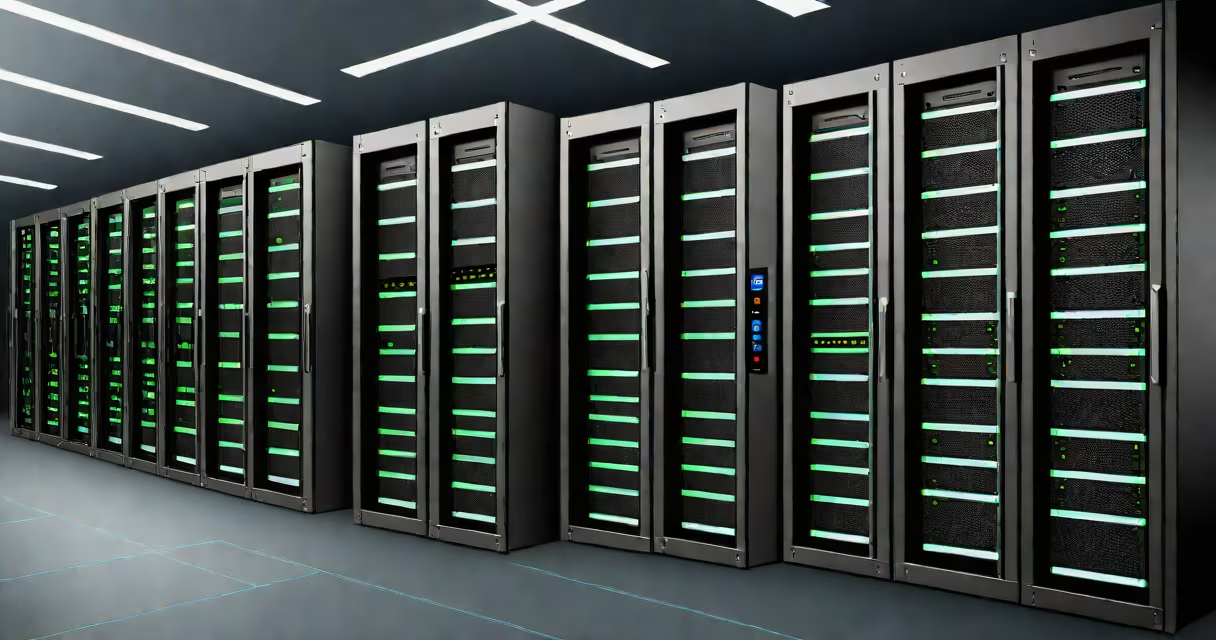
A data center is a facility housing computer systems and related components such as networking equipment, storage arrays, and environmental controls. These facilities process, store, and distribute vast amounts of digital data for businesses, governments, and online services. They operate 24/7 to maintain uptime, reliability, and performance across global networks.
Data centers run on a tightly coordinated system of hardware, software, and human oversight. Servers execute workloads ranging from email routing to AI model training. Storage systems manage petabytes of files. Networking gear ensures low-latency communication between systems. All of this occurs under strict environmental conditions-temperature, humidity, and air quality are monitored and adjusted in real time.
Power delivery is critical. Redundant power feeds from multiple utility sources feed into uninterruptible power supplies (UPS) and backup generators. A single power failure can trigger cascading outages. Cooling systems-often using liquid or precision air conditioning-dissipate heat generated by thousands of running processors. Without proper thermal management, hardware fails within minutes.
Every data center performs five essential tasks: processing, storage, networking, power distribution, and environmental control. Processing involves running virtual machines, containers, and batch jobs across thousands of servers. Storage systems hold data in redundant configurations-typically RAID or distributed file systems-to prevent loss during hardware failures.
Networking connects devices across local and wide-area networks. High-speed switches and fiber-optic cabling enable data transfer rates exceeding 100 Gbps per port. Redundant paths ensure traffic reroutes automatically if a link fails. This resilience supports services like video streaming, financial transactions, and real-time collaboration tools.
Power usage effectiveness (PUE) measures efficiency. A PUE of 1.0 means all energy goes to computing; values above 1.0 indicate overhead from cooling and power conversion. Industry benchmarks show top-tier data centers achieve PUE below 1.2, according to the U.S. Department of Energy's Data Center Energy Efficiency Guide.
There are three primary types: colocation, enterprise, and hyperscale. Colocation centers rent space to external clients who bring their own hardware. Enterprise data centers serve internal business needs-like payroll systems or customer databases-and are managed by a company's IT team. Hyperscale facilities support massive cloud platforms such as AWS, Google Cloud, and Microsoft Azure.
| Type | Scale | Owner | Use Case Example |
|---|---|---|---|
| Colocation | Medium to large | Third-party provider | Hosting a company's website and database |
| Enterprise | Small to medium | Internal IT department | Running internal HR and finance systems |
| Hyperscale | Massive (100k+ servers) | Cloud provider | Supporting YouTube, Gmail, or Amazon's recommendation engine |
Each type uses different design principles. Hyperscale centers prioritize automation and scalability. They deploy custom-designed servers and racks optimized for specific workloads. For example, Google's data centers use AI-driven cooling systems that adjust fan speeds based on real-time temperature maps across server rows.
Physical access is restricted to authorized personnel only. Biometric scanners, badge readers, and surveillance cameras monitor entry points. Security protocols require dual authentication for high-risk zones. A breach in physical security can lead to data theft, sabotage, or service disruption.
One non-obvious fact: most data centers don't rely solely on electricity. Many use free cooling-drawing cold outside air when ambient temperatures permit. This reduces reliance on mechanical chillers and cuts energy costs by up to 30%, per National Renewable Energy Laboratory research.
I once toured a Tier IV-certified data center in northern Sweden. The facility used geothermal cooling and ran entirely on renewable energy. Inside, rows of servers hummed quietly beneath blue LED-lit racks. The air smelled faintly of ozone and metal. A technician explained that even minor dust particles could cause short circuits-so filters replaced every 72 hours.
People often think data centers are just rooms full of blinking lights. In reality, they're complex ecosystems designed around fault tolerance. A single server failure doesn't cause downtime because systems are mirrored across locations. When a disk fails, data is automatically restored from backups in seconds.
Another misconception: data centers are always located near cities. But many are built in remote areas-like deserts or cold climates-to reduce cooling costs and avoid urban congestion. Facebook's data center in Luleå, Sweden, uses Arctic air for cooling and runs on hydroelectric power. This location choice cuts annual cooling expenses by $1.2 million compared to urban sites, according to Facebook Engineering Blog.
Confusion also arises around PUE. Some assume lower PUE means better performance-but it only reflects energy efficiency. A data center with PUE 1.1 may still have poor latency or high maintenance costs. Understanding PUE requires context about workload density and cooling method.
When you type "weather in Seattle" into a search engine, the request travels through a chain of events inside a data center:
This entire flow relies on precise timing, redundant infrastructure, and constant monitoring. If any component fails, automated scripts detect the issue and reroute traffic within 15 seconds.
Understanding what happens in a data center reveals how digital life depends on invisible machinery. From streaming music to sending emails, every online action passes through these secure, efficient, and highly available facilities. The next time you check your phone, remember: somewhere, a data center is working silently to make it possible.