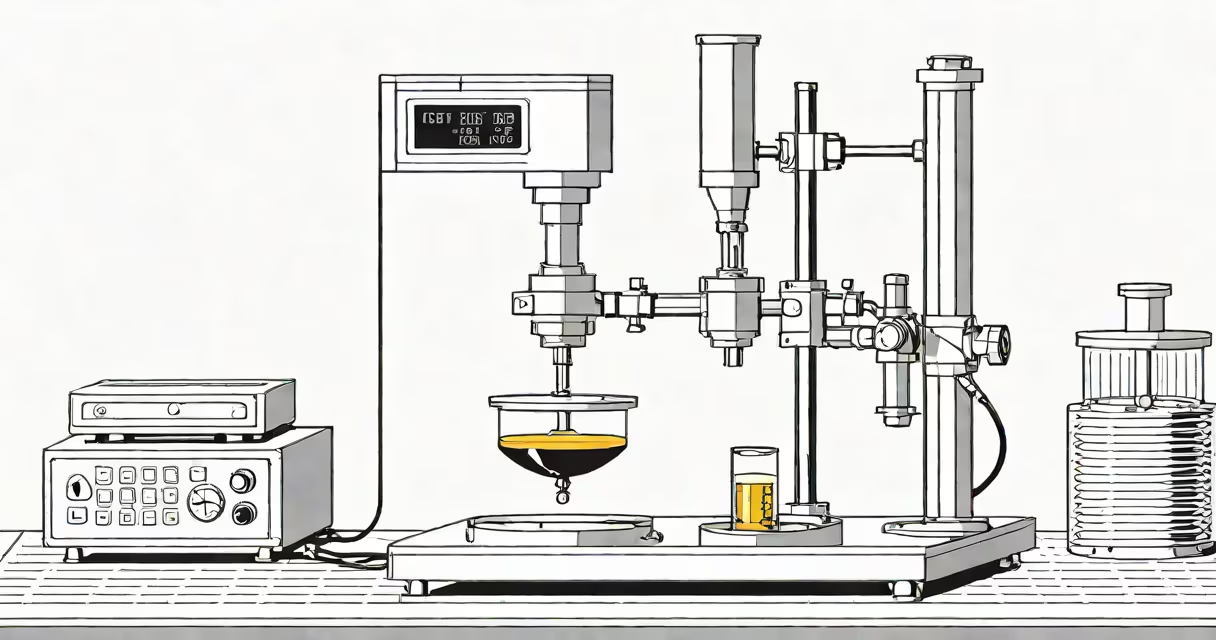
A viscometer is a device that measures the viscosity of a fluid-the internal resistance to flow under applied force. It quantifies how thick or thin a liquid is by assessing its resistance to shear stress or flow deformation.
Viscosity determines how easily a fluid moves. Honey flows slowly due to high viscosity; water flows quickly because of low viscosity. A viscometer provides numerical values in centipoise (cP) or Pascal-seconds (Pa·s), enabling precise comparisons across materials and conditions.
These instruments are critical in manufacturing, research, and quality control. They ensure consistency in products ranging from engine oil to cosmetics and blood samples in clinical labs.
Viscometers operate by applying a controlled force or motion to a fluid and measuring the resulting resistance. The core principle relies on Newton's law of viscosity: shear stress is proportional to shear rate, with viscosity as the constant of proportionality.
In rotational models, a spindle rotates inside the fluid. The torque required to maintain a set speed reflects the fluid's viscosity. As the spindle spins, drag increases with higher viscosity. Digital sensors record torque and rotational speed to calculate viscosity in real time.
Capillary viscometers use gravity. A fluid flows through a narrow tube, and the time it takes to pass between two marks is recorded. The longer the time, the higher the viscosity. This method assumes laminar flow and uses the Hagen-Poiseuille equation to derive viscosity from flow rate and pressure drop.
There are several standard types, each suited to specific applications based on fluid properties and required precision.
| Type | Working Principle | Best For | Typical Range (cP) |
|---|---|---|---|
| Rotational | Spindle rotation against fluid resistance | Non-Newtonian fluids, high-viscosity samples | 0.1 - 100,000 |
| Capillary (Ubbelohde) | Flow time through a calibrated glass tube | Low-viscosity liquids, standard reference testing | 0.5 - 100 |
| Cone-and-plate | Fluid sheared between a cone and flat plate | Shear-thinning fluids, precise rheology | 1 - 10,000 |
| Vibrational | Frequency changes in a vibrating element immersed in fluid | Inline process monitoring, small volumes | 1 - 1,000 |
Rotational viscometers dominate industrial settings. They handle complex fluids like paints, drilling muds, and polymer solutions. Their ability to test at multiple shear rates reveals whether a fluid behaves consistently (Newtonian) or changes under stress (non-Newtonian).
Capillary viscometers remain gold standard for accuracy in basic viscosity tests. The Ubbelohde viscometer, for example, is used in ASTM D445 to measure kinematic viscosity of lubricants. It requires minimal sample volume and delivers results traceable to national standards.
Cone-and-plate systems offer high sensitivity. They apply uniform shear across the fluid layer, making them ideal for studying shear-thinning behavior in products like ketchup or shampoo. These devices are common in R&D labs where rheological profiles matter.
Many assume all viscometers measure the same way. That's false. A capillary viscometer measures kinematic viscosity (changing viscosity divided by density), while rotational models typically report changing viscosity directly. Confusing these leads to incorrect material specifications.
Another mistake is equating viscosity with thickness. While viscous fluids often feel "thick," viscosity is a physical property independent of perceived texture. For example, molasses feels thick but has a viscosity around 5,000 cP at room temperature. Motor oil at 100°C has a viscosity of about 10 cP-much lower-but still feels "slippery."
Viscosity is temperature-dependent. A single reading without specifying temperature is meaningless. Most standards require measurements at 40°C or 100°C. A viscometer must include temperature control or compensation to deliver valid data.
Consider a refinery testing engine oil batches. The target viscosity at 100°C is 12.5 cP ± 0.5 cP. A rotational viscometer with a variable-speed motor and temperature-controlled bath is used.
The technician places a 50 mL sample in a chamber, lowers a stainless steel spindle, and sets the speed to 60 rpm. The instrument records torque and calculates viscosity. After five minutes, the reading stabilizes at 12.7 cP. Within specification, the batch passes.
If the reading were 15.2 cP, the oil would be too thick. It could cause poor cold-start performance or increased fuel consumption. The viscometer flagged a defect before shipment.
This process follows ISO 3104 and ASTM D445 protocols. Without such tools, manufacturers couldn't ensure product safety or meet regulatory standards.
I once observed a viscometer in a food processing plant checking mayonnaise consistency. The product had to stay stable during storage. A cone-and-plate viscometer ran tests at 0.1 to 100 sec⁻¹ shear rates.
At low shear, viscosity was 1,200 cP-ideal for preventing separation. At high shear, it dropped to 300 cP, showing shear-thinning behavior. This ensured the product poured smoothly from the jar but stayed thick on the plate.
Without this data, the formulation would have failed shelf life testing. The viscometer caught the issue early.
According to the National Institute of Standards and Technology (NIST), uncertainty in viscosity measurements affects downstream processes. In pharmaceuticals, even slight deviations can alter drug delivery rates.
The American Society for Testing and Materials (ASTM) defines standardized procedures for viscometer calibration. Devices must be verified annually using certified reference fluids like silicon oil with known viscosity at specified temperatures.
Failure to calibrate leads to drift. A viscometer reading 10% high over time can result in defective batches, recalls, or equipment damage. Regular maintenance and traceable calibration are non-negotiable.
Understanding what a viscometer is-its function, types, and limitations-ensures accurate data collection across science, engineering, and industry. It's not just a tool; it's a gatekeeper of quality.