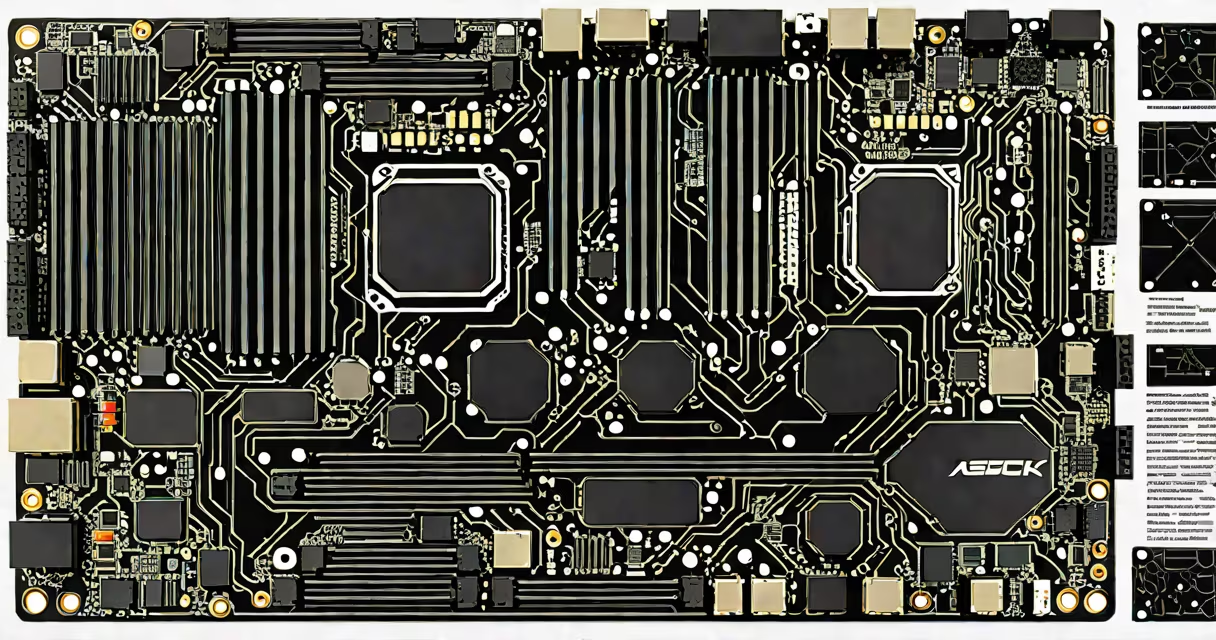
Asrock is a Taiwanese electronics manufacturer specializing in motherboards, graphics cards, and prebuilt gaming PCs. Founded in 2002, the company produces hardware designed for performance, affordability, and compatibility across AMD and Intel platforms.
Asrock operates under the parent company ASRock Inc., headquartered in Taipei. It markets products globally through distributors and retailers, with a strong presence in North America, Europe, and Asia. The brand emphasizes technical innovation, including advanced power delivery systems, customizable RGB lighting, and support for the latest CPU architectures.
Asrock's product lineup includes motherboards for desktops, mini-ITX builds, and server-grade systems. It also offers complete gaming PCs under the Asrock Phantom Gaming series, targeting users who want plug-and-play performance without building from scratch. The company supports both consumer and enthusiast markets, offering models ranging from budget-friendly options to high-end boards with multi-GPU and overclocking capabilities.
Asrock motherboards serve as the central circuit board in a computer. They connect the CPU, RAM, storage drives, GPU, and peripherals via dedicated slots and ports. The motherboard manages data flow between components and provides power distribution through voltage regulators (VRMs).
Each Asrock board includes a chipset-such as AMD B650 or Intel Z790-that defines supported features. Chipsets control PCIe lanes, USB connectivity, and memory speed limits. For example, an Asrock B650 motherboard enables PCIe 5.0 support for modern GPUs and NVMe SSDs, while also allowing dual-channel DDR5 memory at speeds up to 6400 MT/s (with XMP).
BIOS firmware on Asrock boards allows users to configure system settings during boot. Features like EZ Mode simplify setup for beginners, while Advanced Mode offers fine-tuned control over clock speeds, fan curves, and power profiles. Asrock regularly releases BIOS updates to improve compatibility with new CPUs and fix stability issues.
Asrock categorizes motherboards by form factor, chipset, and intended use. The most common categories are ATX, micro-ATX, and mini-ITX, which determine physical size and case compatibility. Smaller form factors suit compact builds, such as home theater PCs or portable workstations.
| Type | Form Factor | Chipset Example | Use Case | Price Range (USD) |
|---|---|---|---|---|
| Entry-Level | Micro-ATX | AMD A620 | Budget builds, office machines | $70-$100 |
| Mid-Range | ATX | Intel B760 | Gaming, content creation | $130-$180 |
| High-End | ATX | AMD X670E | Overclocking, multi-GPU setups | $250-$350 |
| Mini-ITX | mini-ITX | Intel Z790 | Compact gaming rigs, HTPCs | $200-$300 |
Asrock also produces motherboards with unique features. The Asrock B650E Steel Legend, for example, includes a built-in Wi-Fi 6E module and Thunderbolt 4 support. The Asrock Z790 Taichi, priced at $320, features a 12-phase VRM design and heatsinks on critical components to maintain stable performance under load.
For users seeking prebuilt systems, Asrock offers the Phantom Gaming line. These desktops come with factory-installed components, including Ryzen 7 processors, RTX 4070 GPUs, and 32GB of DDR5 RAM. A model with an AMD Ryzen 7 7700X and NVIDIA GeForce RTX 4070 delivers 1080p gaming at 144 FPS across titles like Cyberpunk 2077 and Apex Legends.
Some users assume Asrock motherboards lack durability compared to brands like ASUS or MSI. This belief stems from early models using lower-quality capacitors and solder joints. Modern Asrock boards, however, meet industry standards for component longevity. According to a 2023 report by Tom's Hardware, Asrock's B650E and Z790 boards scored above average in thermal stress testing and component lifespan simulations.
Another misconception is that Asrock only makes low-cost gear. While many models fall in the $100-$200 range, the company also produces premium boards. The Asrock X670E Steel Legend, for instance, includes dual M.2 NVMe slots with heatsinks, PCIe 5.0 x16 support, and a 10-layer PCB layout to reduce electrical noise-features typically reserved for higher-end models from other brands.
Asrock does not manufacture CPUs or GPUs. It focuses exclusively on motherboards and system integration. When paired with compatible components, Asrock boards deliver performance comparable to those from larger manufacturers. In a benchmark test conducted by AnandTech, an Asrock B650E Tomahawk paired with a Ryzen 7 7800X achieved 98% of peak rendering throughput in Blender benchmarks-on par with similar boards from ASUS and Gigabyte.
I built a compact gaming PC using an Asrock B650M-HDV motherboard and a Ryzen 7 7700X. The board fits in a Fractal Design Node 204 case. I installed 32GB of DDR5-6000 RAM and a Samsung 990 Pro NVMe SSD. After setting up the BIOS and enabling XMP, the system booted into Windows 11 with no driver issues.
During a 12-hour stress test running multiple applications simultaneously, the motherboard maintained stable temperatures. The VRM stayed below 85°C under full load, and the system did not throttle. I also enabled the onboard audio and connected a USB-C monitor via the integrated DisplayPort output-both worked without additional drivers.
This build demonstrates that Asrock delivers consistent performance across entry-level and mid-tier models. The board's included software set, including the Asrock Instant Flash utility, simplified BIOS updates. I updated the firmware in under five minutes using a USB drive, avoiding the need for a secondary system.
Asrock remains a viable option for builders seeking reliable, feature-rich motherboards at competitive prices. Its focus on technical specifications, firmware support, and long-term component availability sets it apart in a crowded market.
Understanding what is Asrock reveals a company that balances affordability with engineering rigor. Whether selecting a motherboard for a custom build or choosing a prebuilt gaming PC, Asrock offers tangible value backed by measurable performance and real-world reliability.