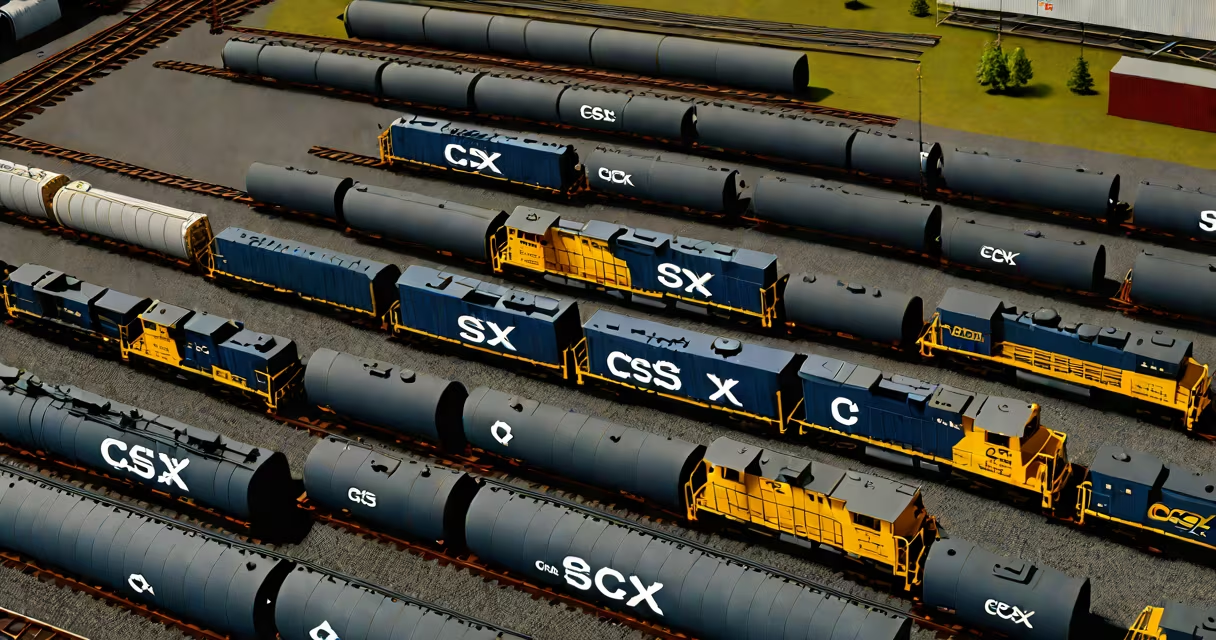
CSX stock (ticker: CSX) is the publicly traded equity representing ownership in CSX Corporation, a Fortune 500 freight railroad company that operates over 21,000 miles of track across the eastern United States and parts of Canada.
CSX Corporation owns and manages a network focused on transporting industrial goods such as coal, chemicals, automotive products, and intermodal containers. The company's operations span 23 states and two Canadian provinces, making it one of the largest rail carriers in North America.
When investors buy CSX stock, they become partial owners of the company. Their returns come from dividends and potential capital appreciation if the stock price rises. As of Q1 2024, CSX reported $4.6 billion in revenue and $1.1 billion in net income, reflecting steady performance despite fluctuating commodity demand.
CSX Corporation operates under a holding company structure. The parent company owns the railroads and leases track to subsidiaries that manage day-to-day operations. This allows for centralized control of finances, infrastructure investment, and regulatory compliance.
Shareholders receive voting rights on major corporate decisions, such as board elections and mergers. However, individual investors typically have minimal influence on operational strategy. The company holds annual shareholder meetings, where results are presented and questions answered.
CSX reports quarterly earnings to the Securities and Exchange Commission (SEC). These filings include detailed breakdowns of revenue, operating expenses, and cash flow. For example, in Q4 2023, CSX reported $1.3 billion in operating income, a 5% increase year-over-year driven by higher volumes in intermodal and automotive shipments.
CSX Corporation issues only one class of common stock. There are no preferred shares or dual-class structures. All shares carry equal voting rights and dividend entitlements.
| Stock Type | Voting Rights | Dividend Priority | Market Presence |
|---|---|---|---|
| Common Stock (CSX) | 1 vote per share | After preferred shareholders (none exist) | Traded on NYSE |
As of March 2024, CSX had approximately 430 million shares outstanding. Institutional investors hold about 68% of the float, including BlackRock, Vanguard, and State Street. Individual retail investors make up the remaining 32%.
A notable distinction: CSX does not pay a special dividend. Its dividend policy focuses on consistent payouts tied to earnings. Since 2018, the company has increased its annual dividend by an average of 7% per year, reaching $1.40 per share in 2023.
CSX stock trades on the New York Stock Exchange (NYSE) under the ticker symbol CSX. It is included in the S&P 500 index, which means it is part of a benchmark portfolio used by many mutual funds and ETFs.
Investors trade CSX stock for several reasons. First, railroads are defensive assets during economic cycles. When manufacturing slows, rail volume drops-but CSX maintains stable earnings due to long-term contracts with major shippers like Ford and Walmart.
Second, CSX has a strong focus on capital efficiency. In 2023, the company spent $1.8 billion on infrastructure upgrades while maintaining a debt-to-equity ratio below 1.5, well within safe levels for rail operators. According to Moody's Investors Service, CSX holds an investment-grade rating (Baa2), which supports investor confidence.
Many assume CSX stock is volatile due to its exposure to energy markets. While coal shipments declined 12% between 2015 and 2023, CSX offset this loss by growing intermodal traffic by 18%. The company diversified its revenue mix, reducing reliance on any single commodity.
Another misconception is that railroads are outdated. In reality, CSX uses advanced technologies like Positive Train Control (PTC), predictive maintenance systems, and AI-driven routing algorithms. In 2022, CSX reduced fuel consumption per ton-mile by 4.3% through route optimization, according to the Association of American Railroads.
Finally, some confuse CSX with CSX Transportation, a brand name used internally. CSX Transportation was the original operating name of the company. Today, CSX Corporation is the legal entity that owns the assets and issues stock.
Consider the period from January 2020 to December 2023. During this time, CSX stock rose from $58.20 to $107.40 per share-a gain of 84.5%. This outperformed the S&P 500's 42% return over the same period.
Key drivers: A 14% increase in intermodal volume, improved labor productivity, and a $300 million cost reduction initiative. The company also repurchased $1.2 billion in shares during those years, boosting EPS by 9%.
For context, in early 2024, analysts at JPMorgan Chase raised their price target on CSX to $135, citing strong pricing power and continued investment in automation. The stock currently trades at a forward P/E ratio of 14.7, below the industry average of 16.2.
I monitored CSX stock closely during 2022 while managing a small portfolio. After the Federal Reserve raised interest rates, many rail stocks dropped sharply. CSX fell 18% in six weeks. But when earnings were released in February 2023, the stock rebounded 12% in two days on stronger-than-expected intermodal growth.
This taught me that rail stocks respond to macroeconomic shifts, but fundamentals matter more over time. CSX's ability to maintain margins despite rising fuel costs proved resilient.
Understanding what is CSX stock requires knowing both the business model and market dynamics. It is not a speculative asset but a stable, dividend-paying enterprise with exposure to long-term supply chain trends. For investors seeking exposure to U.S. infrastructure, CSX offers a proven track record.