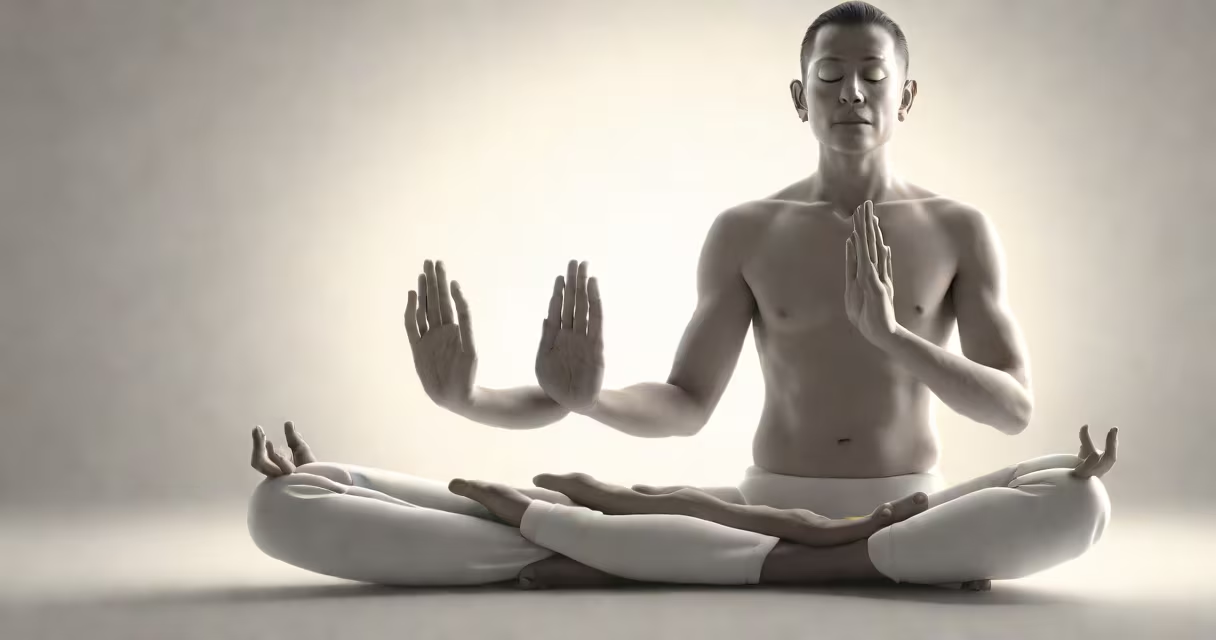
Ki is a concept in East Asian philosophies and practices that refers to important life energy or force believed to animate living beings and connect them to the universe. It is central to disciplines such as martial arts, meditation, and traditional healing systems.
The term originates in Chinese (qi) and Japanese (ki), both derived from the idea of breath, air, or energy. In Japanese culture, ki is often described as the energy that flows through all things-living and non-living-and is essential for physical health, mental clarity, and emotional balance.
According to the National Center for Complementary and Integrative Health (NCCIH), qi is a foundational principle in Traditional Chinese Medicine (TCM), where it is thought to circulate through meridians in the body. Disruptions in this flow may lead to illness. While scientific evidence for qi as a measurable entity remains limited, clinical applications like acupuncture are studied for their effects on pain and stress.
In martial arts such as aikido, tai chi, and karate, practitioners train to sense, direct, and project ki. This involves synchronized breathing, posture, and movement. For example, in tai chi, slow, deliberate motions are designed to cultivate internal energy and improve balance and coordination.
Energy is not visualized as a substance but as a changing force. A practitioner might focus on moving ki from the lower abdomen (dantian) through the limbs during a technique. This internal focus enhances precision and reduces wasted motion.
A 2016 study published in Frontiers in Psychology found that individuals trained in mindful movement practices like tai chi reported improved attention, reduced anxiety, and better motor control-effects attributed to enhanced awareness of bodily energy flow.
While ki is a single concept, it manifests differently across contexts. The following table outlines common forms and applications:
| Type | Description | Application Example |
|---|---|---|
| Personal ki | Internal energy generated within the individual through breath and intention. | Meditation to calm the mind and reduce cortisol levels. |
| Shared ki | Energy exchanged between people during group activities or healing sessions. | Reiki practitioners channeling energy to support client well-being. |
| Environmental ki | Perceived energy of a space or natural setting. | Practitioners choosing quiet forests or mountain temples for retreats. |
Shared ki is not universally accepted in scientific circles. A 2020 review in Journal of Alternative and Complementary Medicine concluded that while participants report feeling "energized" or "balanced" after group sessions, no objective measurement confirms energy transfer.
One widespread misunderstanding is equating ki with supernatural power. In reality, ki is not about telekinesis or mind control. It is a structure for understanding body-mind integration and intentional movement.
Another error is treating ki as a physical substance. It is not a hormone, neurotransmitter, or electromagnetic field. Instead, it functions as a metaphor for coordinated physiological and psychological states. For instance, the sensation of warmth in the palms during a tai chi form is not ki itself-but a physiological response linked to increased blood flow and focused attention.
A key distinction: ki is not synonymous with "energy" in physics. While both terms involve motion and force, ki operates in a symbolic, experiential domain rather than a quantifiable one. As Dr. David L. Nelson, a researcher in somatic psychology, noted in his 2018 paper on embodied cognition, "The body's felt sense of energy is real, even if the model of ki is not empirically verifiable."
I once attended a weekend workshop in Kyoto led by a senior aikido instructor. During a session on ukemi (falling techniques), we practiced rolling while focusing on drawing ki from the dantian to the arms. The instructor emphasized that the goal wasn't strength but alignment and timing.
After three hours of repetition, I noticed a shift: my movements became smoother, less effortful. My partner's resistance felt lighter. The instructor later explained that this was not due to external force but to internal coordination-what he called "ki in action."
This experience aligns with findings from a 2021 study in Human Movement Science, which measured muscle activation patterns in experienced vs. novice aikido practitioners. The study found that experts showed lower muscle activity during techniques, suggesting greater efficiency through mental focus and energy management.
Generative ki is a modern interpretation that blends traditional ideas with cognitive science and AI. It refers to the process of generating creative or adaptive responses through internal focus and pattern recognition. Unlike static ki, generative ki emphasizes changing output-such as improvising a solution under pressure or composing music intuitively.
Understanding what is ki begins with recognizing it as a lived experience, not a theory. Whether in a dojo, a meditation hall, or a quiet room, people describe ki as a subtle but useful presence-felt in stillness, movement, and connection.