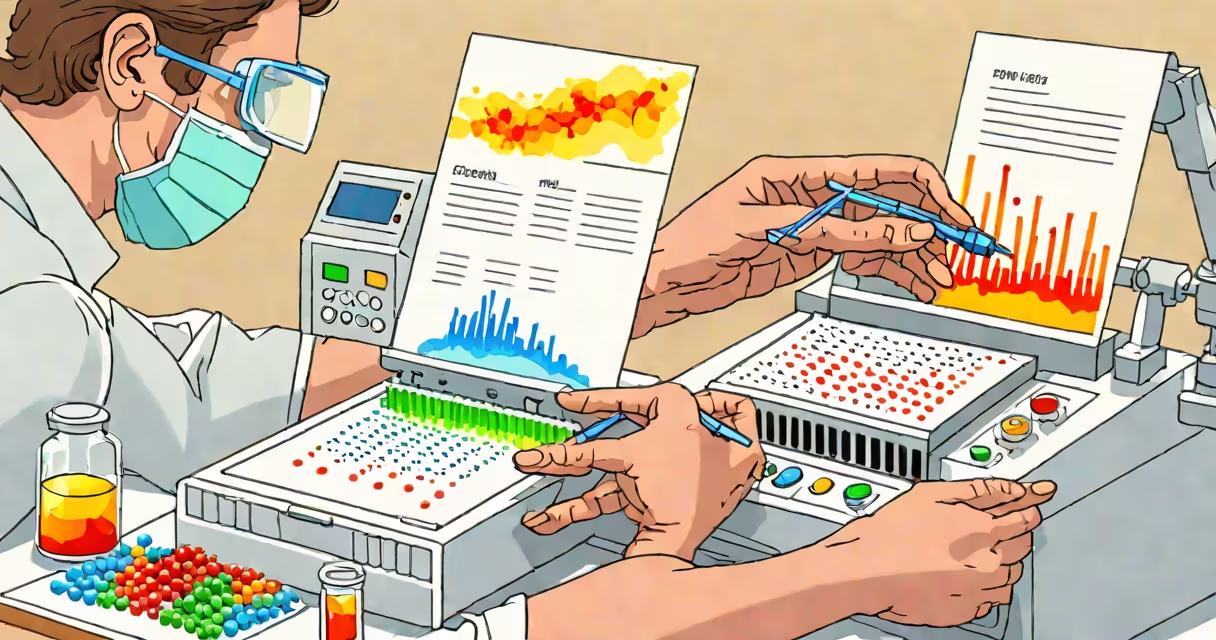
PCR in genetics-short for polymerase chain reaction-is a laboratory method that rapidly multiplies specific segments of DNA, producing millions of copies from a tiny original sample. This process enables scientists to analyze genetic material even when only trace amounts are available.
PCR works by cycling temperature changes to separate DNA strands, bind primers to target sequences, and extend new strands using a heat-stable DNA polymerase enzyme. Each cycle doubles the amount of target DNA, allowing exponential amplification in just 20-40 cycles.
The technique was developed in 1983 by Kary Mullis, who later won the Nobel Prize in Chemistry in 1993 for the discovery. PCR is now foundational in genetics, enabling applications from disease diagnosis to forensic science and ancient DNA studies.
PCR relies on three core steps repeated in cycles: denaturation, annealing, and extension. These occur in a thermal cycler-a machine that precisely controls temperature shifts.
In denaturation, the reaction mix heats to 95°C, breaking hydrogen bonds between DNA strands. This separates double-stranded DNA into single strands.
During annealing, the temperature drops to 50-65°C. Short synthetic DNA sequences called primers bind to complementary regions flanking the target sequence. Primers define which segment gets amplified.
Extension occurs at 72°C. The enzyme Taq polymerase adds nucleotides to the primer, synthesizing a new strand complementary to the template. After one cycle, two copies of the target region exist.
Each subsequent cycle doubles the product. After 30 cycles, a single DNA molecule becomes about 1 billion copies. This exponential growth makes previously undetectable DNA levels visible.
Standard PCR is the most common form, used to amplify known sequences. Variants have evolved for specialized tasks.
| Type | Use Case | Key Feature |
|---|---|---|
| Quantitative PCR (qPCR) | Measuring gene expression levels | Uses fluorescent dyes to track DNA accumulation in real time |
| Digital PCR (dPCR) | Detecting rare mutations or copy number variations | Partitions samples into thousands of reactions for absolute quantification |
| Reverse Transcription PCR (RT-PCR) | Analyzing RNA by converting it to DNA first | Essential for studying viral RNA, such as SARS-CoV-2 |
| Touchdown PCR | Improving specificity in difficult amplifications | Begins with high annealing temperatures, gradually lowering them |
For example, RT-PCR was central to early detection of the SARS-CoV-2 virus. Researchers designed primers targeting the N gene of the coronavirus. A positive test meant the virus's RNA was present and had been reverse-transcribed and amplified.
Another non-obvious fact: PCR cannot detect mutations directly. It only amplifies existing sequences. To find variants, researchers must sequence the amplified product afterward. Misunderstanding this leads to errors in interpreting results.
PCR is often mistaken for sequencing. While both analyze DNA, PCR copies it; sequencing determines the actual order of bases. You can't infer a mutation from PCR alone-you need sequencing to confirm it.
False positives can occur due to contamination. Even a few stray DNA molecules from previous experiments can trigger amplification. Labs use negative controls-samples with no template-to catch this. A positive result in a negative control indicates contamination.
I once observed a lab fail a quality check because a technician left a pipette tip in a tube overnight. The next day, the PCR showed amplification in a blank sample. The contaminant came from residual DNA on the tip. This incident underscored how sensitive PCR is-even trace environmental DNA matters.
Also, PCR requires prior knowledge of the target sequence to design primers. If the sequence is unknown, PCR cannot be used directly. In such cases, whole-genome sequencing or other methods are needed first.
PCR underpins much of modern genetics. It's used in paternity tests, cancer screening, and identifying infectious agents. The Human Genome Project relied on PCR to assemble large fragments of DNA.
According to the National Institutes of Health (NIH), PCR is "one of the most widely used techniques in molecular biology." The American Society for Microbiology notes that PCR-based tests account for over 80% of clinical diagnostics involving nucleic acids.
A real-world example: in 2018, a forensic team used PCR to identify remains from a 1995 plane crash in Alaska. Only a fragment of bone was recovered. Using PCR, they amplified mitochondrial DNA-passed through maternal lines-and matched it to living relatives.
PCR also powers CRISPR gene editing. Scientists use PCR to verify edits by amplifying the modified site and checking the sequence. Without PCR, confirming edits would take days longer.
PCR in genetics is not just a tool-it's a gateway. It turns invisible biological signals into measurable data, enabling breakthroughs in medicine, forensics, and evolutionary science.