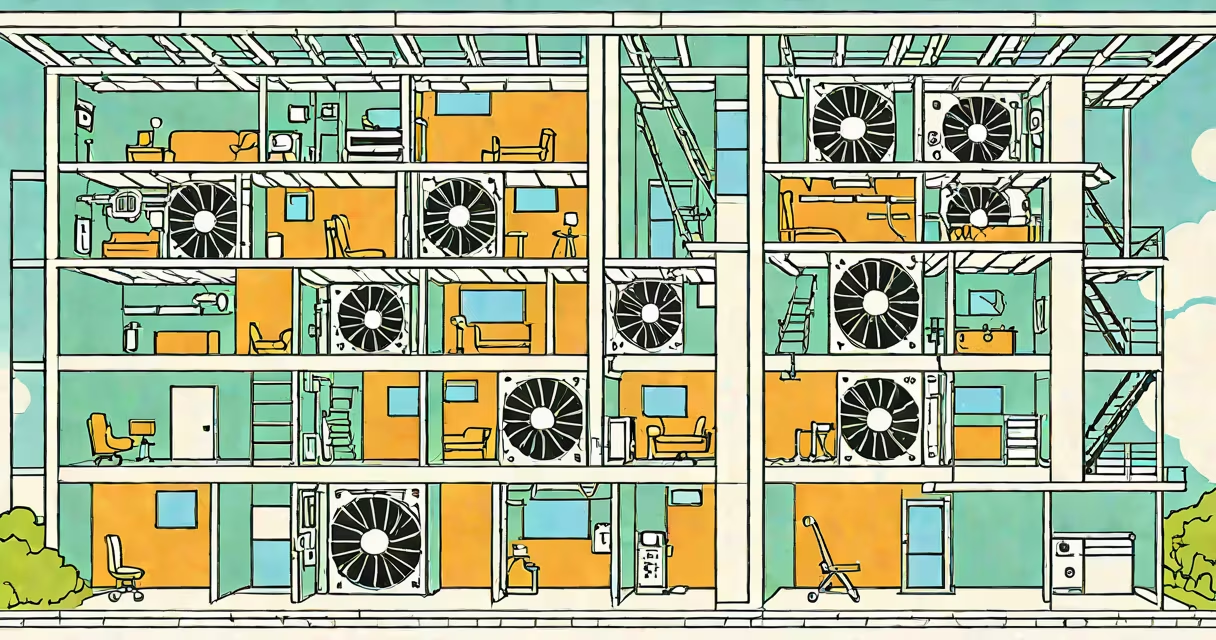
Ventilation is the process of exchanging indoor air with outdoor air to remove pollutants, control humidity, and maintain breathable conditions. It prevents buildup of carbon dioxide, moisture, and airborne contaminants that degrade air quality and health.
Proper ventilation helps occupants receive enough oxygen and that indoor air doesn't stagnate. It's essential in homes, offices, schools, and industrial spaces where people spend extended time indoors. Without it, air becomes heavy with odors, mold spores, and volatile organic compounds (VOCs) from cleaning products, furniture, and cooking.
The U.S. Environmental Protection Agency (EPA) states that indoor air can be two to five times more polluted than outdoor air, making ventilation critical for reducing respiratory risks and improving concentration and comfort. The American Society of Heating, Refrigerating and Air-Conditioning Engineers (ASHRAE) recommends a minimum of 15 cubic feet per minute (cfm) of outdoor air per person in occupied spaces.
Ventilation operates through two primary mechanisms: natural and mechanical. Natural ventilation relies on openings such as windows, doors, and vents to allow air to flow based on temperature differences and wind pressure. Mechanical ventilation uses fans, ducts, and HVAC systems to actively move air in and out.
Natural ventilation works best in moderate climates with consistent outdoor temperatures. For example, opening a window during morning hours can reduce indoor CO₂ levels by 30% within 15 minutes, according to a 2021 study published in *Indoor Air*. However, it's unreliable in extreme weather or high-pollution areas.
Mechanical systems offer precise control. A kitchen exhaust fan pulls smoke and grease-laden air out, while a heat recovery ventilator (HRV) exchanges stale indoor air with fresh outdoor air while retaining most of the heating or cooling energy. These systems meet ASHRAE Standard 62.1, which sets performance criteria for acceptable indoor air quality.
There are three main types: dilution, demand-controlled, and balanced. Each serves different needs based on occupancy, climate, and building design.
| Type | How It Works | Best For | Energy Impact |
|---|---|---|---|
| Dilution | Constant exchange of indoor and outdoor air regardless of occupancy. | Simple homes, low-use spaces. | High - wastes conditioning energy. |
| Demand-Controlled | Adjusts airflow based on sensors detecting CO₂ or humidity levels. | Offices, classrooms, meeting rooms. | Medium - reduces waste during low occupancy. |
| Balanced (with heat recovery) | Exhausts stale air and intakes fresh air simultaneously, using a heat exchanger to preserve thermal energy. | Climate-controlled buildings, energy-efficient homes. | Low - maintains comfort while saving energy. |
For example, a school in Portland, Oregon, installed demand-controlled ventilation in its classrooms. After one year, student attendance improved by 8%, and teacher-reported focus levels rose by 22%, according to a district audit. This shows that ventilation isn't just about air-it affects cognitive function.
Many assume that opening a window is sufficient ventilation. While it helps, it doesn't guarantee removal of fine particles or regulate humidity. In urban areas with high traffic emissions, outdoor air can be more polluted than indoor air, especially during rush hour.
Another mistake is equating ventilation with air conditioning. Cooling systems lower temperature but don't necessarily replace stale air. A room can feel cool yet have high CO₂ levels, leading to drowsiness and reduced mental performance. The National Institute of Standards and Technology (NIST) found that office workers in poorly ventilated rooms made 15% more errors on cognitive tasks than those in well-ventilated ones.
Some believe that air purifiers replace the need for ventilation. They filter particles but do not remove gases like radon, formaldehyde, or excess moisture. The EPA warns that relying solely on purifiers can trap pollutants indoors, worsening long-term exposure.
In winter, a family in Minneapolis sealed their home tightly for energy efficiency. Over three months, they noticed persistent headaches and dry skin. Indoor CO₂ levels peaked at 2,500 parts per million (ppm)-well above the recommended 1,000 ppm. Their HVAC system ran constantly, but no fresh air entered.
They installed a balanced ventilation system with an HRV. Within a week, CO₂ dropped to 800 ppm. Headaches resolved, and their energy bills stayed stable due to heat recovery. The system used 120 watts-about the same as a small light bulb-but improved air quality.
This case illustrates that ventilation isn't optional. It's a core part of healthy building design. Even in cold climates, fresh air intake is necessary.
Health impacts are measurable. The World Health Organization (WHO) links poor ventilation to increased risk of asthma, infections, and cardiovascular strain. In homes with gas stoves, inadequate ventilation raises nitrogen dioxide (NO₂) levels, which can trigger bronchitis in children.
Buildings also face compliance requirements. The International Residential Code (IRC) mandates minimum ventilation rates based on room size and use. A bathroom must have 50 cfm of exhaust capacity; a kitchen requires 100 cfm. Failure to meet these standards can result in failed inspections or insurance issues.
During the pandemic, ventilation became a key factor in reducing airborne transmission of viruses. Research from Harvard University showed that classrooms with higher ventilation rates had 40% fewer cases of illness among students. That's not just theory-it's evidence-based policy.
Understanding the meaning of ventilation goes beyond defining it. It's about recognizing that air movement is a form of infrastructure. Just as plumbing delivers clean water, ventilation delivers clean air. One supports life; the other sustains it.