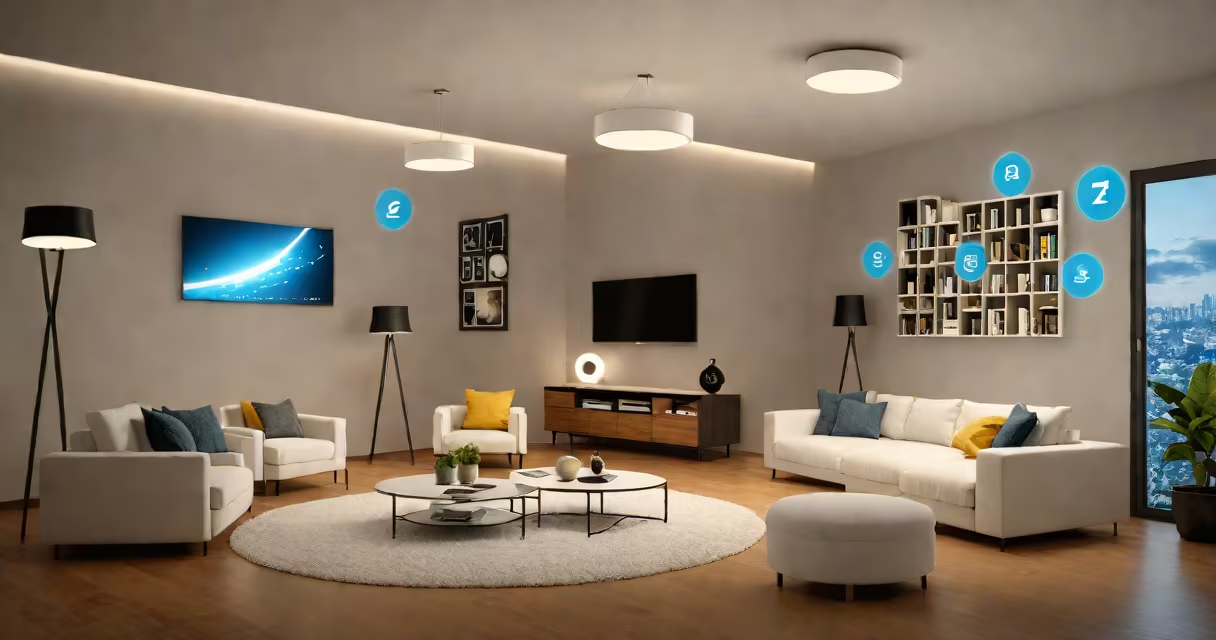
Z-Wave technology is a wireless communication protocol designed for home automation, enabling low-power, long-range control of smart devices like lights, thermostats, door locks, and sensors through a centralized hub.
It operates on a dedicated 908.42 MHz frequency band in the U.S. and 868.42 MHz in Europe, avoiding interference with Wi-Fi and Bluetooth. Devices communicate using a mesh network topology, where each device can relay signals to extend coverage across large homes.
Developed by Silicon Labs (formerly Zensys), Z-Wave supports encryption and authentication to prevent unauthorized access. The protocol is optimized for battery-powered devices, allowing sensors to run for years on a single coin cell battery.
Z-Wave uses a proprietary radio protocol operating at 908.42 MHz in North America and 868.42 MHz in Europe. These frequencies are less crowded than 2.4 GHz bands used by Wi-Fi and Bluetooth, reducing interference and improving reliability in dense environments.
Each Z-Wave device acts as a node in a mesh network. When a command is sent-like turning off a light-the message travels through intermediate devices (e.g., a smart plug or sensor) to reach the destination. This multi-hop routing increases range and resilience; if one path fails, the network reroutes automatically.
A central controller-typically a hub or gateway-manages all devices. Users send commands via smartphone apps, voice assistants, or wall panels. The hub translates inputs into Z-Wave signals and coordinates responses across the network.
Multiple versions of Z-Wave have been released since 2001, each improving speed, range, and security. The current standard is Z-Wave Long Range (LR), introduced in 2020, which extends range to 100 meters indoors and 300 meters outdoors.
| Version | Frequency | Range | Max Data Rate | Security |
|---|---|---|---|---|
| Z-Wave 500 Series | 908.42 MHz (US) | Up to 30 meters | 40 kbps | 128-bit AES encryption |
| Z-Wave Plus (v2) | 908.42 MHz | Up to 50 meters | 100 kbps | Enhanced AES-128 |
| Z-Wave Long Range (v3) | 908.42 MHz | Up to 100 meters indoors | 100 kbps | End-to-end encryption |
Devices labeled "Z-Wave Plus" meet enhanced performance standards, including improved battery life and faster response times. All certified devices must pass interoperability testing through the Z-Wave Alliance, ensuring compatibility across brands.
Z-Wave is widely used in residential automation systems. A typical deployment includes a Z-Wave hub (such as the Samsung SmartThings Hub or Aeotec Z-Stick), paired with devices like motion sensors, door/window contacts, smart plugs, and dimmable lighting.
For example, a homeowner installs a Z-Wave motion sensor in a hallway. When movement is detected at night, the sensor sends a signal to the hub. The hub triggers a Z-Wave-enabled smart bulb to turn on at 30% brightness. After five minutes of inactivity, the bulb turns off automatically. All communication happens securely over the mesh network without relying on internet connectivity.
Another example: a Z-Wave-enabled thermostat adjusts temperature based on occupancy data from a Z-Wave door sensor. If the front door opens during winter, the system detects the drop in indoor temperature and activates heating before the user enters.
Z-Wave is often mistaken for Zigbee, another wireless protocol used in smart homes. Both support mesh networking and low power consumption, but they operate on different frequencies and are incompatible without a dual-protocol hub.
Zigbee runs on 2.4 GHz globally, while Z-Wave uses sub-GHz bands. This difference affects range and penetration through walls. Z-Wave typically offers better wall penetration and longer range in large homes, especially when using Z-Wave Long Range devices.
Unlike Wi-Fi, Z-Wave does not require a direct connection to the internet. Many Z-Wave devices function locally even when the internet is down. This makes them more resilient during outages compared to cloud-dependent systems.
One overlooked detail: Z-Wave devices do not share a common Wi-Fi network. They form their own private mesh network. This isolation reduces exposure to cyber threats targeting home Wi-Fi networks.
Another key point: Z-Wave devices can be added or removed without reconfiguring the entire system. During pairing, the hub discovers devices and assigns unique IDs. Replacing a faulty sensor only requires removing the old device from the network and adding the new one-no need to reset the whole system.
I once replaced a Z-Wave door sensor in a 1920s Victorian house with thick brick walls. The original sensor had poor range due to distance from the hub. After installing a Z-Wave repeater near the front door, signal strength improved dramatically. The new sensor responded instantly-even when the front door was closed.
According to the Z-Wave Alliance, over 1,500 certified products from 300+ manufacturers are available worldwide. Devices must pass strict certification tests for interoperability, security, and performance before receiving the Z-Wave logo.
All Z-Wave devices use 128-bit AES encryption for data transmission. Commands are authenticated using a shared key established during initial pairing. This prevents eavesdropping and replay attacks.
The protocol also supports Secure Key Exchange (SKE), which allows devices to securely exchange keys without exposing them to the network. This feature is critical for protecting sensitive operations like unlocking doors or arming alarms.
As of 2023, Z-Wave has implemented end-to-end encryption for all traffic between devices and the hub. This helps even if a signal is intercepted, the content remains unreadable.
For context, the Federal Communications Commission (FCC) regulates Z-Wave's frequency usage in the U.S., and the European Telecommunications Standards Institute (ETSI) governs its use in Europe. Compliance ensures devices operate legally and safely.
Z-Wave technology provides a reliable, secure way to connect and control smart home devices. Its mesh network design, low power consumption, and strong encryption make it ideal for applications requiring consistent performance and privacy. With thousands of certified devices and ongoing improvements like Z-Wave Long Range, it remains a leading choice for home automation.