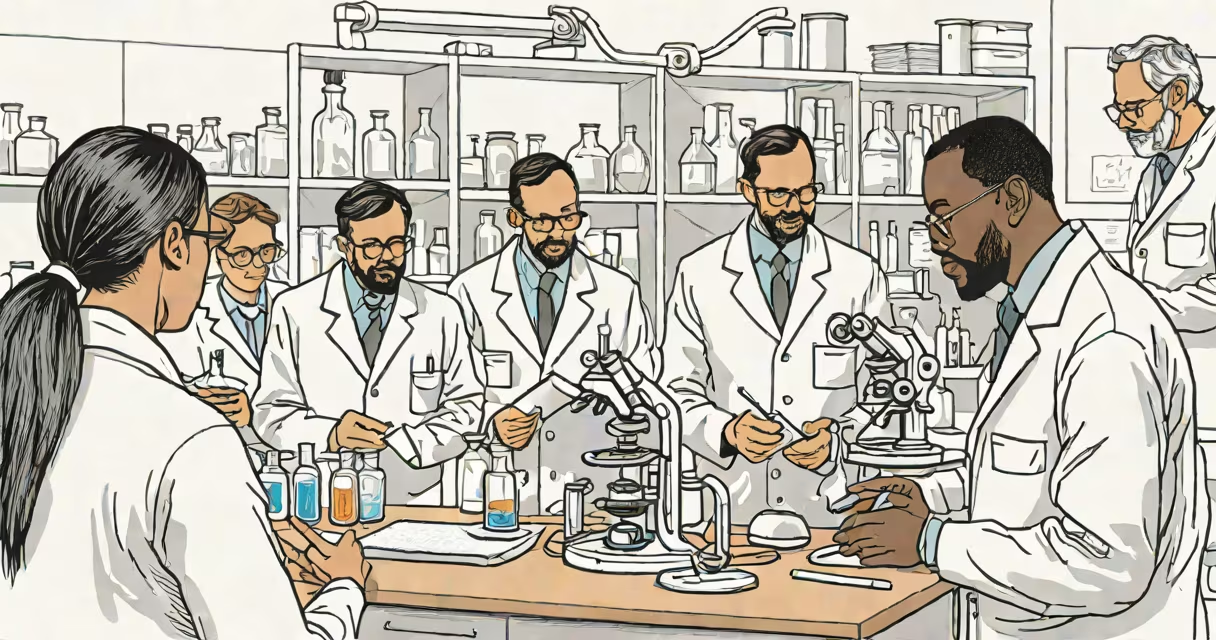
A scientist is someone who uses systematic observation, experimentation, and evidence-based reasoning to understand natural phenomena. This definition holds regardless of formal education, job title, or workplace setting.
Scientific work begins with a question about how the world operates. A biologist might ask, "How do migratory birds go through across continents?" An astrophysicist might wonder, "Why does dark energy appear to accelerate the universe's expansion?" The process involves forming testable hypotheses, collecting measurable data, and revising conclusions based on results.
The core of science lies in reproducibility. If another researcher cannot replicate your findings under the same conditions, the result is not accepted as valid. This principle separates science from opinion, belief, or anecdote. For example, in 2011, a team at CERN reported neutrinos traveling faster than light-initially suggesting a violation of Einstein's relativity. But after multiple independent replications failed, the original result was traced to a loose cable. Science corrected itself through verification.
Science is not a single method but a structure for inquiry. It relies on falsifiability: a claim must be capable of being proven false. If a hypothesis cannot be tested or contradicted, it falls outside science. This is why statements like "God exists" or "The universe is conscious" are not scientific-they lack testable predictions.
Every scientific investigation follows steps: observe, hypothesize, predict, test, analyze, conclude. These steps aren't always linear. Researchers often loop back-revising hypotheses after new data emerges. In 1996, the discovery of a fossilized feathered dinosaur in China challenged long-held views that birds evolved from small theropods. Subsequent fossil finds confirmed the link, reshaping evolutionary biology.
Peer review is the gatekeeper. Before publication, studies undergo scrutiny by experts in the field. A 2020 study in *Nature* found that 80% of published neuroscience papers failed replication attempts when retested under identical conditions. This led to reforms in how journals assess statistical rigor and transparency. Peer review doesn't guarantee truth-but it reduces error and bias.
Scientists are not defined by their degrees, but by their habits. They prioritize data over intuition. They accept uncertainty. They revise beliefs when evidence demands it. A physicist may spend years refining a model of quantum gravity. A climate scientist may spend decades analyzing ice cores to reconstruct past temperatures.
There are three primary types of scientific roles:
| Type | Description | Example |
|---|---|---|
| Experimental | Designs and runs controlled tests to validate or reject hypotheses. | Testing drug efficacy in mice before human trials. |
| Theoretical | Develops mathematical models or simulations to explain phenomena. | Using equations to predict black hole behavior. |
| Observational | Collects data from nature without intervention. | Tracking whale migration via satellite tags. |
Each role contributes to cumulative knowledge. No single scientist holds all answers. Progress happens through collaboration across disciplines.
Science informs policy, medicine, engineering, and daily decisions. When a pandemic hits, epidemiologists model transmission rates to guide lockdowns. When a bridge collapses, structural engineers analyze material fatigue to prevent future failures. Even weather forecasts rely on atmospheric models developed by meteorologists.
Public trust in science hinges on transparency. The 1998 paper falsely linking vaccines to autism was retracted after the lead author admitted to fabricating data. The fallout delayed immunization programs and increased disease outbreaks. This case shows that science requires accountability-not just expertise.
Science is not neutral. It reflects societal values. In the 1970s, researchers studying intelligence differences between racial groups misused statistics to support eugenics. Modern standards require ethical review boards to approve studies involving human subjects. Today, journals demand conflict-of-interest disclosures and data sharing.
Many people equate "scientist" with "doctor." Not all doctors are scientists. Physicians diagnose and treat patients using clinical guidelines, not experimental validation. A neurosurgeon may perform brain surgery based on decades of medical research-but they don't design experiments to test surgical tools.
Another misconception: science is only about facts. It's not. Science deals in probabilities and confidence levels. Climate models don't predict exact future temperatures-they estimate ranges based on emissions scenarios. The Intergovernmental Panel on Climate Change (IPCC) reports state that global warming is "unequivocal" with 95% certainty, based on physical evidence from 12,000 studies.
Here's a non-obvious distinction: not all research is scientific. A study claiming "yoga cures depression" lacks control groups, blinding, or statistical power. Without these, it's descriptive, not scientific. True science requires controls-like comparing yoga participants to a group doing nothing or a placebo activity.
In 2012, Jennifer Doudna and Emmanuelle Charpentier published a paper showing how CRISPR-Cas9 could edit DNA with precision. Their experiment involved designing RNA sequences to target specific genes in bacteria. They then applied the system to human cells and observed successful edits.
They didn't claim to have cured cancer. They reported a tool. Other labs replicated the method within months. Within five years, CRISPR was used to treat sickle cell anemia in clinical trials. The key was not the initial discovery-but the ability to reproduce, refine, and apply the technique across fields.
This illustrates what makes you a scientist: not fame, not awards, but the consistent application of evidence-based methods. Doudna didn't become a scientist because she won a Nobel Prize. She became one because she asked a question, designed an experiment, collected data, and shared results openly.
I once watched a high school student conduct a soil pH experiment using household vinegar and baking soda. She measured pH changes in four soil samples, recorded data daily for two weeks, and presented her findings at a regional science fair. Her project wasn't published in a journal. But she followed the scientific method: formulating a hypothesis, testing variables, analyzing results. That's what made her a scientist-even without a degree.
What makes you a scientist is not a title, a lab coat, or a PhD. It's the commitment to evidence, reproducibility, and revision. Anyone who asks questions, collects data, and adjusts beliefs based on results is part of science. The practice matters more than the label.
Understanding this shifts how we engage with science-from passive acceptance to active participation. reading a study, ask: Can this be tested? Is the evidence clear? Has it been replicated? These are the hallmarks of scientific thinking-and they define who truly counts as a scientist.