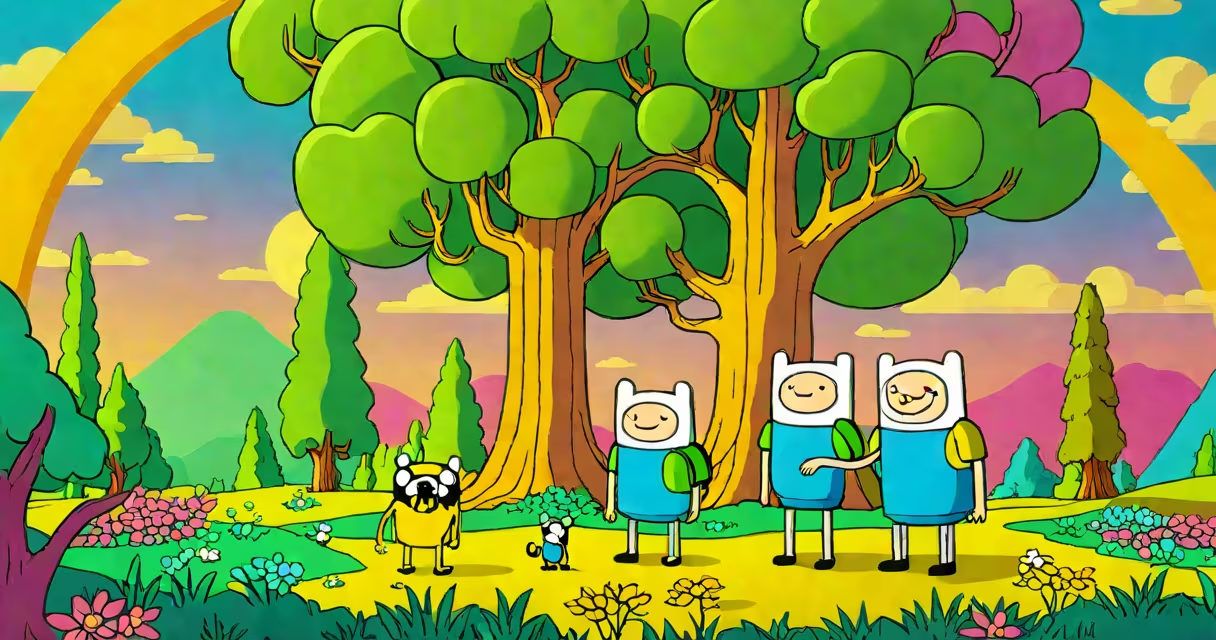
Adventure Time S1 Ep 1, titled "The Night King," premiered on April 13, 2010, introducing Finn the Human and his talking dog Jake in the fantastical area of Ooo. This episode establishes the show's core tone: surreal, emotionally resonant, and rooted in childlike wonder.
The episode opens with Finn waking up in a treehouse, a structure suspended among floating islands and glowing flora. He greets Jake, who stretches with cartoonish exaggeration. Their morning routine-eating pancakes, playing video games, and discussing dreams-feels ordinary until the sky turns black and a shadowy figure descends. The Night King, a silent, towering entity made of darkness, appears and begins to absorb light and color from the environment. Finn and Jake confront him not with violence, but through shared imagination and emotional connection.
What makes this episode foundational is its narrative restraint. There's no villain monologue, no grand battle. Instead, Finn uses storytelling-a tale about a boy who defeats a monster by naming it-to weaken the Night King. When Finn says, "I'm afraid of you," the creature dissolves into mist. The resolution hinges on empathy, not force. This theme recurs throughout the series, shaping Adventure Time's identity as a show that values emotional honesty over spectacle.
"The Night King" functions as a metaphor for childhood anxiety. The sudden darkness represents fear of the unknown, while the resolution through storytelling mirrors how children process fear by reframing it. The episode avoids exposition; viewers learn about Ooo's rules through visual cues-the floating continents, sentient trees, and anthropomorphic animals.
Finn's design reflects early 2000s cartoon minimalism: large eyes, oversized limbs, and a red cap. His dialogue is sparse, often punctuated by silence. Jake, in contrast, speaks in slang, uses sarcasm, and moves with exaggerated physicality. Their changing is central: Finn is impulsive and idealistic; Jake is laid-back and wise in a self-deprecating way. Together, they embody the show's dual focus-adventure and emotional growth.
A key detail often missed: the Night King is never shown with a face. His form shifts, but he remains featureless. This absence reinforces the idea that fear loses power when given a name. The episode ends with Finn sleeping peacefully, Jake guarding the door. No victory music. No celebration. Just quiet safety.
Adventure Time S1 Ep 1 was animated using traditional hand-drawn techniques, with limited animation frames. The art style blends 1950s Americana with psychedelic surrealism. Backgrounds feature repeating patterns-stripes, polka dots, spirals-creating a sense of instability. Colors shift rapidly: warm yellows give way to cold blues during the Night King's arrival.
Sound design plays a important role. The episode uses diegetic music-Finn and Jake play a record on a turntable. The song, "The Night King," is a distorted lullaby sung in reverse. When the Night King appears, the music stops abruptly. Silence becomes a character. The lack of score during the confrontation heightens tension.
According to the NPR, the episode's success lies in its ability to balance absurdity with sincerity. "It treats a child's fear as real, not silly," wrote critic Ann Powers. "That's rare in animation."
This episode launched a series that became a touchstone for adult-oriented cartoons. It aired on Cartoon Network's nighttime programming block, Adult Swim, which allowed creators greater creative freedom. Unlike most kids' shows, Adventure Time didn't shy away from grief, loneliness, or moral ambiguity.
"The Night King" introduced recurring motifs: the Tree Fort, the Candy Kingdom, the Ice Kingdom. These locations were not just settings-they were emotional states. The Tree Fort symbolizes safety and home. The Night King represents internalized dread. Later episodes revisit these ideas with deeper complexity.
By 2015, Adventure Time had won two Annie Awards for Best Animated Television Production. The show's influence extended beyond television: it inspired fan art, cosplay, and even academic papers on narrative structure in animated media. A 2018 study published in Animation Studies noted that "The Night King" exemplifies the "emotional logic" of modern cartoon storytelling-where plot serves feeling, not the other way around.
Many assume Adventure Time S1 Ep 1 is a direct parody of classic fantasy tropes. It is not. While it borrows elements-talking animals, magical realms-it subverts expectations. The Night King isn't defeated by a sword or spell. He's undone by a story. This is not satire; it's sincerity.
Another myth: Finn and Jake are based on creator Pendleton Ward's childhood pets. Ward confirmed in a 2012 interview with Vulture that Finn was inspired by Ward's own childhood curiosity, while Jake emerged from a sketch of a dog wearing a hat. "Jake wasn't a pet. He was a friend," Ward said.
Some viewers think the episode is a standalone. It isn't. The Night King returns in later seasons, evolving into a symbolic figure tied to Finn's personal growth. In Season 6, Finn confronts a version of himself as the Night King-an act of self-forgiveness. The original episode sets up this arc.
Adventure Time episodes fall into three categories: standalone adventures, serialized arcs, and thematic explorations. "The Night King" belongs to the third category-episodes that explore emotional themes rather than plot progression.
| Type | Example | Focus |
|---|---|---|
| Standalone | "Dentist" (S1E3) | Self-contained story with clear beginning and end |
| Serialized | "The Lich" (S3E12) | Continues larger narrative threads |
| Thematic | "The Night King" (S1E1) | Explores fear, memory, and connection |
"The Night King" is a thematic episode. It doesn't advance the plot of the Candy Kingdom or the Ice Kingdom. Instead, it defines the show's emotional language. It teaches viewers that stories can heal. That silence can be useful. That a dog in a hat can be a hero.
Finn wakes up to find the sky dark. Jake suggests they go to the library to find answers. They walk through a forest where trees hum and flowers glow. As they near the treehouse, the ground cracks. The Night King rises from beneath the earth, a silhouette taller than the tallest tree.
Finn stands in front of him. He says nothing. Then he begins to tell a story: "Once, there was a boy who lived in a house made of stars. He was afraid of the dark. So he made up a monster. And then he gave it a name..."
As Finn speaks, the Night King trembles. The air vibrates. The color drains from the sky. When Finn finishes, saying, "And the monster disappeared," the Night King dissolves into smoke. The sun returns. Birds sing. Jake says, "Wow. You just beat a ghost with a bedtime story."
Finn replies, "Yeah. I guess stories are stronger than monsters."
This moment is not dramatic. It's quiet. It's real. It's why the episode endures.
I watched this episode in 2011, sitting on my dorm room floor with a laptop and headphones. I didn't understand the symbolism then. But I felt something. A warmth. A sense of being seen. That's the power of adventure time s1 ep 1-not as entertainment, but as emotional architecture.
For more on the characters, see Jake from Adventure Time. To watch the full series, visit this guide.