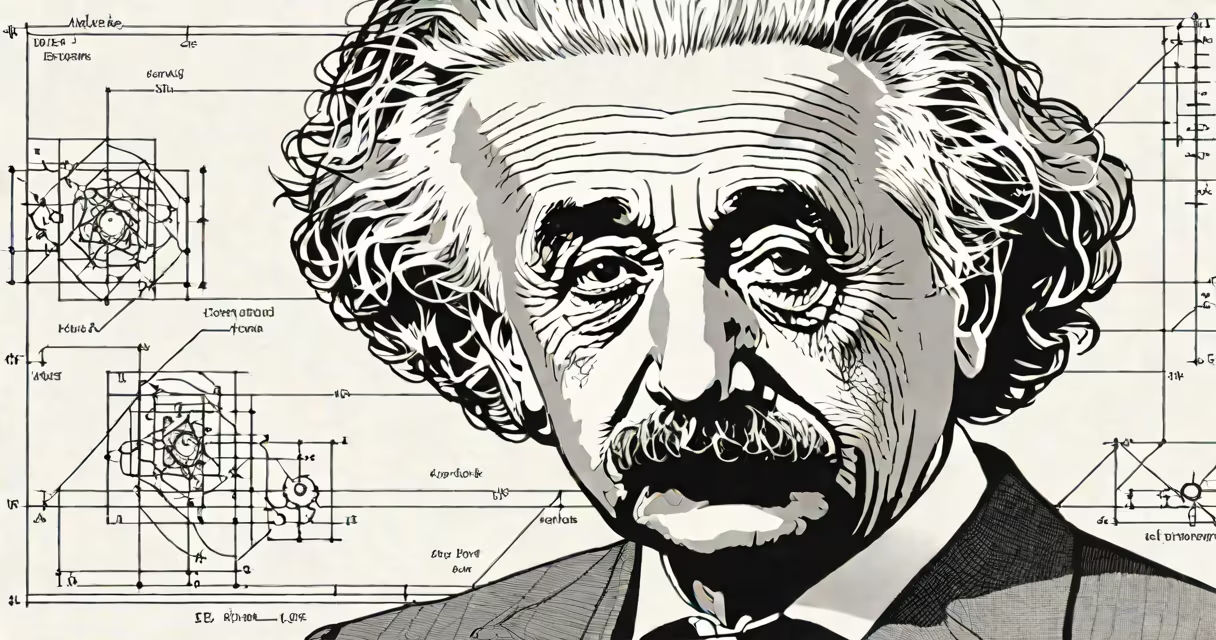
Albert Einstein steckbrief is a concise summary of the life, work, and impact of the theoretical physicist who developed the theory of relativity and reshaped modern physics. His contributions spanned quantum mechanics, cosmology, and atomic energy, making him one of the most influential scientists of the 20th century.
Einstein's career began in 1905, known as his annus mirabilis, when he published four new papers while working as a patent clerk in Bern, Switzerland. These included the photoelectric effect, Brownian motion, special relativity, and the equivalence of mass and energy (E=mc²). The last equation became a global symbol of scientific insight, appearing in textbooks, films, and public discourse.
His 1915 general theory of relativity redefined gravity as the curvature of spacetime caused by mass and energy. This model predicted phenomena such as gravitational lensing and black holes-later confirmed through astronomical observations. The 1919 solar eclipse expedition led by Arthur Eddington verified light bending near massive objects, turning Einstein into a worldwide celebrity.
Einstein's work extended beyond relativity. He co-authored the Bose-Einstein statistics with Indian physicist Satyendra Nath Bose, which described the behavior of particles now called bosons. His 1924 paper laid the foundation for the Bose-Einstein condensate-a state of matter observed experimentally in 1995.
He also played a role in nuclear science. In 1939, he signed a letter to President Franklin D. Roosevelt warning of Nazi Germany's potential development of atomic weapons. This letter contributed to the initiation of the Manhattan Project, though Einstein later regretted his involvement and advocated for nuclear disarmament.
Despite his fame, Einstein remained deeply skeptical of quantum mechanics' probabilistic nature. He famously said, "God does not play dice," rejecting the idea that randomness governs subatomic events. His debates with Niels Bohr highlighted fundamental philosophical divides in physics that persist today.
Einstein was born in Ulm, Germany, in 1879. He moved to Switzerland in 1895 and later became a Swiss citizen. In 1901, he naturalized as a Swiss citizen, though he never renounced his German roots. He left Germany in 1933 due to rising anti-Semitism under the Nazi regime and emigrated to the United States, eventually becoming a U.S. citizen in 1940.
He lived in Princeton, New Jersey, at the Institute for Advanced Study, where he continued research until his death in 1955. His personal life included two marriages: first to Mileva Marić, a fellow physicist, with whom he had two sons; and later to Elsa Einstein, his cousin. Their relationship was both personal and professional, with Elsa managing much of his correspondence and public appearances.
After his death, Einstein's brain was preserved and studied. Research showed no structural differences compared to average brains, challenging myths about genius being linked to unique anatomy. His skull remains a subject of scientific interest, though ethical concerns have limited further study.
Many assume Einstein failed math in school. This is false. He excelled in mathematics and physics early on. His academic record shows strong performance in advanced calculus and electromagnetism. The myth likely stems from confusion between his early education in Munich and his later struggles with formal schooling systems.
Another misconception is that Einstein was a poor student. He graduated from the Eidgenössische Technische Hochschule (ETH Zurich) with high honors in 1900. His difficulty finding academic positions after graduation stemmed from lack of connections, not poor grades. He secured a job at the Swiss Patent Office because of his technical training and analytical skills.
A lesser-known fact: Einstein's 1905 paper on Brownian motion provided the first empirical evidence for atoms. Before then, atomic theory was debated. His mathematical model of particle movement in fluids matched experimental data, helping settle the debate. This work earned him recognition from the scientific community long before relativity.
| Year | Event | Impact |
|---|---|---|
| 1905 | Publishes four seminal papers | Lays groundwork for quantum theory and relativity |
| 1915 | Presents general relativity | Replaces Newtonian gravity with spacetime geometry |
| 1921 | Wins Nobel Prize in Physics | For photoelectric effect, not relativity |
| 1939 | Signs letter to Roosevelt | Helps initiate U.S. atomic bomb program |
| 1955 | Dies in Princeton | Legacy cemented in science and culture |
I once visited the Einstein House in Bern, where he lived during his annus mirabilis. The small apartment, now a museum, contains original notebooks and letters. Standing in the room where he wrote E=mc², I felt the weight of ideas that changed how humanity sees time, space, and energy.
His influence extends beyond science. Einstein's views on peace, civil rights, and education shaped public discourse. He supported the NAACP and spoke out against racial segregation in the U.S. He believed science should serve humanity, not war.
Albert Einstein steckbrief captures a life of relentless questioning, intellectual courage, and moral responsibility. His legacy is not just in equations but in the way he modeled how to think-deeply, independently, and with humility.