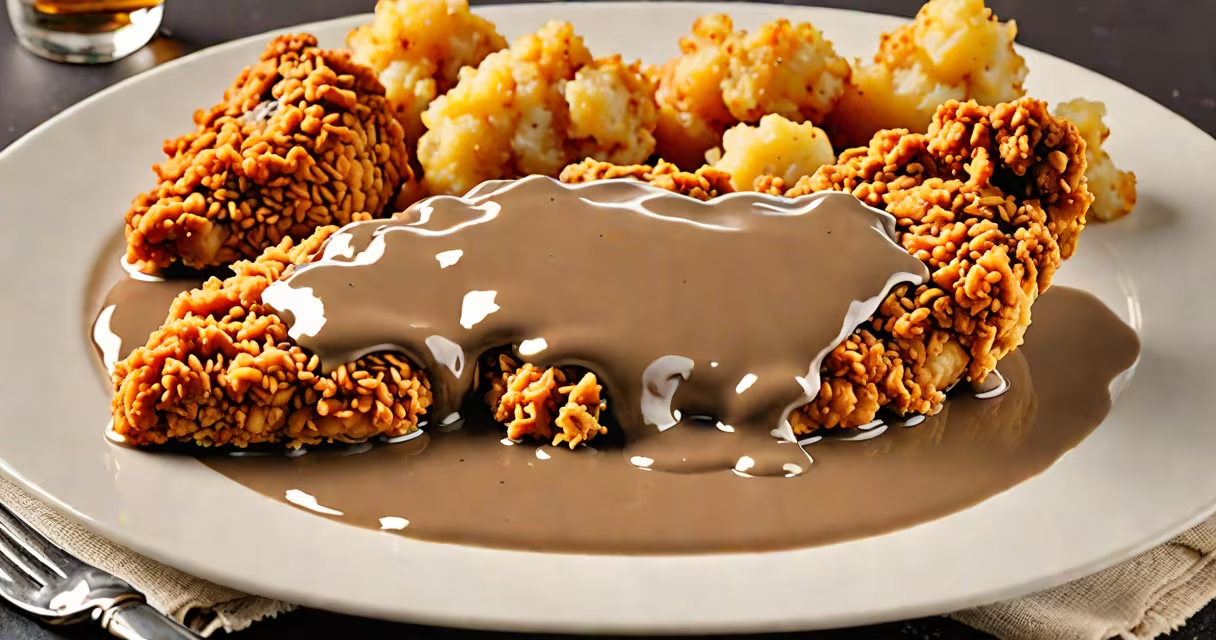
Chicken fried chicken with country gravy is a Southern American dish consisting of a breaded and pan-fried chicken cutlet served with a thick, savory gravy made from pan drippings, flour, milk, and seasonings. It's a high-fat, high-calorie meal rooted in rural cooking traditions and often associated with Sunday dinners and family gatherings.
The dish originated in the American South during the 19th century, evolving from German and Central European fried chicken styles brought by immigrants. It differs from standard fried chicken by using a thicker breading and a specific method of frying in a cast iron skillet. The name "chicken fried" refers to the cooking technique, not the bird's species.
Country gravy is distinct from other gravies due to its base of pan drippings and milk rather than stock. It's typically seasoned with black pepper, salt, and sometimes a touch of onion powder. The gravy thickens through a roux made from rendered fat and flour, then is diluted with warm milk until it reaches a pourable consistency.
Chicken fried chicken begins with a boneless, skinless chicken breast pounded thin to about ½ inch. The meat is dredged in flour, dipped in beaten eggs, then coated in seasoned breadcrumbs or cornmeal. It's fried in hot oil or lard in a heavy skillet until golden brown and cooked through-usually 3 to 4 minutes per side.
After removing the chicken, the skillet is drained of excess fat, leaving behind the flavorful drippings. A roux is formed by stirring in flour and cooking it briefly over medium heat. Warm milk is slowly added while whisking continuously to prevent lumps. Seasonings-typically salt, black pepper, and sometimes garlic powder-are stirred in. The mixture simmers for 2 to 3 minutes until thickened.
The finished gravy is poured over the hot chicken, which absorbs some of the richness. The contrast between the crisp exterior of the chicken and the soft, creamy gravy creates a balanced mouthfeel. The dish is traditionally served with mashed potatoes, biscuits, or collard greens.
Core ingredients include boneless chicken breasts, all-purpose flour, eggs, breadcrumbs or cornmeal, lard or vegetable oil, milk, salt, and black pepper. Some cooks use buttermilk for the egg wash to add tang and tenderize the meat further.
Regional variations exist. In parts of Texas and Louisiana, cooks may add a pinch of cayenne or smoked paprika to the breading. In the Carolinas, some use a mix of cornmeal and flour for the coating. The gravy may include a small amount of chopped onion sautéed in the drippings before adding flour.
| Dish Component | Typical Ingredients | Key Difference from Standard Fried Chicken |
|---|---|---|
| Breading | Flour, eggs, breadcrumbs or cornmeal | Thicker, more textured coating; often includes cornmeal in Southern versions |
| Frying Medium | Lard or vegetable oil | Lard adds richer flavor; preferred in traditional recipes |
| Gravy Base | Pan drippings, flour, milk | No broth used; relies on fat and dairy for body and flavor |
| Seasoning | Salt, black pepper, optional garlic or onion powder | Minimal herbs; focus on simplicity and depth |
Chicken fried chicken with country gravy remains a staple in Southern U.S. households, especially in rural areas and among older generations. It's frequently served at family reunions, church potlucks, and regional festivals such as the Tennessee State Fair and the North Carolina State Fair.
The dish reflects a history of resourcefulness. In the early 20th century, families used leftover chicken or inexpensive cuts, breading them to stretch meals. Lard was widely available and cheaper than butter or vegetable oil. Milk was common in home pantries, making the gravy easy to prepare.
Today, it appears on menus at classic Southern diners like Denny's (which markets it as "Country Fried Chicken") and local roadside eateries such as The Blue Plate in Nashville. These restaurants often serve it with a side of sweet tea and a slice of banana pudding.
Many people mistake chicken fried chicken for "chicken-fried steak," which uses beef instead. While both are breaded and pan-fried, the meat type defines the dish. Chicken-fried steak is a Texan variant, often served with red-eye gravy-a coffee-based sauce-rather than country gravy.
Another frequent error is confusing country gravy with white sauce or béchamel. Country gravy contains no cheese, and its thickness comes from a roux, not cream. Béchamel is made with butter and flour, then enriched with milk-but lacks the savory depth of pan drippings.
A lesser-known fact: country gravy is often made with whole milk, not skim. The fat content contributes to the gravy's richness and prevents separation. According to the USDA, whole milk contains 3.25% fat, which helps stabilize the emulsion. Skim milk produces a thinner, less cohesive result.
I once prepared this dish at a family reunion in Mississippi. My grandmother insisted on using lard from a pig she'd raised herself. The resulting gravy had a deep, nutty aroma and clung perfectly to the chicken. When served over mashed potatoes, it created a satisfying, warming meal that lasted through the evening.
For those interested in dietary balance, chicken is not alkaline-its pH is around 5.5 to 6.0, placing it in the acidic range. This doesn't affect the taste or enjoyment of the meal, but it's relevant for those tracking acid-base balance in their diet.
Chicken fried chicken with country gravy is more than a meal-it's a cultural artifact. Its preparation method, ingredient choices, and serving context reveal centuries of adaptation, scarcity, and culinary pride. Understanding its roots enhances appreciation beyond the plate.