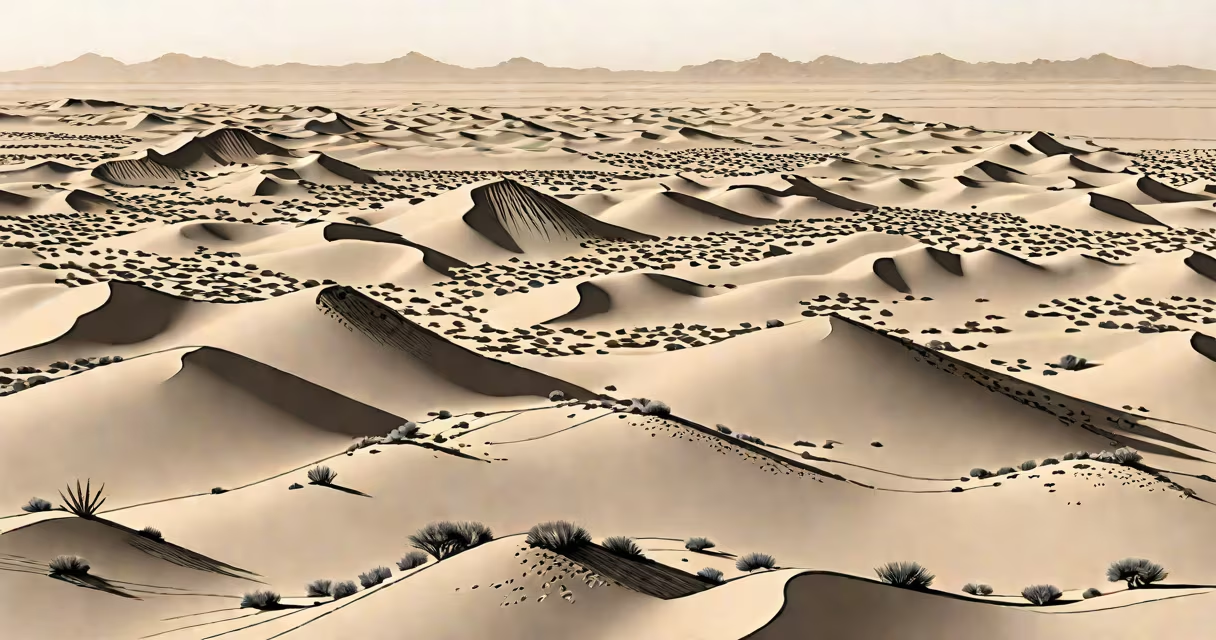
Desert biome characteristics define regions with less than 250 mm of annual rainfall, extreme temperature fluctuations, and ecosystems adapted to water scarcity. These areas cover about 33% of Earth's land surface and support life through specialized physiological and behavioral traits.
Deserts form primarily due to global atmospheric circulation patterns. The subtropical high-pressure zones, located around 30° north and south latitude, create dry conditions as air descends and warms, suppressing cloud formation. This results in minimal precipitation. For example, the Sahara Desert receives less than 25 mm of rain annually in many areas, while Death Valley in California averages 51 mm per year.
Despite their reputation for barrenness, deserts host diverse life forms. Plants such as cacti and succulents store water in thick stems and leaves. Animals like kangaroo rats and fennec foxes conserve water by producing highly concentrated urine and minimizing sweating. These adaptations allow survival in environments where water is scarce and temperatures exceed 45°C during the day and drop below freezing at night.
Water conservation is central to survival in desert biomes. Plants reduce transpiration through small or absent leaves, waxy cuticles, and CAM photosynthesis-where stomata open at night to minimize water loss. The saguaro cactus, native to the Sonoran Desert, can store up to 200 liters of water in its trunk during rare rain events.
Animals use behavioral strategies to avoid heat. Many species are nocturnal, becoming active after sunset when temperatures drop. The kit fox, found in North American deserts, hunts at night and rests in underground burrows during the day. Some reptiles, like the Gila monster, rely on thermal regulation by basking in the sun early in the morning and retreating to shaded crevices later.
Soil composition also influences desert ecology. Sandy or rocky soils drain quickly, preventing water retention. However, some desert regions have caliche layers-hardened calcium carbonate deposits-that restrict root penetration and limit plant growth. Despite this, certain plants like creosote bushes develop extensive shallow root systems to capture surface moisture.
Deserts fall into four main categories based on climate and geography:
| Type | Climate Pattern | Location Example | Key Adaptation |
|---|---|---|---|
| Hot and dry | High daytime temps, low humidity, minimal rain | Sahara, Arabian Desert | Deep taproots, reflective surfaces |
| Coastal | Marine influence reduces temperature extremes | Atacama Desert (Chile), Namib Desert (Namibia) | Adaptations to fog harvesting (e.g., lichens, beetles) |
| Temperate | Seasonal variation with cold winters | Great Basin Desert (USA), Patagonian Desert (Argentina) | Dormancy during winter, drought-resistant seeds |
| Cold | Low temperatures year-round, limited snowmelt | Gobi Desert (Mongolia/China), Antarctica's Dry Valleys | Insulating fur, metabolic slowdown |
The Atacama Desert, the driest non-polar region on Earth, receives less than 1 mm of rain per year in some areas. Yet life persists through fog-dependent species like the Atacama fog-basking beetle, which collects moisture from coastal fog using its body's hydrophilic surface.
Desert biome characteristics are often misunderstood as uniformly hot and barren. In reality, cold deserts exist and experience freezing temperatures. The Gobi Desert sees winter lows below -40°C. Similarly, not all deserts lack vegetation. The Chihuahuan Desert supports over 3,000 plant species, including yucca and agave.
A frequent error is equating desert with arid. While all deserts are arid, not all arid regions qualify as deserts. Arid zones may receive 250-500 mm of rain annually-enough for shrublands or grasslands. True deserts fall below 250 mm. The Mojave Desert averages 100 mm per year, qualifying it as a hot desert, whereas the Kalahari Desert-receiving 200-500 mm-falls into the semi-arid category.
Another confusion lies in assuming desert animals are inactive. Many are highly mobile. The sidewinder rattlesnake moves sideways to reduce contact with hot sand, using a unique locomotion method called lateral undulation. This adaptation allows efficient movement across shifting terrain.
The Sonoran Desert spans parts of Arizona, California, and northwestern Mexico. Annual rainfall ranges from 50 to 250 mm, depending on elevation. Temperature extremes reach 48°C in summer and occasionally dip below 0°C in winter.
Native plants include the saguaro cactus, which takes 70 years to reach maturity and can live over 150 years. Its ribs expand to store water after rare rains. Birds like the cactus wren build nests in the spiny branches for protection from predators and heat.
Human impact is significant. Urban expansion in Phoenix has altered natural drainage patterns, increasing flash flood risks. Conservation efforts focus on protecting native species like the desert tortoise, whose population declined by 90% between 1970 and 2000 due to habitat loss and disease.
One non-obvious fact: desert soils contain high levels of organic carbon despite low biomass. Microbial communities in desert soil remain metabolically active even during dry periods, cycling nutrients slowly. Research from the Nature Scientific Reports shows that microbial respiration continues at measurable rates below 10% soil moisture.
During fieldwork in southern Utah, I observed a single creosote bush surviving 18 months without rainfall. Its roots extended 3 meters deep, tapping into groundwater. This confirmed that long-term drought resistance is not just behavioral-it's structural and genetic.
Understanding desert biome characteristics reveals how life adapts to environmental stress. These systems are not empty wastelands but complex networks shaped by water scarcity, temperature extremes, and evolutionary innovation. Recognizing this helps distinguish true deserts from other arid zones and informs conservation priorities.