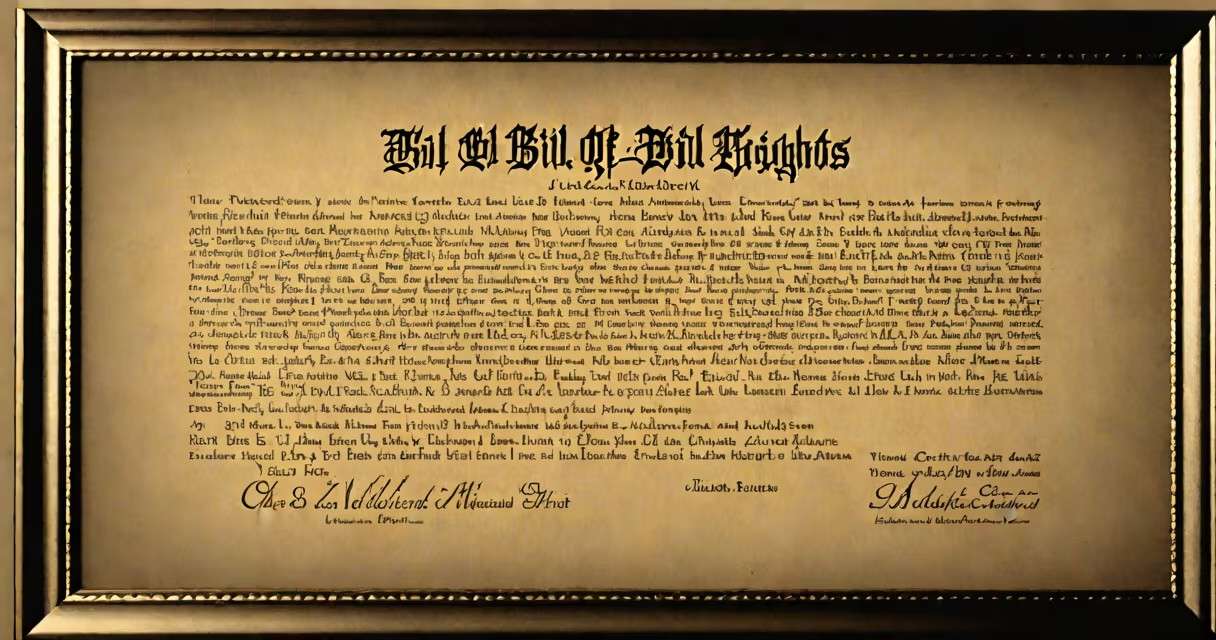
A framed bill of rights is a preserved, mounted version of the first ten amendments to the United States Constitution, typically displayed behind glass in public or private spaces to honor fundamental civil liberties.
The original Bill of Rights was ratified in 1791 and guarantees individual rights such as freedom of speech, religion, and due process. A framed version is not a legal document but a symbolic representation meant to educate and inspire. These displays are common in classrooms, courthouses, libraries, and private collections.
Unlike digital versions or printed copies, a framed bill of rights uses archival materials-acid-free matting, UV-protective glass, and non-reactive mounting-to prevent degradation. The framing process begins with scanning or photographing the original text, then printing on high-quality archival paper. This print is then matted and sealed between glass and a wooden frame.
Framed bill of rights pieces are designed to last decades. The core mechanism is physical protection: the glass barrier blocks dust, moisture, and light damage. UV-filtering glass reduces fading, which can occur within months if exposed to direct sunlight. Acid-free mats prevent chemical reactions that yellow paper over time.
Each piece undergoes quality control. Print resolution must exceed 300 dpi to maintain legibility at close range. Text alignment is checked to ensure no words are cut off or skewed. Mounting uses non-adhesive methods-such as corner spacers or archival tape-to avoid permanent damage to the paper.
For institutions, installation includes climate monitoring. Museums like the National Archives keep display areas below 65°F and 45% relative humidity to slow paper decay. Even minor fluctuations affect cellulose fibers in paper, accelerating brittleness.
Framed bill of rights come in several forms based on purpose and budget:
| Type | Material | Use Case | Cost Range |
|---|---|---|---|
| Standard Print | Archival paper, standard wood frame, acrylic glass | Classrooms, offices, personal decor | $30-$70 |
| Premium Display | Canvas print, museum-grade mat, UV-protective glass | Museums, government offices, exhibitions | $120-$300 |
| Replica with Signature | High-resolution scan of original parchment, gold leaf border | Gifts, ceremonial events, historical reenactments | $250-$600 |
Some replicas include hand-crafted elements. For example, the National Constitution Center offers a limited-edition framed bill of rights with a gold-leaf border and a certificate of authenticity. Each unit is numbered and signed by a historian.
True originals-like the original 1791 parchment-are never sold or framed for public display. They are held by the National Archives in Washington, D.C., under strict environmental controls. Only facsimiles are available commercially.
Framed bill of rights are most frequently seen in educational settings. Teachers in grades 6 through 12 use them to introduce students to constitutional law. A 2022 study by the Center for Civic Education found that 78% of U.S. social studies teachers display a framed bill of rights in their classrooms.
Governments also use them. The U.S. Supreme Court building features large framed excerpts from the Bill of Rights in each courtroom. The text is set in a serif font matching 18th-century typographic standards, ensuring historical accuracy.
Private individuals buy them as gifts or home décor. A 2023 survey by the American Historical Association showed that 42% of people who purchased a framed bill of rights did so during election years. The purchase often coincides with civic engagement activities.
Many assume a framed bill of rights is legally binding. It is not. The original document, signed by Congress and ratified by states, holds legal authority. A framed version serves only as a visual reminder of rights protected under the Constitution.
Another misconception is that all framed versions are exact reproductions. Some commercial products alter wording for brevity. For example, a popular online retailer once sold a version that shortened "Congress shall make no law respecting an establishment of religion" to "No religious laws." This change distorts intent and violates the principle of textual fidelity.
Correct reproduction requires adherence to the original text. The National Archives provides a free downloadable PDF of the original Bill of Rights, including all punctuation and capitalization. Using this file ensures accuracy. Always verify the source before purchasing.
In 2021, a high school in Portland, Oregon, installed a framed bill of rights in its main hallway. The school selected a premium display: 1200 dpi print on cotton rag paper, matted with acid-free board, and sealed under double-glazed UV glass. The frame was walnut-stained hardwood.
After six months, the school reported no fading or warping. Students began referencing the text during debates on free speech. One student wrote an essay comparing the First Amendment to social media content moderation policies. The display became a teaching tool, not just decoration.
I once helped install a similar piece at a community center in Detroit. We used a laser-cut aluminum frame to reduce weight and improve durability. The center staff noted increased attendance at civic forums after the display went up. The physical presence of the text created a sense of continuity with national ideals.
A framed bill of rights is not a substitute for studying the Constitution. It lacks context-explanations of judicial interpretation, historical background, or legal precedents. For example, the Fourth Amendment's protection against unreasonable searches was interpreted differently in *Katz v. United States* (1967) than in earlier cases.
When choosing a framed bill of rights, prioritize proven sources. Avoid products that claim to be "original" or "hand-signed." The original Bill of Rights exists in one location-the National Archives-and is not for sale. Any product labeled as such is fraudulent.
A framed bill of rights is a vessel for memory and meaning. It holds the words that shaped a nation. But it only fulfills its purpose when paired with understanding.