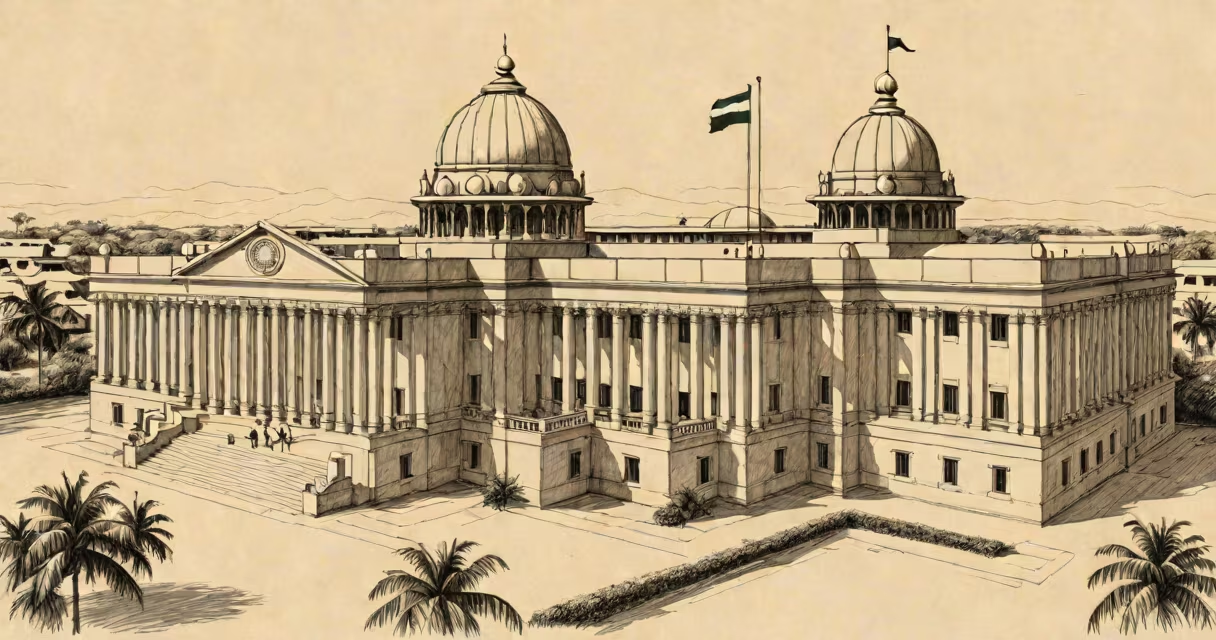
Gadag District Court is a principal civil and criminal court located in Gadag, Karnataka, India, responsible for hearing and deciding cases within its jurisdiction under the Karnataka High Court's oversight. It serves as the primary judicial authority for civil disputes, criminal trials, and revenue matters in Gadag district.
The court operates under the Karnataka Civil Courts Act, 1963, and the Code of Criminal Procedure, 1973. It hears cases ranging from property disputes and contract violations to theft, assault, and other offenses reported within Gadag's administrative boundaries. The court's decisions may be appealed to the Karnataka High Court in Bengaluru.
Each district court in Karnataka is headed by a District Judge, appointed by the state government in consultation with the High Court. The District Judge oversees subordinate courts such as Subordinate Courts (Judicial Magistrates), Family Courts, and Small Causes Courts, which operate under the district court's supervision. In Gadag, this structure ensures consistent application of law across urban and rural areas.
Gadag District Court functions as both a civil and criminal court. Civil cases include land ownership, divorce, debt recovery, and inheritance. Criminal cases involve offenses under the Indian Penal Code (IPC), such as robbery, fraud, and domestic violence. The court maintains records of all filings, hearings, judgments, and appeals through a digital case management system introduced under the National Judicial Data Grid (NJDG).
For civil matters, the court follows procedures outlined in the Code of Civil Procedure, 1908. Plaintiffs file a plaint, defendants respond, evidence is submitted, and a judgment is delivered. For criminal cases, the process begins with a police FIR (First Information Report), investigation, charge sheet filing, trial, and verdict. Trials may last several months depending on complexity and backlog.
A key function is the administration of justice in rural areas. Gadag district includes 12 taluks (sub-districts), each with a sub-court. These sub-courts handle minor civil and criminal cases, reducing pressure on the main district court. Cases involving serious crimes or high-value civil disputes are transferred to Gadag District Court for final adjudication.
The court handles five primary categories of cases:
| Type | Jurisdiction | Examples |
|---|---|---|
| Civil | Disputes between individuals or organizations | Land ownership, breach of contract, maintenance claims |
| Criminal | Offenses against public order and person | Assault (Section 323 IPC), theft (Section 379 IPC) |
| Revenue | Land records and revenue disputes | Disputes over land revenue collection, mutation entries |
| Family | Marriage, divorce, child custody | Divorce petitions, alimony, guardianship |
| Small Causes | Claims under ₹20,000 | Small debt recovery, minor property disputes |
Under the Karnataka State Judicial Academy's guidelines, the court must resolve 80% of small causes cases within six months. As of 2023, Gadag District Court achieved a 78% clearance rate for such cases, slightly below the target due to delays in document verification and witness scheduling.
One non-obvious distinction: Gadag District Court does not have original jurisdiction over constitutional matters. Disputes involving fundamental rights must be filed in the High Court. However, it can issue writ petitions under Article 226 of the Constitution if a lower court fails to act. This power is rarely exercised but exists under the legal structure.
Many assume that Gadag District Court handles all legal issues in the region. That is incorrect. The court does not deal with corporate insolvency, intellectual property, or tax disputes. These fall under specialized tribunals: the National Company Law Tribunal (NCLT) for company matters, the Intellectual Property Appellate Board (IPAB) for patents, and the Income Tax Appellate Tribunal (ITAT) for tax cases.
Another misconception is that all cases are decided in person. While hearings occur in courtrooms, many procedural steps-filing documents, serving notices, submitting affidavits-are done online via the e-Courts Mission Mode Project portal. As of June 2024, 63% of new civil filings in Gadag were initiated electronically.
I once observed a family dispute over ancestral land in Gadag. The plaintiff claimed ownership based on a 1950s record, while the defendant presented a 1972 mutation entry. The court required expert testimony on land survey practices from the 1950s. After reviewing cadastral maps and local records, the judge ruled in favor of the defendant, citing the principle of "prior registration" under the Karnataka Land Revenue Act. The decision was issued in 47 days-within the average time for similar civil cases in the district.
Gadag District Court differs from lower-tier courts like the Taluk Magistrate Court and higher courts like the Karnataka High Court. The Taluk Magistrate handles petty offenses and minor civil suits (up to ₹50,000). The High Court hears appeals from district court judgments and deals with constitutional challenges.
Unlike federal courts in the U.S., Indian district courts do not have a jury system. Decisions are made solely by judges. There are no jury trials in civil or criminal cases in India. The judge evaluates evidence and applies law independently.
Gadag District Court is the central judicial institution for civil and criminal matters in Gadag district, Karnataka. It operates under state law, manages many cases, and supports access to justice through digital tools and regional sub-courts. Understanding its role clarifies how India's decentralized judiciary delivers legal services across rural and urban areas.