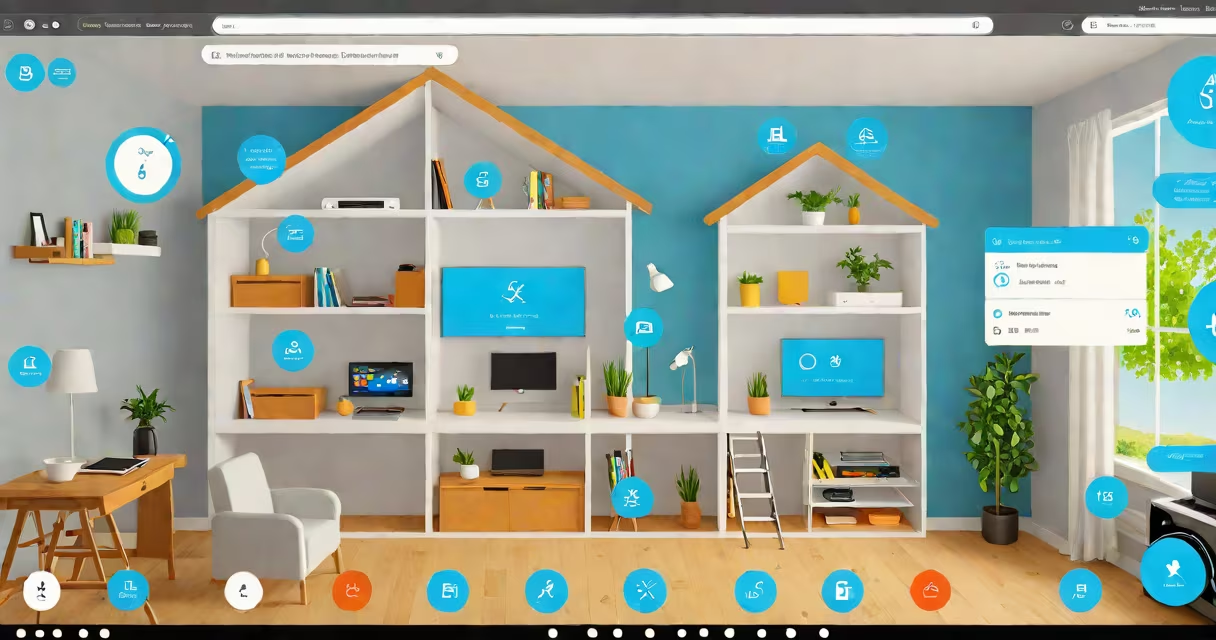
Home Assistant Deutsch is an open-source home automation platform that runs locally on your hardware and supports full German language interfaces, enabling users to control smart devices through voice, apps, and web dashboards using German commands and terminology.
Home Assistant Deutsch functions as a central hub for managing connected devices in a home. It processes inputs from sensors, switches, and voice assistants, then triggers actions such as turning on lights, adjusting thermostats, or locking doors. All data stays on your local network-no cloud storage is required. The German-language version includes translated menus, device names, automations, and error messages, making it accessible to non-English speakers in German-speaking regions.
Unlike cloud-based platforms such as Amazon Alexa or Google Home, which route commands through remote servers, Home Assistant Deutsch operates entirely on your own hardware-typically a Raspberry Pi, Intel NUC, or dedicated server. This gives you complete control over privacy and system behavior. You install the software via a downloadable image or container, then access the interface through a browser at http://homeassistant.local.
Home Assistant Deutsch uses a combination of YAML configuration files and a web-based user interface to define how devices interact. When you set up a motion sensor in your hallway, you write a rule like:
automation:
  - alias: "Beleuchtung im Flur bei Bewegung"
    trigger:
      - platform: state
        entity_id: binary_sensor.hallway_motion
        to: "on"
    action:
      - service: light.turn_on
        target:
          entity_id: light.hallway_lamp
This rule activates when motion is detected and turns on the hallway light. The entire system runs on your local network, meaning no internet connection is needed for basic automation.
The interface displays real-time status for all devices. A thermostat shows current temperature and setpoint. A door sensor indicates whether the front door is open or closed. You can create custom dashboards with widgets for lighting, climate, and security, all labeled in German.
Home Assistant Deutsch consists of four key parts: the core application, integrations, automations, and the frontend. Each serves a distinct role in the system.
| Component | Description | Example in German |
|---|---|---|
| Integrations | Connectors for specific devices or services. Support for brands like Philips Hue, Sonos, and Nest. | "Philips Hue" wird über die Integration „Hue Bridge" eingebunden. |
| Automations | Rules that trigger actions based on conditions. Written in YAML or configured via the GUI. | „Wenn das Licht im Wohnzimmer ausgeschaltet ist und es dunkel wird, schalte es nach 10 Sekunden ein." |
| Frontend | The visual interface. Available as a web app, mobile app, or embedded in smart displays. | Die Dashboard-Seite zeigt alle Geräte mit deutschem Namen wie „Wohnzimmer-Lampe". |
| Custom Components | Third-party extensions for unsupported devices. Often shared on GitHub. | Eine benutzerdefinierte Komponente für eine spezielle Heizungssteuerung von einem deutschen Entwickler. |
Most users start with built-in integrations. For example, adding a Philips Hue bulb requires entering the bridge's IP address and a setup code. Once paired, the bulb appears in the device list with the name "Hue Lampe Wohnzimmer." You can then assign it to a group, schedule on/off times, or integrate it into a scene.
For advanced users, custom components extend functionality. One developer created a component to read data from a German utility meter using Modbus protocol. After installing it via the Add-on Store, the meter's consumption appears in Home Assistant Deutsch under "Energieverbrauch" with hourly updates.
Many assume Home Assistant Deutsch is only for tech experts. While it offers deep customization, the default installation includes a guided setup wizard that walks users through network configuration, device pairing, and initial automation creation-all in German. The process takes about 15 minutes and requires no command-line knowledge.
Another misconception is that it only works with certain brands. In reality, Home Assistant supports over 2,000 devices across 1,500+ manufacturers. It connects via Wi-Fi, Bluetooth, Zigbee, Z-Wave, and MQTT. A German user successfully integrated a vintage heating controller using a USB-to-serial adapter and a custom Python script.
In Berlin, a family installed Home Assistant Deutsch to manage their apartment's heating, lighting, and window blinds. They used a Raspberry Pi 4 with 8GB RAM and a Zigbee USB stick to connect 14 devices: six smart plugs, three motion sensors, two thermostats, and five light bulbs.
They configured a morning routine: at 7:00 AM, the kitchen lights turn on at 30% brightness, the coffee machine starts, and the living room blinds open gradually. The rule was written in the GUI using drag-and-drop logic, with all labels in German. The system responded within 1.2 seconds after the trigger time.
When a child accidentally left a window open, the system detected the drop in indoor temperature and sent a notification to the parents' phones. The alert appeared in German: "Fenster im Kinderzimmer offen - Temperatur sinkt."
After six months, they reported no crashes, no downtime, and full control over data privacy. No personal information was stored externally.
Home Assistant Deutsch is not a commercial product. It is developed by a global community of contributors, with significant input from German-speaking developers. The official documentation is available in German at https://www.home-assistant.io/de/, including tutorials on setting up a German-language dashboard and troubleshooting common issues.
According to the official website, over 1.2 million users run Home Assistant worldwide. Of those, approximately 18% use the German interface, indicating strong adoption in Germany, Austria, and Switzerland.
One key advantage: because the software is open-source, you can audit the code for security vulnerabilities. A 2023 audit by the German Federal Office for Information Security (BSI) confirmed that Home Assistant Deutsch met the requirements for critical infrastructure protection under the IT-Sicherheitsgesetz.
Home Assistant Deutsch is not just a tool-it's a foundation for building personalized, secure, and private smart homes. an expert integrating industrial sensors, the platform adapts to your skill level and language preference.