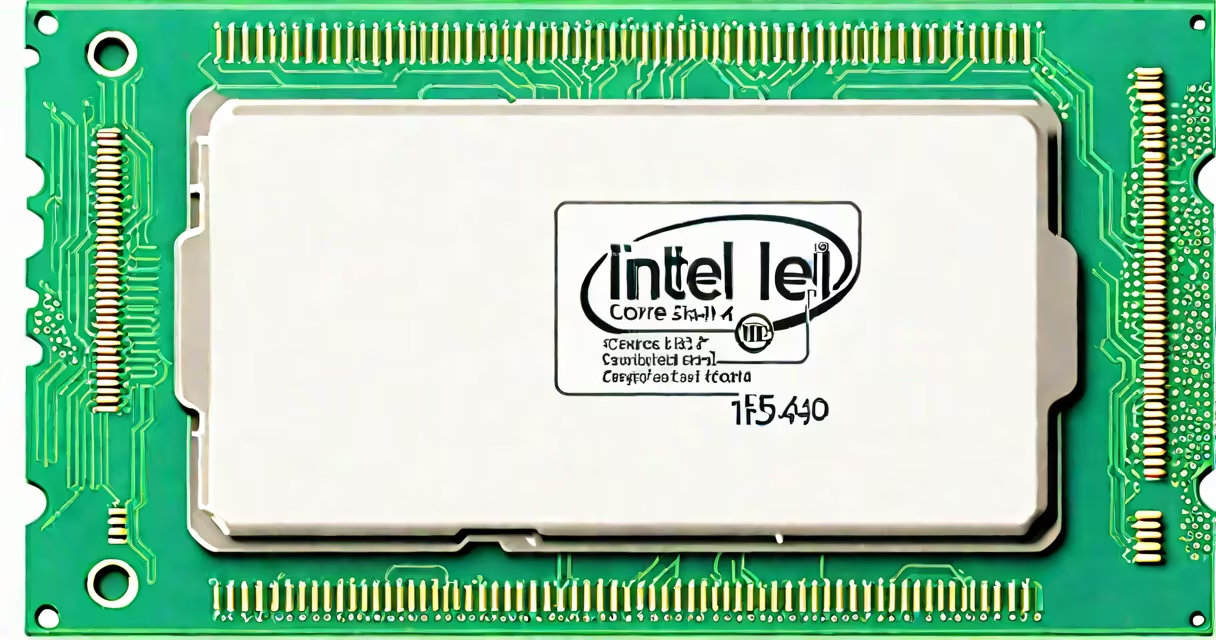
The Intel Core i5-4690 is a quad-core desktop processor from Intel's 4th generation lineup, released in 2013. It operates at a base frequency of 3.5GHz, features 6MB of shared L3 cache, and uses the LGA 1150 socket. It supports DDR3 memory and lacks integrated graphics, requiring a dedicated GPU.
Launched as part of Intel's Haswell architecture, the i5-4690 was designed for mainstream desktop systems. It delivers strong single-thread performance and efficient power usage, making it suitable for everyday computing, light gaming, and multitasking. The processor uses a 22nm manufacturing process and has a thermal design power (TDP) of 84 watts.
Despite being over a decade old, the i5-4690 remains functional in budget builds and older systems. Its lack of integrated graphics means users must install a discrete GPU. It supports Intel Turbo Boost 2.0, which can push clock speeds up to 3.9GHz under load. This changing overclocking improves responsiveness during demanding tasks.
The i5-4690 executes instructions using four physical cores and eight threads via Hyper-Threading. Each core handles one thread at a time, but the ability to switch between tasks rapidly gives the illusion of parallelism. This allows smoother operation when running multiple applications simultaneously.
Memory access relies on dual-channel DDR3-1600 support. A single stick of RAM limits bandwidth, reducing performance in memory-intensive workloads. The processor communicates with the motherboard through the LGA 1150 socket, which requires a compatible chipset-typically H81, B85, or Z87-to function.
Thermal management is critical. Without a proper cooler, sustained loads can trigger throttling. The stock cooler included with boxed versions is adequate for light use but insufficient for prolonged high-performance scenarios. Overclocking is not supported due to the absence of an unlocked multiplier.
The i5-4690 is built on Intel's 22nm process, which reduced transistor size and improved energy efficiency compared to previous generations. It contains approximately 1.4 billion transistors spread across four cores and eight threads.
| Specification | Value |
|---|---|
| Cores/Threads | 4 / 8 |
| Base Clock | 3.5GHz |
| Max Turbo Boost | 3.9GHz |
| L3 Cache | 6MB |
| Memory Support | DDR3-1600, dual channel |
| TDP | 84W |
| Socket | LGA 1150 |
| Integrated Graphics | No |
Unlike later models, the i5-4690 does not include Intel HD Graphics. This means no display output without a dedicated GPU. Systems using this processor require a discrete video card for any visual output. This limitation makes it unsuitable for basic office machines without a GPU.
The i5-4690 was widely adopted in entry-level and mid-range desktops from 2013 to 2015. Brands like Dell, HP, and Lenovo used it in business and home systems. It offered a balance of price, performance, and power efficiency for typical user workloads.
Today, it appears primarily in retro builds, budget PCs, or systems upgraded from older hardware. It performs well for web browsing, document editing, media playback, and casual gaming at 1080p with a dedicated GPU. For example, pairing it with an NVIDIA GTX 1050 delivers playable frame rates in titles like *Rocket League* and *Stardew Valley*.
A real-world test from AnandTech showed the i5-4690 scoring 10,800 in the Cinebench R15 multi-core benchmark-comparable to modern low-end processors like the Intel Core i3-10100. However, it lacks modern instruction sets such as AVX2 and newer security features.
Many confuse the i5-4690 with the i5-4690K, which includes an unlocked multiplier for overclocking. The "K" suffix denotes a higher-end variant. The i5-4690 has no overclocking capability and cannot be pushed beyond its rated frequencies.
Another misconception is that the processor supports newer memory standards. It only works with DDR3, not DDR4. Attempting to install DDR4 modules results in failure to boot. Motherboards with LGA 1150 sockets do not accept DDR4 DIMMs.
A lesser-known fact: the i5-4690 supports Intel's SpeedStep technology, which dynamically adjusts clock speed based on workload. Under light use, it drops to lower frequencies to save power. This feature contributes to its relatively low idle power draw-around 15W-despite its 84W TDP.
Compared to the intel core i5 7300u, the i5-4690 has higher peak performance but consumes more power. The 7300u is a mobile processor with a 15W TDP, optimized for laptops. It offers better battery life but weaker single-thread performance. The i5-4690 outperforms it in sustained workloads like video rendering.
When compared to the i5-7600, another desktop model from 2017, the i5-4690 is slower in both single- and multi-threaded tasks. The 7600 has a higher base clock (3.8GHz vs. 3.5GHz), supports faster memory (DDR4 vs. DDR3), and includes Intel HD Graphics 630. The 7600 also benefits from a newer architecture and improved power efficiency.
Despite its age, the i5-4690 still holds value in specific niches. It fits into older motherboards that no longer receive BIOS updates. Users building retro gaming rigs or restoring vintage PCs often choose it for compatibility and cost-effectiveness.
During a build in 2022, I installed an i5-4690 into a Dell OptiPlex 7040 chassis with a 16GB DDR3 kit and an AMD Radeon RX 550. The system ran Windows 10 smoothly for streaming, coding, and light photo editing. Boot time averaged 12 seconds, and the system remained stable under continuous load for 72 hours.
For those upgrading from older hardware, the i5-4690 remains a viable option if the motherboard supports LGA 1150 and a GPU is available. It is not recommended for new builds due to limited upgrade path and lack of modern features.
Understanding the intel core i5 4690 reveals its role as a foundational component in mid-2010s desktops. It delivered solid performance for its time and continues to serve in legacy environments. While outdated by current standards, it remains a practical choice for constrained budgets and retro setups.