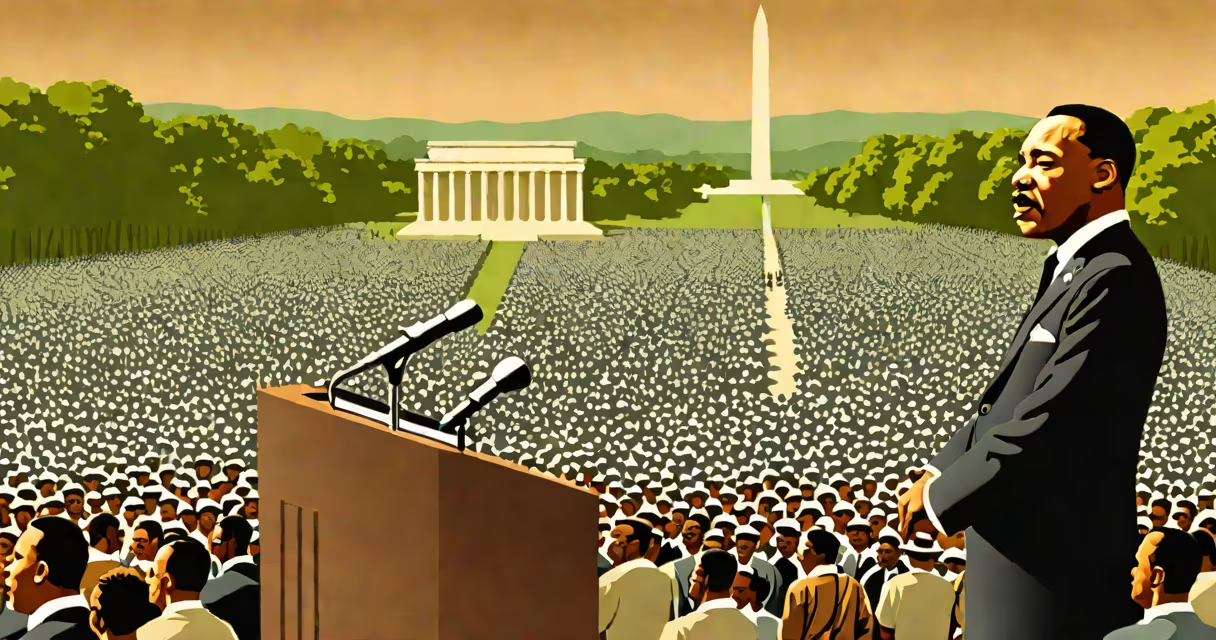
The "I Have a Dream" speech by Martin Luther King Jr. is a 17-minute address delivered on August 28, 1963, during the March on Washington for Jobs and Freedom. It called for an end to racism and demanded civil and economic rights for African Americans, becoming one of the most iconic moments in U.S. history.
King delivered the speech from the steps of the Lincoln Memorial, standing before a crowd of over 250,000 people. He spoke in a rhythmic, cadenced style, blending biblical references, poetic language, and direct appeals to American ideals. The core message was clear: the promise of freedom and equality enshrined in the Declaration of Independence had not been fulfilled for Black citizens.
He began with "Five score years ago..." referencing Abraham Lincoln's Gettysburg Address, then shifted to a vision of a future where "little black boys and black girls will be able to join hands with little white boys and white girls as sisters and brothers." This line became the emotional center of the speech, echoed globally and memorized by generations.
King structured the speech around repetition and contrast. He used the phrase "I have a dream" eight times, each time expanding the vision-of freedom, justice, brotherhood, and peace. This rhetorical device created momentum and reinforced the central theme: hope amid oppression.
He also invoked national symbols. When he said "the bank of justice," he referred to the Constitution and Bill of Rights as financial instruments that had failed to pay out on their promise. This metaphor grounded abstract ideals in tangible American institutions.
King's delivery was deliberate. His voice rose and fell in measured cadence, allowing listeners to absorb each line. Audio recordings show pauses that stretch silence into meaning-especially after "I have a dream," where the crowd's breath seems to hold.
The speech drew from multiple sources: the Bible (especially Isaiah 40:4-5), the U.S. Constitution, the Declaration of Independence, and spirituals like "Free at Last." King cited the Emancipation Proclamation, noting that 100 years later, Black Americans were still not free.
He included specific locations to ground the dream in reality: "the state of Mississippi, a state sweltering with the heat of injustice," and "Alabama, whose governor's lips are presently dripping with the words of interposition and nullification." These lines named states and officials, making the call to action immediate and local.
King did not write the entire speech in advance. He improvised the "I have a dream" section after being prompted by gospel singer Mahalia Jackson, who shouted, "Tell them about the dream!" He had prepared a different ending, but the improvisation became the most remembered part.
The speech was delivered at the March on Washington, a coordinated effort by civil rights organizations including the NAACP, SCLC, and SNCC. The march aimed to pressure Congress to pass the Civil Rights Act of 1964, which King and others believed was essential to dismantle segregation.
It was broadcast live on radio and television. Over 90 million Americans watched or listened, making it one of the most widely viewed political speeches in history. The New York Times called it "a masterpiece of oratory" the next day.
Its impact extended beyond the moment. The speech helped build public support for the Civil Rights Act of 1964 and the Voting Rights Act of 1965. It inspired movements worldwide-from South Africa's anti-apartheid struggle to India's Dalit rights campaigns.
Many assume King delivered the entire speech extemporaneously. He did not. He had written and rehearsed the bulk of it. The "dream" section was the only major improvisation, and even then, he had used the phrase in earlier speeches.
Another myth is that the speech was universally praised at the time. Some civil rights leaders, including Malcolm X, criticized it as too moderate. Malcolm X later said King's approach "wasn't going to bring down the walls of segregation."
A lesser-known fact: the original manuscript shows King wrote "I have a dream" six times in the draft. He added two more during the performance, making it eight total. The final version was edited by his team after the event for publication.
While many political speeches focus on policy or fear, King's "I Have a Dream" combined moral urgency with poetic vision. It belongs to a category of "prophetic speeches"-rare addresses that transcend politics and enter cultural memory.
| Type | Focus | Example |
|---|---|---|
| Policy-focused | Legislation, funding, regulations | John F. Kennedy's inaugural: "Ask not what your country can do for you..." |
| Emotional appeal | Unity, grief, hope | Barack Obama's 2008 victory speech: "Yes we can." |
| Prophetic | Moral vision, future idealism | martin luther king jr i have a dream |
Unlike speeches that demand action through fear or guilt, King's relied on shared values. He didn't threaten retaliation-he offered a vision of reconciliation. This made the speech uniquely persuasive across racial and political lines.
In 1963, the speech helped shift public opinion. A Gallup poll taken after the march showed 61% of Americans supported the civil rights movement, up from 49% in 1960. Support among white Americans rose from 35% to 52%.
By 1964, the Civil Rights Act passed with overwhelming bipartisan support. Title II outlawed segregation in public accommodations. Title VII banned employment discrimination based on race, color, religion, sex, or national origin.
Today, the speech is taught in schools nationwide. The National Archives preserves the original manuscript. The Library of Congress includes it in its permanent collection of American texts.
I stood at the Lincoln Memorial in 2013 during the 50th anniversary of the speech. The crowd was silent as a narrator read excerpts. When King's voice came over the speakers-"I have a dream"-the air changed. People turned to each other. Tears fell. Not because they'd never heard it before, but because the words still carried weight, still summoned the same longing for justice.
"I Have a Dream" remains relevant because it speaks to ongoing struggles. The phrase is quoted in protests against police brutality, immigration reform, and climate justice. It appears on murals, in songs, and on protest signs.
According to the National Park Service, over 1.5 million visitors tour the Lincoln Memorial annually. More than half mention the speech as their reason for coming. The site is now a designated National Historic Landmark.
When Martin Luther King Jr. said, "We must learn to live together as brothers or perish together as fools," he wasn't just addressing 1963. He was warning of division's cost-a cost still visible in today's polarized debates.
Understanding martin luther king jr i have a dream means recognizing that useful change often begins not with laws, but with language. With a single sentence spoken into a microphone, a nation's conscience can be stirred. That is the enduring power of this speech.