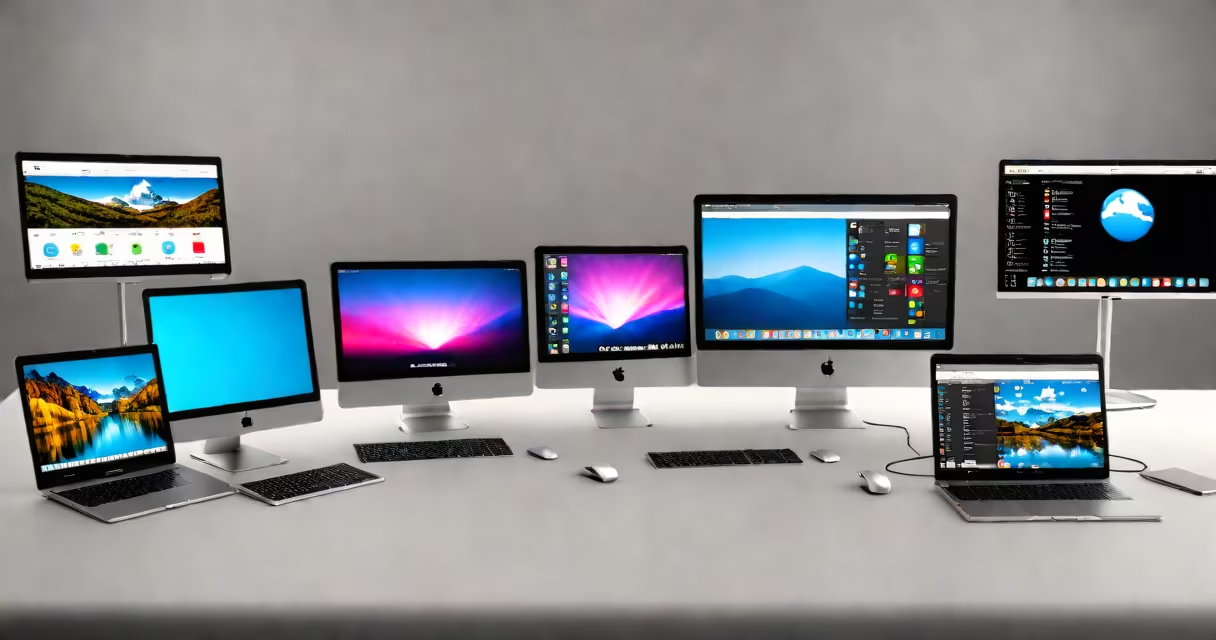
An operating system in market is software that manages computer hardware, allocates resources, and provides a platform for running applications. It acts as the core interface between users, programs, and physical components like processors, memory, and storage.
Every device with computing power-ranging from smartphones to servers-relies on an operating system to function. The term "in market" specifies that these are commercially available systems used widely across industries, consumer electronics, and enterprise environments.
Major players include Microsoft Windows, Apple's macOS and iOS, Google's Android, and various Linux distributions. These systems handle tasks such as process scheduling, memory management, file systems, and security enforcement.
The operating system runs at a low level, directly interacting with the CPU, RAM, and input/output devices. When a user opens an app, the OS allocates memory, assigns processing time, and handles communication with peripherals like keyboards, displays, and network cards.
For example, when you click a file icon on a Windows PC, the OS checks permissions, loads the file from disk into memory, and launches the associated program. This entire sequence happens in milliseconds, orchestrated by kernel-level processes.
Modern operating systems use a layered architecture. The kernel sits at the center, controlling hardware access. Above it, system services manage networking, user authentication, and device drivers. Application programming interfaces (APIs) allow developers to build apps without writing low-level code.
Operating systems fall into categories based on their design goals and deployment context. The most common types are:
| Type | Use Case | Examples | Key Feature |
|---|---|---|---|
| Desktop OS | Personal computers and workstations | Windows 11, macOS Sonoma, Ubuntu | Graphical user interface (GUI), multitasking, extensive software support |
| Mobile OS | Smartphones and tablets | iOS, Android, iPadOS | Touch-based navigation, app sandboxing, battery optimization |
| Embedded OS | Dedicated devices with limited resources | FreeRTOS, VxWorks, QNX | Real-time response, minimal footprint, reliability under constraints |
| Server OS | Data centers and network infrastructure | Windows Server, Red Hat Enterprise Linux, SUSE Linux | High availability, remote administration, scalability |
Each type balances performance, security, and usability differently. For instance, iOS prioritizes app isolation and secure boot, while Linux distributions used in cloud environments emphasize stability and customizable configurations.
Desktop operating systems dominate personal and professional computing. Windows powers over 70% of global PCs according to NetMarketShare (2023), making it the most widely deployed OS in market for productivity tools, gaming, and development.
Apple's macOS and iPadOS serve niche but influential roles. macOS is favored by creative professionals due to its integration with Final Cut Pro and Logic Pro. iPadOS enables tablet-centric workflows through features like Stage Manager and Apple Pencil support-tools not available on standard Android tablets.
Android controls nearly 70% of the global smartphone market (Statista, 2023). Its open-source foundation allows customization by manufacturers, leading to diverse devices across price points. However, fragmentation remains a challenge: different versions run on millions of devices, complicating updates and security patches.
Linux powers over 90% of public cloud servers (Red Hat, 2022). Its modularity and open licensing make it ideal for large-scale deployments. Companies like Amazon, Google, and Meta rely on customized Linux kernels to manage data centers efficiently.
Many assume that "operating system in market" refers only to consumer-facing products like Windows or iOS. But embedded systems like those in medical devices, automotive infotainment, and industrial robots also count. A car's infotainment system may run QNX, a real-time OS used in over 100 million vehicles worldwide.
Another misconception is that all mobile OSes are similar. While both iOS and Android support touch gestures and app stores, they differ fundamentally in architecture. iOS uses a closed structure with strict app review policies, whereas Android allows sideloading and greater customization-though at the cost of increased vulnerability to malware.
Consider setting up a web server using a Raspberry Pi. You'd install a Linux distribution-like Raspberry Pi OS-because it's lightweight, free, and optimized for ARM architecture. After installation, you configure Apache or Nginx to serve websites.
The OS manages the Pi's CPU, allocates memory to the web server process, handles incoming HTTP requests, and logs activity. Without the operating system, the Pi couldn't even start the web service-it would lack the basic coordination needed to run any software.
This example shows how the operating system in market isn't just a tool-it's the foundation of every digital interaction. Even simple actions like loading a webpage depend on layers of OS functionality working silently behind the scenes.
Understanding the role of the operating system in market helps explain why software fails, why devices slow down, and why certain features are only available on specific platforms. It's not just about choosing between Windows and macOS-it's about recognizing how each system shapes the user experience, security posture, and long-term viability of a device.