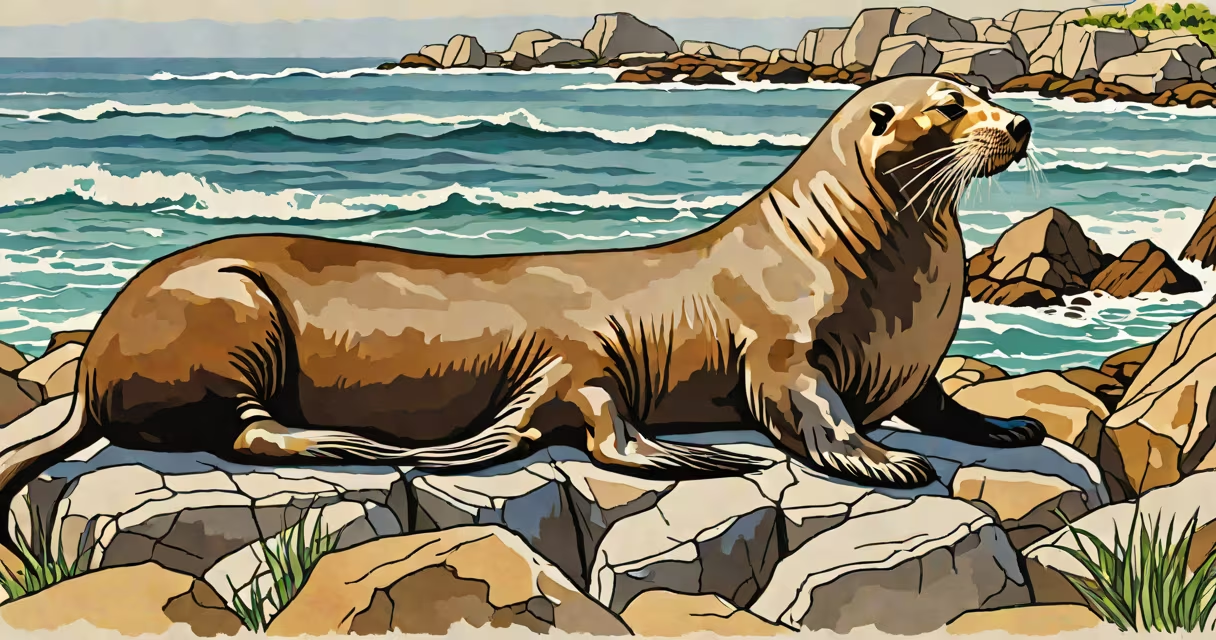
Sea lion habitat consists of coastal areas with access to both land and water, including rocky shores, sandy beaches, and offshore islands used for breeding, resting, and molting. These animals rely on specific environmental conditions to survive, hunt, and raise their young.
Sea lions are highly social marine mammals that return to the same coastal sites year after year. They require safe, elevated ground to give birth and nurse pups, while also needing nearby ocean access to forage for fish, squid, and octopus. Their habitats span temperate and subarctic regions along the Pacific and Atlantic coasts, from California to South America and the southern tip of Africa.
These animals do not migrate long distances like whales, but they travel regularly between feeding grounds and rookeries-breeding colonies. For example, California sea lions (Zalophus californianus) often haul out on rocky ledges at Ano Nuevo State Park in California, where they spend months on land during breeding season. The location's proximity to rich fishing zones makes it ideal for mothers to feed and return to nursing pups.
Sea lions depend on stable, predator-free zones near productive waters. Their habitat choice balances safety from predators like great white sharks and orcas with efficient access to prey. A study by the National Oceanic and Atmospheric Administration (NOAA) found that sea lion colonies located within 10 kilometers of nutrient-rich upwelling zones had higher pup survival rates due to abundant food.
Land features matter. Rocky outcrops provide secure footing and protection from strong currents. Sandy beaches allow for easier movement during seasonal migrations. Offshore islands reduce exposure to terrestrial predators such as coyotes and feral dogs. In the Galápagos Islands, Galápagos sea lions (Zalophus wollebaeki) use lava rock formations to shelter from storms and sun, which helps regulate body temperature during extended haul-outs.
Human activity disrupts these natural patterns. Coastal development, boat traffic, and pollution degrade habitat quality. In 2015, a heatwave in the Pacific caused a collapse in sardine populations, leading to starvation among sea lion pups in California. NOAA documented a 60% increase in stranded pups during that period-many were found far from known rookeries, indicating habitat stress forced them to search for food beyond normal ranges.
Different species occupy distinct habitat types based on climate, geology, and food availability. The table below outlines key differences:
| Species | Primary Habitat Type | Geographic Range | Key Features |
|---|---|---|---|
| California sea lion | Rocky shores, offshore islands | Western U.S. and Mexico | Highly social; uses man-made structures like docks and piers |
| Steller sea lion | Coastal rocks, glacial fjords | Alaska, Russia, Japan | Less tolerant of human presence; avoids crowded areas |
| Galápagos sea lion | Lava rock formations, sandy coves | Galápagos archipelago | Adapts to volcanic terrain; sensitive to El Niño events |
| Antarctic fur seal | Glacial ice edges, rocky coasts | Subantarctic islands | Uses sea ice for pupping; vulnerable to melting trends |
While all sea lions need land and water, their specific habitat preferences reflect evolutionary adaptation. Steller sea lions, for instance, avoid dense urban areas and prefer remote, cold-water zones. In contrast, California sea lions frequently use artificial structures such as piers and breakwaters-so much so that researchers at the University of California, Santa Cruz, observed over 40% of adult males using man-made platforms in San Francisco Bay during winter months.
Many assume sea lions live exclusively in the ocean. This is incorrect. They spend significant time on land-up to 80% of their daily cycle during breeding and molting seasons. On land, they regulate body temperature, rest, and interact socially. During molting, they remain ashore for weeks, unable to swim due to shedding outer layers of skin and fur.
Another misconception is that sea lions inhabit tropical waters. While some species occur near the equator-like the Galápagos sea lion-most thrive in temperate zones. The warmest sea lion populations are found in regions with consistent upwelling, which brings cold, nutrient-rich water to the surface. This supports high fish biomass, essential for sea lion diets.
A lesser-known fact: sea lion habitat selection is influenced by sound. Research published in *Marine Mammal Science* shows that sea lions avoid areas with high underwater noise from shipping lanes. Even low-frequency engine rumble can disrupt communication between mothers and pups, increasing separation risk. This sensitivity underscores that habitat quality isn't just about physical space-it includes acoustic conditions.
In 2022, a group of scientists from the Monterey Bay Aquarium studied a colony at Point Reyes National Seashore. The site had historically supported over 1,000 sea lions during summer. But after a series of coastal construction projects and increased tourism, the number dropped to fewer than 300 within five years.
Analysis revealed that noise from construction equipment and frequent human visits caused chronic stress. Pups were abandoned more often, and lactation failure rose by 37%. The study concluded that even minor disturbances in otherwise suitable habitat can trigger population decline.
This case illustrates that habitat suitability isn't just about geography-it's about ecological integrity. A site may have the right rocks and proximity to the ocean, but if human pressure exceeds tolerance thresholds, it fails as functional habitat.
Sea lion habitat is not a single environment but a network of interconnected land and marine zones shaped by biology, climate, and human influence. Protecting these areas requires managing both physical space and behavioral needs. Conservation efforts must consider not only where sea lions live, but how they use those places.
Understanding sea lion habitat helps prevent unintended harm. When we recognize that a rocky beach isn't just a place to rest-it's a critical nursery-we act with greater care. The health of sea lion populations reflects the health of coastal ecosystems. Monitoring their habitat use offers early warnings of environmental change.
For more on animal behavior and anatomy, see our drawing of a lion.