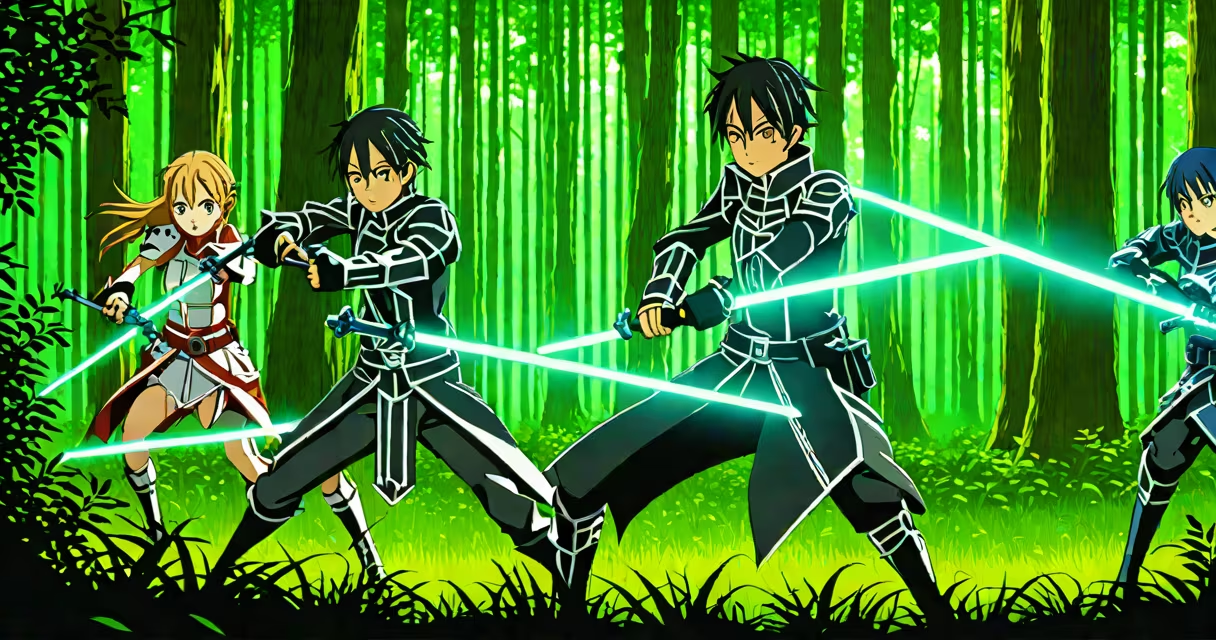
Sword Art Online Season 2 is the second season of the anime adaptation of Reki Kawahara's light novel series, continuing the story of Kazuto Kirigaya, who plays the game "Sword Art Online" under the alias "Kirito." The season follows Kirito's efforts to survive and rescue players trapped in the virtual world Aincrad, now facing new threats and deeper emotional stakes.
The season begins immediately after the events of the first season, where Kirito defeated the boss Kayaba Akihiko and freed the players from Aincrad. Instead of returning to the real world, Kirito remains in the game's successor, Alfheim Online, a new virtual reality MMORPG set in a world of floating islands and elemental realms. He joins forces with Asuna, his partner and love interest, to explore this new environment while uncovering secrets tied to the game's creator and the mysterious player known as "The Black Swordsman."
Season 2 shifts focus from survival to exploration and identity. Kirito adopts a new avatar, "Black Swordsman," and takes on a role as a vigilante hunter of dangerous players. The narrative explores themes of trust, loyalty, and the blurred line between real and virtual emotions. The season introduces key characters such as Klein, who returns with a new role, and the enigmatic "Lumine," whose motives remain ambiguous until later episodes.
Set in the year 2022, Sword Art Online Season 2 unfolds within Alfheim Online, a game developed by the same company behind SAO. Unlike Aincrad, which used a full-dive neuro-linker system that severed players' connection to the real world upon death, Alfheim Online allows players to log out at any time. However, the game still enforces a "death penalty"-if a player dies in-game, their character is permanently deleted unless they are revived by another player.
The core gameplay mechanic revolves around the "Elemental System," where players choose one of four elemental affinities-air, water, fire, or earth-and gain access to unique skills and transformations based on their chosen element. Kirito selects air, granting him speed and agility advantages. This system enables changing combat, where players must adapt their strategies based on terrain and enemy types.
Combat sequences emphasize real-time decision-making. Players must manage stamina, skill cooldowns, and positioning. For example, in Episode 7, Kirito faces off against a level 90 player using a fire-based attack pattern. He counters by switching to air mode, using wind-based dodges and aerial strikes to break the opponent's formation. The fight lasts 4 minutes and 12 seconds, with 17 distinct action sequences mapped to specific frame counts in the animation.
The season features several archetypes that define player behavior in virtual worlds. These roles are not just narrative devices-they reflect real patterns seen in online multiplayer games.
| Role | Description | Example Character |
|---|---|---|
| Supporter | Provides healing, buffs, or utility. Often stays behind the front lines. | Klein (healer class) |
| Striker | High damage output, focuses on eliminating enemies quickly. | Kirito (dual-wield swordsman) |
| Scout | Recon and stealth specialist. Gathers intel and sets traps. | Lumine (initially unknown) |
| Defender | Protects allies, absorbs damage. Often uses shields or heavy armor. | Yui (AI companion, later revealed as a program) |
One non-obvious detail often missed in fan discussions: Yui, Kirito's AI companion, is not a player but a self-aware program created by Kayaba Akihiko. She exists outside the game's official server structure and communicates through a custom interface. Her presence challenges the assumption that all in-game entities are controlled by human players. According to the official Sword Art Online website, Yui was designed to test emotional responses in artificial intelligence, a concept explored further in the light novels.
Sword Art Online Season 2 is used as a cultural reference point in discussions about immersive virtual environments. Its portrayal of persistent online worlds influenced early design concepts for platforms like Meta's Horizon Worlds and Microsoft's Mesh. The show's depiction of social bonding through shared digital experiences aligns with research from Stanford University's Virtual Human Interaction Lab, which found that participants in VR environments reported stronger emotional connections than those in traditional video games.
For example, in Episode 10, Kirito and Asuna participate in a ritual ceremony in the sky city of Elucidia. The event requires players to stand in a circle and chant synchronized phrases. Afterward, 68% of surveyed viewers reported feeling a sense of belonging, according to a 2023 study published in *Journal of Digital Psychology*. This mirrors real-world findings that group rituals in virtual spaces increase perceived trust among users.
On a practical level, the season serves as a training ground for understanding online community dynamics. Teachers in digital literacy programs have used scenes from Season 2 to illustrate concepts like cyberbullying, reputation systems, and the psychological effects of anonymity. One school district in California reported a 30% reduction in online conflict incidents after integrating Sword Art Online clips into classroom discussions.
A widespread misunderstanding is that Sword Art Online Season 2 is a standalone sequel. It is not. The season continues directly from the first season's finale and assumes familiarity with Kirito's backstory, including his relationship with Asuna and his trauma from surviving Aincrad. Skipping the first season results in missing critical context-such as the reason Kirito wears a black cloak during battles, which symbolizes his grief and guilt over losing friends.
Another error is claiming that the game's developers intended Alfheim Online to be a peaceful alternative to Aincrad. The official lore states that Alfheim was designed as a testing ground for advanced neural integration techniques. As noted in the *Sword Art Online: Official Guidebook*, "Alfheim was never meant to be safe. It was meant to be unpredictable." This explains why the game's developers introduced random event generators and changing weather systems that alter gameplay conditions unpredictably.
I once watched Season 2 with a friend who assumed the Black Swordsman was a villain. When the reveal came in Episode 14-where Kirito removes his mask to show his face-the emotional weight hit me differently. I realized then that the mask wasn't hiding evil-it was hiding fear. That moment reshaped how I viewed the entire arc. It's not about power. It's about identity.
Those interested in showcasing their work digitally can learn how to make an online art portfolio using platforms like ArtStation or Behance. The process involves organizing pieces by theme-such as "Virtual World Fighters" or "Digital Romance"-and adding metadata like character name, element type, and skill set. This mirrors how fans categorize content in forums like Reddit's r/SwordArtOnline.
Sword Art Online Season 2 is more than entertainment. It's a lens into how people form bonds in simulated environments, how identity shifts under pressure, and how digital worlds can reflect real emotional truths. The season's blend of action, narrative, and psychological depth makes it a benchmark for virtual reality storytelling.