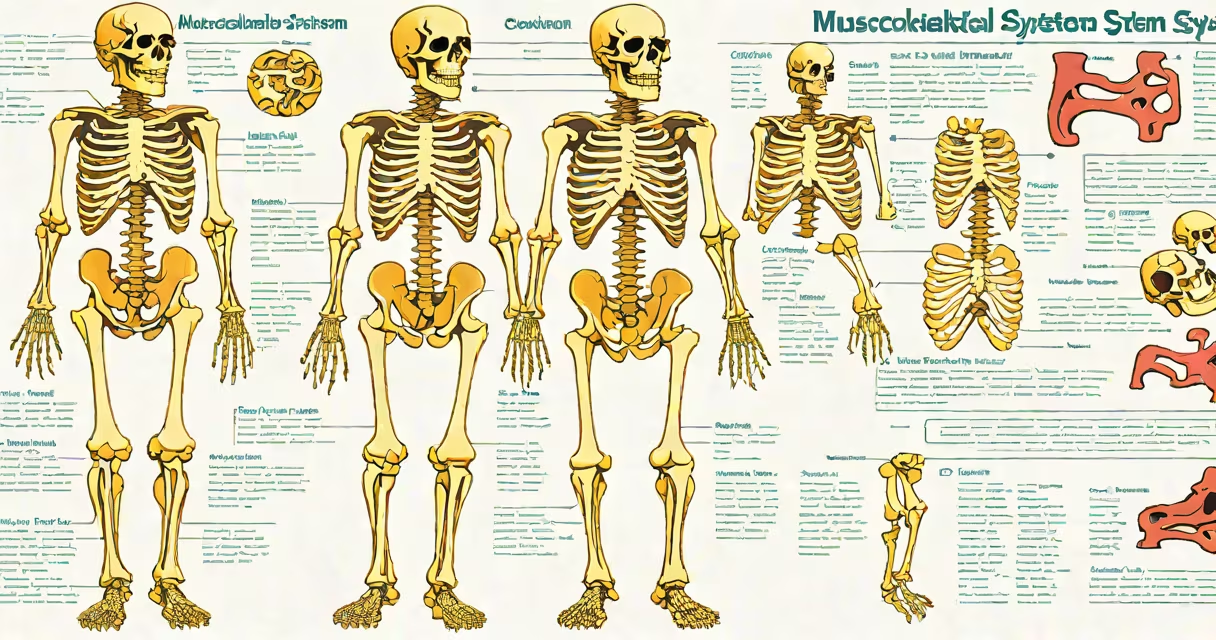
The types of musculoskeletal system refer to the structural components-bones, muscles, joints, and connective tissues-that work together to provide support, stability, and motion in the human body. These elements form a functional network enabling posture, locomotion, and protection of internal organs.
Bones make up the skeletal structure. They are rigid structures composed primarily of calcium phosphate and collagen. The adult human skeleton contains 206 bones, categorized into axial (skull, spine, ribcage) and appendicular (limbs, shoulder girdle, pelvis) divisions. Bones serve as levers during movement and act as mineral reservoirs, storing calcium and phosphorus critical for metabolic processes.
Muscles constitute the contractile portion of the system. There are three types: skeletal, cardiac, and smooth. Skeletal muscles attach to bones via tendons and generate force through contraction. They enable voluntary movements such as walking, lifting, and facial expressions. Cardiac muscle forms the heart wall and pumps blood; smooth muscle lines internal organs and controls involuntary actions like digestion and blood vessel constriction. For movement, skeletal muscles operate in antagonistic pairs-biceps and triceps in the arm, quadriceps and hamstrings in the leg.
Joints connect bones and allow varying degrees of motion. They are classified by structure and function. Fibrous joints (like skull sutures) permit little to no movement. Cartilaginous joints (such as intervertebral discs) allow limited flexibility. Synovial joints-most common-are freely movable and include ball-and-socket (hip, shoulder), hinge (knee, elbow), pivot (atlantoaxial joint), saddle (thumb), condyloid (wrist), and plane (carpals) types. Each synovial joint type corresponds to a specific range and axis of motion.
| Type | Movement Allowed | Example Location | Joint Type |
|---|---|---|---|
| Ball-and-socket | Rotation, flexion, extension, abduction, adduction | Shoulder, hip | Synovial |
| Hinge | Flexion and extension only | Elbow, knee | Synovial |
| Pivot | Rotation around a central axis | Atlantoaxial joint (neck) | Synovial |
| Saddle | Bi-directional motion in two planes | Thumb base | Synovial |
| Condyloid | Flexion, extension, abduction, adduction | Wrist | Synovial |
| Plane | Gliding motions | Carpal bones in wrist | Synovial |
Connective tissues link and stabilize the system. Ligaments bind bone to bone at joints, limiting excessive motion and preventing dislocation. Tendons connect muscle to bone, transmitting force generated by muscle contraction. Cartilage covers bone ends in joints, reducing friction and absorbing shock. Fascia surrounds muscles and organ systems, providing structural integrity and facilitating coordinated movement.
A common misconception is that the musculoskeletal system exists solely for movement. While mobility is a primary function, the system also protects important organs-such as the brain (skull), heart and lungs (ribcage)-and produces blood cells in bone marrow. Red bone marrow in spongy bone regions generates red blood cells, white blood cells, and platelets through hematopoiesis.
One non-obvious fact: the human hand contains 27 bones, more than any other single body part. This complexity allows fine motor control essential for tasks like writing, typing, and playing instruments. The carpals (wrist bones) alone consist of eight small bones arranged in two rows, enabling multidirectional wrist motion.
During a clinical anatomy lab, I observed a cadaveric specimen where the rotator cuff muscles were partially torn. The patient had experienced chronic shoulder pain due to repetitive overhead motion. Repair required precise reattachment of tendons to the humerus using suture anchors. This confirmed that even minor disruptions in tendon-bone interface integrity can severely impair joint function.
Another key distinction: bones are living tissues that remodel continuously. Osteoblasts build new bone, while osteoclasts resorb old or damaged portions. This process maintains strength and adapts to mechanical stress. In weight-bearing bones like the femur, trabecular bone aligns along stress lines-a phenomenon known as Wolff's Law. Bone density increases in areas under higher load, optimizing resistance to fracture.
When discussing the types of musculoskeletal system, avoid conflating it with the nervous system. While both coordinate movement, the nervous system sends signals to initiate contractions; the musculoskeletal system executes them. A stroke may paralyze muscles, but the underlying musculoskeletal structures remain intact unless secondary injury occurs.