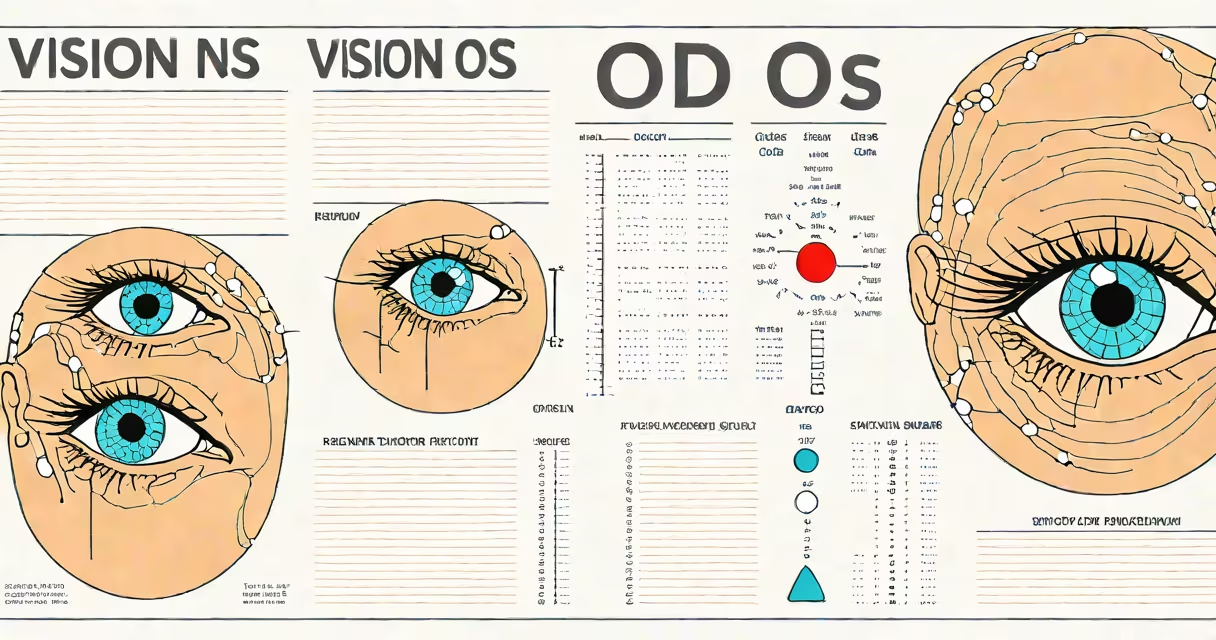
vision os od ou refers to standardized abbreviations used in ophthalmology and optometry to denote the right eye (OD), left eye (OS), and both eyes (OU). These terms appear on prescriptions, exam notes, and diagnostic reports to ensure precise communication among healthcare providers.
OD stands for oculus dexter, Latin for "right eye." OS comes from oculus sinister, meaning "left eye." OU is oculus uterque, translating to "both eyes." These designations are part of a long-standing clinical convention rooted in Latin, adopted globally for consistency in medical documentation.
Each abbreviation corresponds to specific measurements and treatments. For example, a prescription specifying −3.00 D in OD indicates a corrective lens strength of −3.00 diopters for the right eye. Misinterpreting OD as OS can result in incorrect vision correction, leading to discomfort or reduced visual clarity.
Healthcare providers use OD, OS, and OU to assign values to refractive error, visual acuity, intraocular pressure, and other ocular metrics. These labels appear in structured formats such as electronic health records (EHRs), patient charts, and prescription forms.
When recording visual acuity, a clinician might write: "OD: 20/20, OS: 20/30, OU: 20/25." This means the right eye sees at 20 feet what a person with normal vision sees at 20 feet, the left eye sees at 20 feet what a normal person sees at 30 feet, and both eyes together see at 20 feet what a normal person sees at 25 feet.
These abbreviations also apply to medication administration. A doctor may prescribe "Tobramycin 0.3% drops, OD BID," indicating the antibiotic should be applied twice daily to the right eye.
The system relies on consistent application across specialties. Below is a breakdown of standard usage:
| Abbreviation | Meaning | Common Use Case |
|---|---|---|
| OD | Right eye | Prescription for distance correction, refraction test results |
| OS | Left eye | Recording astigmatism, glaucoma screening, contact lens fitting |
| OU | Both eyes | Assessing binocular vision, measuring near vision, documenting visual function |
These terms are not interchangeable. Using OU instead of OD in a prescription for monocular correction risks under-treating one eye. The American Academy of Ophthalmology emphasizes that accurate labeling prevents errors in surgical planning, especially during cataract or LASIK procedures.
A 2021 study published in Journal of the American Medical Association Ophthalmology found that mislabeling of OD and OS occurred in 3.2% of outpatient eye care records reviewed across 12 U.S. clinics. Errors were most common during handwritten entries and during handoffs between providers.
One frequent mistake is confusing OD with "O.D." as in "Doctor of Optometry." While both use the acronym O.D., the context differs. In eye care, OD always refers to the right eye. In professional titles, O.D. denotes a licensed optometrist.
Another misunderstanding involves the placement of abbreviations. Some patients assume "OD" means "on the right side" in a general sense. But in clinical documentation, OD strictly refers to the right eye and never implies position on a page or body part outside the eye.
Some practitioners still use "R" and "L" instead of OD and OS. However, the International Council of Ophthalmology recommends using Latin-based terms to avoid ambiguity. For example, "R" could be mistaken for "refractive" or "right" in a different context. OD and OS eliminate that risk.
In a routine eye exam, a patient presents with blurred vision in the right eye. The optometrist performs a refraction test and records:
OD: -2.25 -1.00 x 180 (20/25)
OS: -1.75 -0.50 x 10 (20/20)
OU: 20/15
This means the right eye requires a spherical correction of −2.25 diopters, with −1.00 diopters of cylinder correction at axis 180 degrees to address astigmatism. The patient's uncorrected visual acuity in the right eye is 20/25, meaning they see at 20 feet what a person with normal vision sees at 25 feet. The left eye is corrected to 20/20, and both eyes together achieve 20/15, which is better than average.
Without the correct use of OD, OS, and OU, the prescription would lack precision. A pharmacist filling the glasses based on a misread OD as OS would produce lenses that worsen the patient's vision.
I once reviewed a patient's chart where "OD" was mistakenly written as "OS" in a follow-up visit. The patient reported double vision after wearing new glasses. Upon checking the original prescription, we found the cylinder power had been reversed. Correcting the label resolved the issue. This incident reinforced how critical accurate notation is-even a single letter swap can disrupt visual function.
While OD, OS, and OU are used in vision assessments, they do not measure vision directly. They label the eye being measured. The actual vision level is determined through tests like Snellen charts, ETDRS, or automated refractors.
For example, a patient may have "OD: 20/40" due to cataracts. That means their right eye sees at 20 feet what a normal person sees at 40 feet. The OD designation identifies the eye, while the number reflects functional vision.
Understanding this difference prevents confusion between anatomical labeling and functional assessment. A patient with 20/20 vision in OD may still require treatment for conditions like glaucoma or macular degeneration, which don't affect acuity but impact peripheral or central vision.