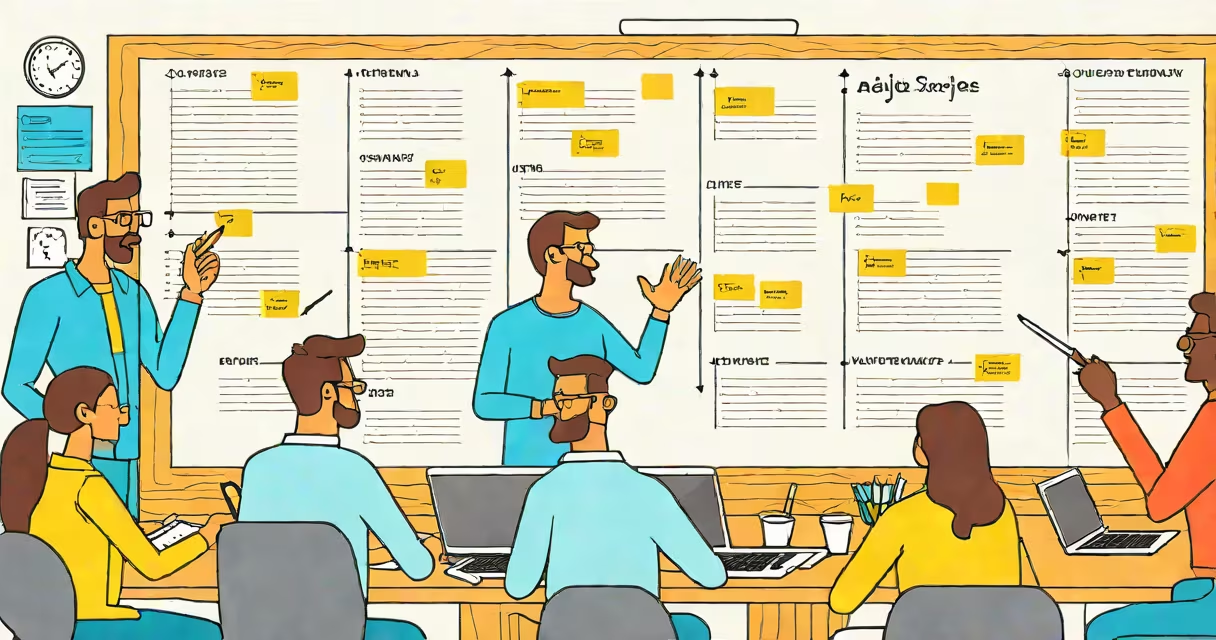
The agile software development model is an iterative approach to building software that delivers functional features in short cycles, emphasizing teamwork, customer feedback, and rapid adaptation to change. Instead of completing a project in one long phase, teams build small increments of working software every few weeks, adjusting based on real-world input.
Agile emerged in response to the limitations of traditional waterfall methods, where requirements were locked early and changes were costly. The Agile Manifesto, published in 2001 by 17 software developers, established core values: individuals and interactions over processes and tools, working software over complete documentation, customer collaboration over contract negotiation, and responding to change over following a plan.
Major tech companies like Spotify, Amazon, and Microsoft use agile frameworks internally. For example, Amazon's "two-pizza team" rule ensures small, autonomous units that can deliver features rapidly using agile principles. This model reduces time-to-market and increases product relevance.
Agile operates in time-boxed iterations called sprints, typically lasting two to four weeks. At the start of each sprint, the team selects tasks from a prioritized backlog-a list of features, bug fixes, and improvements ranked by business value. During the sprint, daily stand-up meetings ensure alignment and show blockers.
At the end of each sprint, the team demonstrates a potentially shippable product increment. Stakeholders review the work, provide feedback, and adjust priorities for the next cycle. This continuous loop enables teams to pivot quickly if market conditions or user needs shift.
A real-world example: a fintech startup developing a mobile banking app used two-week sprints. After Sprint 3, users reported confusion during the account setup flow. The team added usability testing in Sprint 4, redesigned the interface, and released a revised version within a week. Without agile, this issue might have gone unnoticed until the final release.
While agile is a philosophy, several frameworks implement it. Scrum and Kanban are the most widely adopted.
| Structure | Key Structure | Best For |
|---|---|---|
| Scrum | Fixed-length sprints, defined roles (Product Owner, Scrum Master, Development Team), regular ceremonies (planning, review, retrospectives) | Projects with evolving requirements, cross-functional teams |
| Kanban | Visual workflow board, work-in-progress limits, continuous delivery | Support and maintenance, steady stream of small changes |
| SAFe (Scaled Agile Structure) | Aggregation of multiple teams into larger programs, synchronized planning events | Large enterprises with multiple interdependent teams |
Scrum requires specific rituals. A Product Owner defines the backlog and prioritizes features. The Scrum Master facilitates meetings and removes obstacles. The Development Team plans and executes work autonomously. These roles are not hierarchical but collaborative.
Contrary to common belief, agile doesn't mean "no documentation." It means creating only what's necessary. According to the Agile Manifesto, "working software is the primary measure of progress," but documentation is still produced when it adds value. A 2022 study by the Standish Group found that agile projects had a 60% higher success rate than waterfall projects, largely due to frequent validation and reduced rework.
Agile software development model is standard in tech-driven industries. Startups adopt it to test ideas quickly. Enterprises use scaled versions like SAFe to coordinate hundreds of engineers across departments.
It's especially effective when requirements are uncertain or likely to evolve. A healthcare software provider developing a patient portal used agile to incorporate feedback from doctors and nurses during each sprint. By Sprint 6, they had reduced form completion time by 40% compared to initial prototypes.
Agile also supports faster innovation. Google's early development of Gmail relied on agile practices-releasing new features every two weeks based on user behavior data. This allowed them to refine the product in real time, leading to widespread adoption.
Many assume agile means "no planning." In reality, it requires disciplined planning-but at a smaller scale. Teams plan only the next sprint, not the entire project. This reduces overcommitment and improves accuracy.
Another myth is that agile eliminates project managers. Agile doesn't remove oversight-it shifts responsibility. The Scrum Master manages process health, while the Product Owner owns business outcomes. Project managers often transition into these roles.
Some organizations apply agile superficially-holding daily stand-ups without empowering teams. This leads to "agile theater," where rituals exist but decision-making remains centralized. Research from McKinsey shows that teams with true autonomy achieve 30% higher productivity than those with top-down control.
I once observed a team using agile incorrectly. They held daily meetings, updated a Kanban board, but decisions were still approved by a single executive. When a critical bug emerged, the team couldn't act without waiting days. The process was labeled agile, but lacked psychological safety and authority-core elements of successful agile implementation.
Waterfall follows a linear sequence: requirements → design → implementation → testing → deployment. Once a phase ends, you don't return. Agile reverses this: you begin with a minimal viable product and improve it continuously.
Consider a mobile app for tracking fitness goals. In waterfall, the team would spend six months gathering requirements, designing screens, coding everything, then testing. If users disliked the interface, fixing it would require another full cycle. In agile, the team builds a basic version in Sprint 1, tests it with five users, refines the layout, and releases an improved version in Sprint 2.
Waterfall works well for regulated environments where changes are risky (e.g., medical devices). Agile excels in changing markets where speed and responsiveness matter.
To begin with the agile software development model, start small. Choose a pilot project with clear objectives and a stable team. Use Scrum or Kanban to structure work. Prioritize transparency-share progress openly via dashboards or physical boards.
The agile software development model is not a one-size-fits-all solution. It thrives in environments that value learning, trust, and flexibility. When implemented correctly, it turns software delivery from a linear task into a responsive, human-centered process.