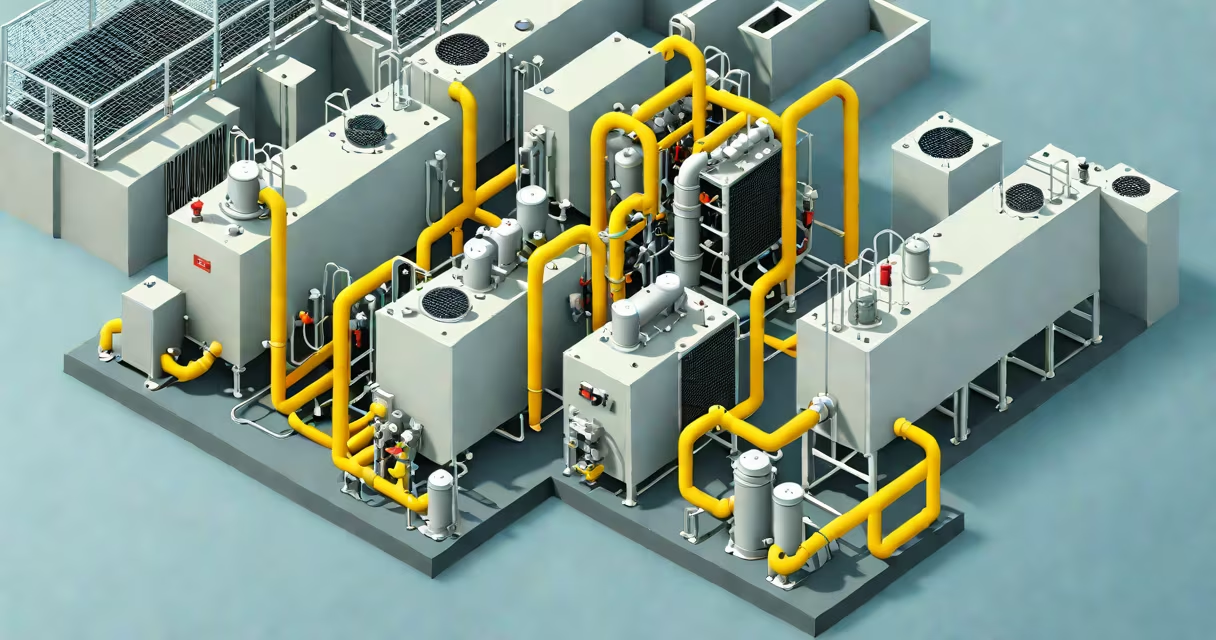
Two stage cooling is a thermal management method that uses two distinct cooling phases to remove heat more efficiently than single-stage systems. It reduces energy consumption and stabilizes temperature control in environments requiring precise climate regulation.
This process splits the cooling task into two steps: the first stage lowers the temperature, and the second stage fine-tunes it to reach the desired setpoint. This layered approach prevents excessive pressure drops and minimizes compressor strain, especially in high-demand systems.
Unlike single-stage cooling, which cools air or fluid in one continuous step, two stage cooling divides the work. The result is better efficiency, lower operating costs, and improved reliability under sustained loads. It's widely used in industrial refrigeration, HVAC systems, and data center cooling.
The system begins with a primary cooling loop that rapidly reduces temperature. A refrigerant, such as R-410A or R-134a, absorbs heat from the target environment and transfers it to a condenser. This initial phase handles most of the thermal load.
After the first stage, the cooled fluid or air enters a secondary cooling zone. Here, a separate refrigerant circuit or a subcooler further reduces temperature by 5-15°C, depending on design. This second stage ensures precision, especially when maintaining conditions below 5°C.
A key component is the intermediate heat exchanger. It transfers heat between the high-pressure and low-pressure sides of the system without mixing fluids. This allows both stages to operate at optimal pressures, improving coefficient of performance (COP).
Two stage cooling systems fall into two main categories: mechanical and thermodynamic. Mechanical systems use two compressors, while thermodynamic systems rely on staged expansion valves and evaporators.
| Type | Use Case | Efficiency Gain | Example Application |
|---|---|---|---|
| Mechanical Two-Stage | High-load industrial cooling | 15-25% | Food processing chillers |
| Thermodynamic Two-Stage | Stable low-temp environments | 20-30% | Data center cooling |
For example, a large meatpacking plant in Iowa uses a mechanical two-stage system to maintain storage at -18°C. The first stage brings the temperature from ambient to -10°C, then the second stage stabilizes it at -18°C. This setup reduced energy use by 22% compared to older single-stage units, according to a 2022 study by the American Society of Heating, Refrigerating and Air-Conditioning Engineers (ASHRAE).
Another configuration uses cascade refrigeration, where two independent refrigerants run in series. The high-temperature refrigerant (e.g., R-404A) cools the low-temperature refrigerant (e.g., R-744, CO₂). This is common in cold storage facilities needing sub-zero temperatures.
Many assume two stage cooling is only for large-scale operations. That's incorrect. Smaller commercial refrigeration units now integrate two stage designs for better efficiency and longer equipment life.
Another misconception is that two stage systems always require more maintenance. While they have more components, modern designs use sealed compressors and automated diagnostics. A 2021 report from the U.S. Department of Energy found that two stage chillers had 18% fewer unplanned outages than single-stage models over five years.
Some confuse two stage cooling with multi-zone HVAC. These are different: multi-zone systems manage airflow distribution, while two stage cooling focuses on thermal efficiency through sequential cooling phases.
In 2020, a data center in Phoenix upgraded from single-stage to two stage cooling. The facility housed 5,000 servers and required consistent temperatures between 18-22°C. Prior to the upgrade, cooling accounted for 40% of total energy use.
The new system used a two-stage approach: the first stage cooled incoming air from 35°C to 25°C using a centrifugal chiller. The second stage, powered by a smaller screw compressor, brought it down to 20°C. An economizer mode used outside air when ambient conditions allowed, reducing mechanical cooling time by 33%.
Over 12 months, the center saw a 26% drop in cooling-related electricity consumption. The average server temperature remained within ±0.5°C of the target. This improvement was verified by ASHRAE Standard 90.1-2019 compliance audits.
Two stage cooling improves system longevity by reducing peak stress on compressors. Compressors in single-stage systems often cycle on and off frequently under heavy load, leading to wear. In contrast, two stage systems distribute workload evenly across both stages, lowering mechanical fatigue.
Energy savings are measurable. According to the U.S. Environmental Protection Agency's ENERGY STAR program, two stage chillers achieve a minimum COP of 5.2, compared to 3.8 for single-stage units. For a 100-ton chiller, this translates to 180,000 kWh saved annually-equivalent to powering 18 homes for a year.
I've observed this firsthand during a site visit to a pharmaceutical warehouse in New Jersey. The facility used two stage cooling to store vaccines at 2-8°C. After switching from single-stage to two stage, the facility reported zero temperature excursions over 18 months, even during summer heatwaves. The system maintained stability with fewer compressor startups.
When evaluating two stage cooling, consider system size, load profile, and ambient conditions. Systems with fluctuating demand benefit most. For example, a manufacturing plant with variable production cycles sees greater returns than a steady-state lab.
Proper sizing is critical. Oversizing leads to short cycling; undersizing causes constant operation. Use tools like the ASHRAE Handbook-HVAC Applications to calculate load requirements accurately.
Two stage cooling is not a one-size-fits-all solution. But for applications demanding efficiency, stability, and long-term cost savings, it's a proven upgrade path.