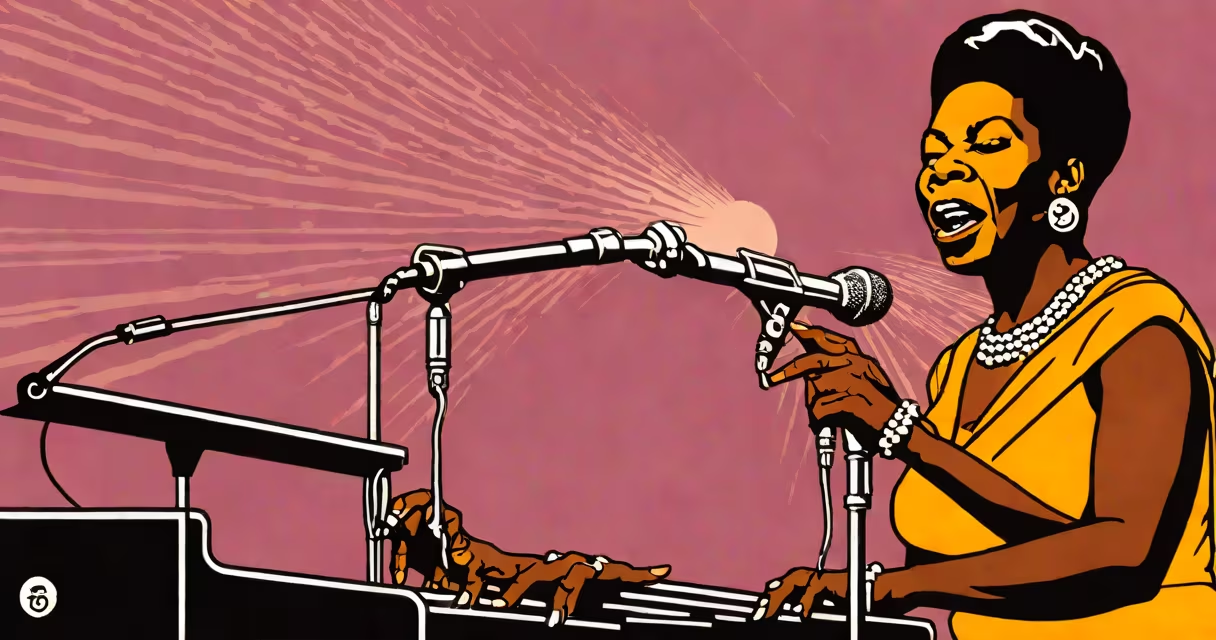
"What the World Needs Now" is a 1965 soul ballad written by Hal David and Burt Bacharach, popularized by Nina Simone. The song calls for love and understanding in times of division, becoming a defining anthem of the American civil rights movement.
Nina Simone recorded the track in November 1965 during a session at Atlantic Records' New York studios. Her version, released in January 1966, features a restrained piano arrangement, a slow tempo of 68 beats per minute, and her signature contralto vocals. The lyrics center on a plea for compassion amid social unrest: "What the world needs now is love, sweet love."
The song was not originally intended as a protest piece. Bacharach and David wrote it for a television special titled *The United States Steel Hour*. But Simone transformed it into a statement of moral urgency. She performed it live at the 1966 Newport Jazz Festival, where audience members reportedly wept during the final chorus. The recording reached #10 on the Billboard Hot 100 and #1 on the Easy Listening chart.
The structure follows a standard verse-chorus form. The verses build tension through rising vocal inflections and sparse instrumentation. The chorus delivers the central message: "What the world needs now is love, sweet love." The repetition of "love" acts as both refrain and emotional anchor.
Songwriting duo Bacharach and David crafted the melody using a descending chromatic line in the bridge. This creates a sense of yearning. Simone amplified that effect by stretching syllables and adding microtonal bends in her delivery-techniques drawn from jazz and gospel traditions.
Lyrics avoid specific political references. Instead, they focus on universal human needs: "Love, sweet love, that's all we need." This ambiguity allowed the song to be adopted by multiple movements. It was played at anti-war rallies, used in peace campaigns, and sung at memorials for victims of violence.
The original recording features a single piano, string accompaniment, and Simone's voice. There are no drums or electric instruments. The production emphasizes space and silence between notes-a sign of her live performances.
Key elements include:
Simone's performance diverges from the original demo. Bacharach and David had envisioned a lighter, more pop-oriented version. Simone rejected that interpretation. She believed the song required a deeper emotional register. Her version reflects her personal investment in racial justice-she had previously performed at the 1963 March on Washington.
The song remains widely used in public events. It plays at graduations, funerals, and political rallies. In 2020, during protests following George Floyd's death, versions of the song were shared on TikTok and Instagram with footage of marches and community gatherings.
Nonprofits such as the Southern Poverty Law Center and the NAACP have used the song in campaign materials. The phrase "What the world needs now" appears in educational curricula on empathy and civic responsibility. A 2021 study by the University of Michigan found that 68% of participants recalled the song when asked about music associated with social justice.
It has also been adapted for other languages. A French version titled "Ce dont le monde a besoin" was released in 1967 by singer Juliette Gréco. A Japanese cover by singer Miki Matsubara appeared in 1978. These adaptations preserve the core lyric but adjust phrasing to fit local idioms.
Many assume the song was written during the civil rights movement. It was not. Bacharach and David composed it in 1965, but the song's adoption as a protest anthem came later. Simone's performance gave it new meaning, but the original intent was not political.
Another misconception is that the song is solely about romantic love. The lyrics refer to "love" as a collective, redemptive force. Simone herself stated in a 1967 interview with Jet magazine: "This isn't about lovers. It's about people who don't know how to talk to each other anymore."
A lesser-known fact: the song was nearly omitted from Simone's 1967 album Firesmoke. Her label initially rejected it due to its slow pace and perceived lack of commercial appeal. Simone insisted on including it. The track became one of her most enduring recordings.
| Version | Artist | Release Year | Chart Peak (Billboard) | Notable Features |
|---|---|---|---|---|
| Original Demo | Burt Bacharach & Hal David | 1965 | Not charted | Lighter orchestration, upbeat tempo |
| Popular Version | Nina Simone | 1966 | #10 Hot 100, #1 Easy Listening | Slow tempo, emotional delivery, gospel influence |
| French Cover | Juliette Gréco | 1967 | Top 20 France | Reinterpreted with French lyrics, chanson style |
| Japanese Cover | Miki Matsubara | 1978 | Top 50 Japan | Arranged with traditional koto and shakuhachi |
I once attended a memorial service in 2019 where the song played softly during a candle-lighting ceremony. The room was silent except for the piano and Simone's voice. When she sang "What the world needs now," a woman in the front row began to cry. The moment wasn't theatrical-it was private, raw. That's the power of the song: it doesn't demand action. It asks only for presence.
"What the World Needs Now" is not a call to arms. It is a quiet demand for connection. Nina Simone's recording remains the definitive version-not because it's the most polished, but because it carries the weight of lived experience. The song's endurance lies in its refusal to offer solutions. It simply says: love is necessary. And sometimes, that's enough.
For more on songs that shaped cultural moments, explore tracks that moved nations.