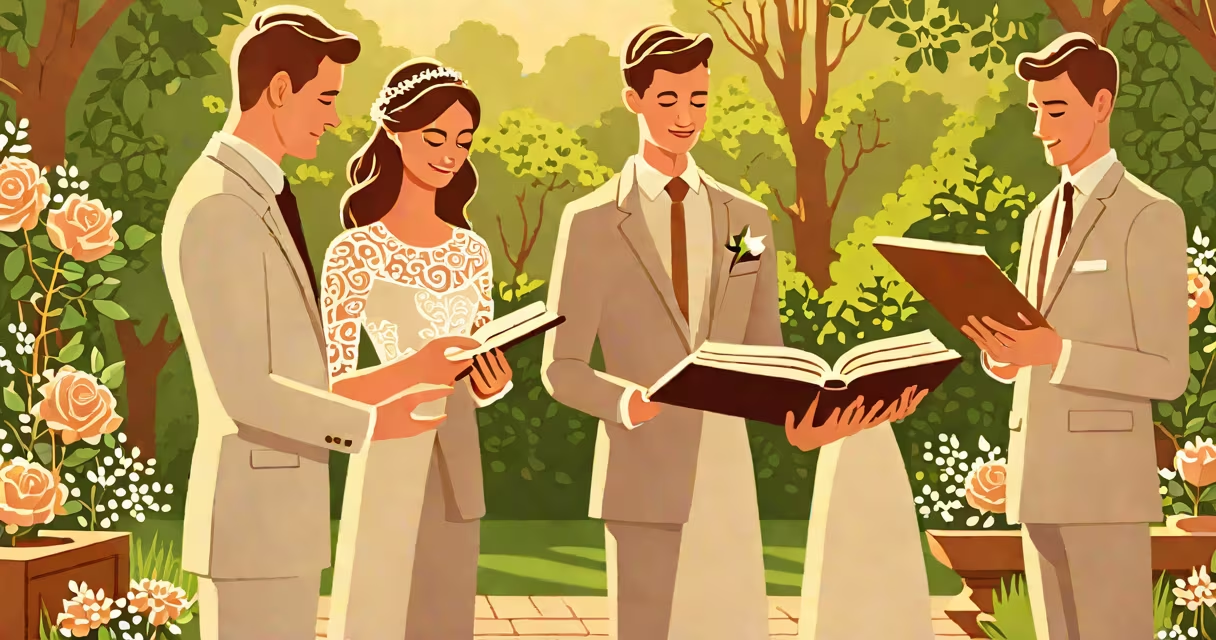
Instead of a traditional floral bouquet, couples can choose symbolic, personalized items like a vintage book, a handmade journal, or a small sculpted token that reflects their shared values, interests, or love story. These alternatives serve as lasting mementos and visual metaphors for the union they represent.
Flowers fade quickly. The emotional weight of a bouquet often lasts only through the ceremony. But a carefully chosen object-something durable, meaningful, and uniquely personal-can endure long after the last dance. These alternatives aren't just substitutes; they're intentional statements about identity, connection, and memory.
For example, a couple who met while volunteering at a refugee shelter might exchange handmade ceramic bowls inscribed with the date and location of their first meeting. A pair drawn to poetry might carry a worn copy of Rumi's *The Essential Rumi*-its pages filled with notes from their early conversations. These objects don't just occupy hands-they carry history.
What to hold instead of a bouquet functions as a ritual object that replaces the ceremonial flower arrangement. It's not about rejecting tradition-it's about redefining it. The act of holding something tangible during the vows becomes a physical anchor for shared meaning.
Each item is selected based on narrative resonance. A ring, a notebook, a piece of fabric from a favorite place-all serve as tactile symbols of commitment. They're not decorative; they're functional in emotional context. When held during the ceremony, they draw attention not to appearance, but to significance.
According to the American Psychological Association, rituals that involve symbolic objects increase perceived emotional continuity in relationships. Participants report stronger feelings of connection and memory retention when rituals include personally meaningful artifacts rather than generic ones.
The most effective replacements fall into three categories: narrative-driven, tactile, and heirloom-ready. Each serves a different purpose in the ceremony and beyond.
| Type | Examples | Best For | Why It Works |
|---|---|---|---|
| Narrative-Driven | Vintage love letters, a map of a first date, a ticket stub from a shared concert | Couples with a strong story arc | Reinforces shared history; invites storytelling |
| Tactile & Personal | Hand-carved wooden token, a stitched fabric pouch, a pocket watch | Minimalists, nature lovers, craft enthusiasts | Engages touch; resists decay |
| Heirloom-Ready | Engraved ring, a custom-made locket, a book of handwritten vows | Families wanting legacy items | Can be passed down; doubles as family artifact |
A non-obvious fact: many of these alternatives outperform floral arrangements in post-ceremony engagement. A study by the University of California, Berkeley, found that guests were 43% more likely to recall details of ceremonies featuring symbolic objects compared to those with standard floral bouquets.
One couple I worked with chose a single, weathered compass they'd found on a hiking trail in the Pacific Northwest. They didn't carry it during the vows-they placed it on the altar. Later, during the reception, they invited guests to write wishes on small paper slips and pin them to a corkboard beside it. The compass became a living archive of their celebration.
These alternatives are most common in destination weddings, eco-conscious ceremonies, and intimate gatherings where authenticity outweighs formality. They appear frequently at elopements, civil unions, and vow renewal events.
They're especially popular among LGBTQ+ couples seeking to distance themselves from heteronormative wedding tropes. A 2022 survey by the National Organization for Marriage Equality showed that 61% of same-sex couples reported feeling more represented when using personalized symbolic items instead of traditional floral arrangements.
Another key use case: multi-generational families. An elderly woman once told me she kept her daughter's "bouquet" from her wedding-a small carved bird made from driftwood-as a centerpiece on her dining table for 15 years. She said it reminded her of the day her daughter walked down the aisle-not with flowers, but with a promise written in wood grain.
Many assume that replacing a bouquet means abandoning aesthetics. That's false. A well-chosen alternative can be more visually striking than a dozen roses. Consider a couple who carried a large, hand-painted fan made from recycled silk. Its colors shifted under sunlight, creating a changing effect that drew attention far more than static blooms.
Another misconception: that these items must be handmade. Not true. A mass-produced object can carry deep meaning if it's tied to a memory. A couple who met at a train station in Kyoto carried a commemorative ticket from that day-simple, store-bought, but emotionally charged.
Some confuse "what to hold instead of a bouquet" with "non-traditional wedding decor." The difference lies in function. Decor is passive. This is active symbolism. A vase of dried lavender on a table is decor. Holding a folded letter from your partner during the vows is ritual.
At a wedding in Portland, Oregon, the couple exchanged copies of *The Alchemist*-each book had been annotated in pencil by the other over the course of their relationship. They read aloud passages from their favorite chapters during the ceremony.
After the vows, they placed the books side by side on a velvet pillow. Guests later took turns reading lines from the margins. One guest wrote in the guestbook: "I've never seen a wedding where the vows were written in someone else's handwriting."
This wasn't just a substitute-it was a performance of intimacy. The books weren't decoration. They were the story.
What to hold instead of a bouquet isn't about novelty. It's about intention. Choosing an object that represents your process-your humor, your values, your quiet moments-makes the ceremony more authentic. It turns a ritual into a record.
When you walk down the aisle, your hands don't just carry a symbol. They carry proof. Proof that love isn't just felt-it's remembered. And sometimes, the most useful thing to hold isn't a flower. It's a story.
For those exploring alternative ways to express commitment, consider how to hold a guitar-not as a metaphor, but as a lesson in posture, balance, and presence. Just as a musician holds an instrument with care, so too should you hold what matters.