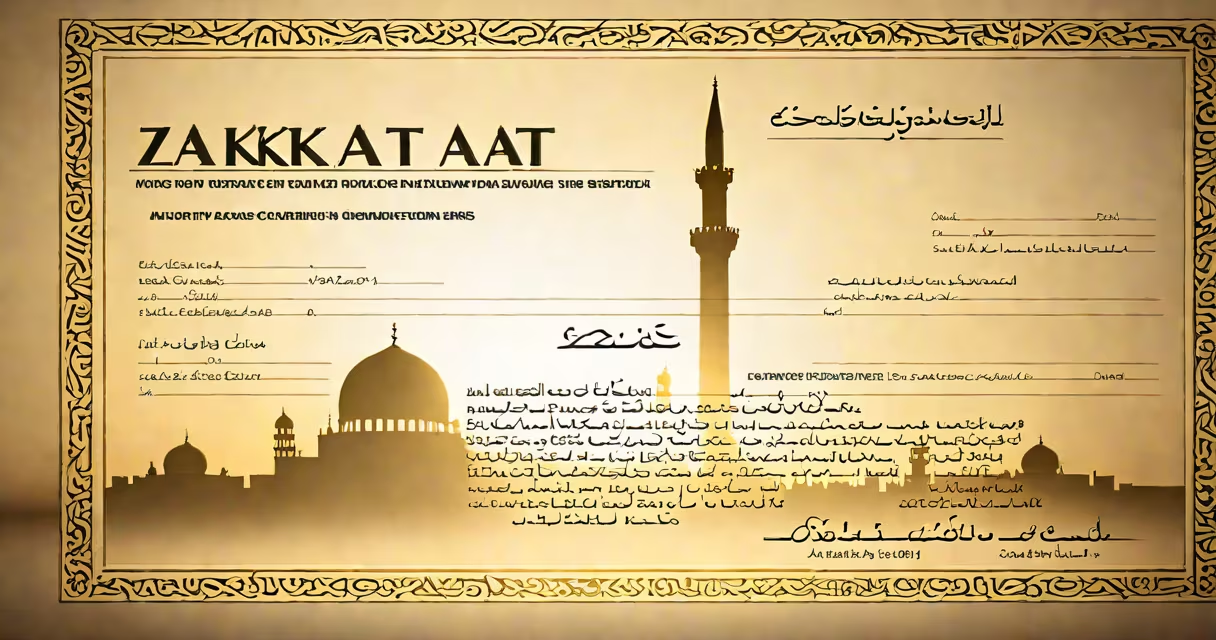
The zakat declaration form is a standardized document used by Muslims to calculate and report their annual zakat obligation, a mandatory charitable contribution under Islamic law. It details eligible assets, calculates the 2.5% zakat rate on wealth exceeding the nisab threshold, and confirms compliance with Sharia principles.
Zakat is one of the Five Pillars of Islam, requiring eligible Muslims to give 2.5% of their net savings and investments annually if they have held them for a full lunar year. The form serves as both a personal record and a tool for mosques, Islamic centers, or financial institutions to verify eligibility and track contributions. It is not a government tax form but a religious obligation documented for accountability and transparency.
While not legally enforced by secular governments, the zakat declaration form is widely used in Muslim-majority countries and communities worldwide. In Indonesia, for example, the Ministry of Religious Affairs provides official forms through local Islamic offices. In the U.S., many mosques offer downloadable versions tailored to American tax practices, though they are not filed with the IRS.
The form operates on the principle that zakat applies only to wealth above the nisab-the minimum amount of wealth that makes a person liable. Nisab is traditionally equivalent to 87.48 grams of gold or 612.36 grams of silver. As of June 2024, the silver-based nisab was approximately $470 USD, based on current market prices.
To complete the form, users list all zakat-eligible assets: cash, savings, stocks, business inventory, and investment accounts. Assets such as primary homes, vehicles, and personal belongings are excluded. The total value of eligible assets is then compared to the nisab. If the total exceeds the threshold and has been held for one lunar year (about 354 days), zakat is due.
For example, a person with $12,000 in savings, $8,000 in mutual funds, and $5,000 in gold jewelry-totaling $25,000-would owe 2.5% of that amount: $625. The form includes fields for asset categories, dates of ownership, and a signature confirming accuracy. Some versions also allow for deductions of debts owed.
Forms vary by region, institution, and purpose. Most fall into three categories:
| Type | Use Case | Provider | Key Features |
|---|---|---|---|
| Standard Mosque Form | Individuals donating through local mosques | Mosque committees | Simple layout, often printable, may include donation tracking |
| Islamic Financial Institution Form | Banked zakat from Islamic banks or investment platforms | Sharia-compliant banks (e.g., Al Rajhi, Fawry) | Integrated with account systems, auto-calculates based on balances |
| Government-Approved Form | Nations with formal zakat collection (e.g., Saudi Arabia, Pakistan) | National religious authorities | Legally binding, may require submission to state bodies |
Some institutions issue digital versions compatible with accounting software. For instance, the Islamic Relief USA website offers a web-based calculator that generates a printable declaration form. These tools reduce errors in manual calculations and improve consistency across users.
Many assume zakat applies to all income or earnings. This is incorrect. Zakat is not levied on salary or wages unless those funds are saved and held for a full lunar year. A person earning $5,000 monthly but spending it all within the month owes no zakat.
Another misconception is that zakat can be paid in kind-such as food or clothing-instead of money. While historically accepted, most contemporary scholars agree that monetary zakat is preferred because it allows flexible allocation to the most urgent needs. The Quran specifies that zakat recipients must be poor or indebted, not necessarily those who are physically hungry.
A lesser-known fact: zakat is not due on assets acquired through inheritance until one lunar year has passed since the heir took possession. This differs from regular savings, where the clock starts when the money is deposited. The form typically includes a field for "date of acquisition" to capture this nuance.
Amira, a resident of Toronto, completed her zakat declaration form for 2024. She had:
She totaled her eligible assets: $24,700. After subtracting $2,000 in debt, she reported $22,700 as taxable wealth. Applying 2.5%, her zakat liability was $567.50. She signed the form and submitted it to her local mosque's zakat committee, which verified the figures and distributed the funds to local families in need.
I once observed a community zakat drive in Chicago where volunteers processed over 120 forms in a single day. The most common error was forgetting to exclude personal-use items like a car or home. One man mistakenly included his mortgage balance as a deduction, but the form clarified that only short-term debts were eligible for offset.
The zakat declaration form is not just a checklist-it's a spiritual practice. By documenting wealth and intention, it reinforces mindfulness about material possessions and social responsibility. According to the Encyclopedia of Islam, zakat aims to purify wealth and reduce economic inequality.
When properly filled out, the form enables accurate tracking of zakat distribution. Organizations like the Islamic Society of North America (ISNA) use aggregated data to assess regional needs and allocate funds accordingly. In 2023, ISNA reported distributing over $18 million in zakat-funded aid across 37 countries.
The zakat declaration form is a practical instrument for fulfilling a core Islamic duty. It ensures fairness, accuracy, and transparency in giving. Whether used online or on paper, it remains a important tool for Muslims seeking to live according to both faith and financial responsibility.