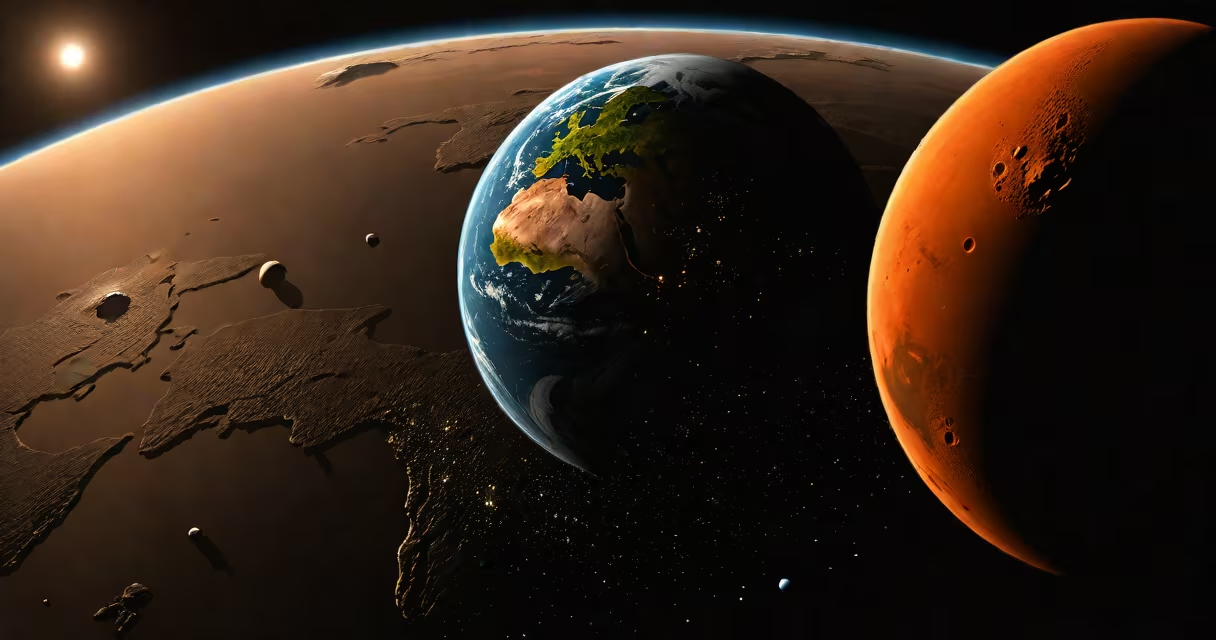
The distance from Earth to Mars ranges from approximately 54.6 million kilometers at closest approach to about 401 million kilometers at maximum separation, due to the elliptical orbits of both planets around the Sun.
Mars orbits the Sun at an average distance of 228 million kilometers, while Earth orbits at 149.6 million kilometers. Because both planets travel at different speeds and in slightly tilted, elliptical paths, their separation changes constantly. The shortest distance occurs during a Mars opposition, when Earth passes between Mars and the Sun.
At its nearest, Mars appears bright in the night sky and is ideal for launching spacecraft. The last close approach was in 2020, when the planets were 57.6 million km apart. The next such event happens in 2035. These variations are predictable using orbital mechanics models developed by NASA and the European Space Agency.
Earth completes one orbit around the Sun in 365.25 days. Mars takes 687 Earth days. Because Mars moves slower, Earth laps it roughly every 26 months. This creates a cycle of close approaches known as oppositions.
During opposition, Mars rises at sunset and remains visible all night. Its apparent brightness increases dramatically. The 2003 opposition brought Mars within 55.7 million km-its closest in nearly 60,000 years. That proximity allowed detailed imaging from Earth-based telescopes and enhanced radio communication with orbiters.
When Earth and Mars are on opposite sides of the Sun, the distance exceeds 380 million km. Communication delays during this phase can exceed 20 minutes one way, making real-time control of rovers impossible. NASA's Mars Exploration Program plans missions based on favorable launch windows occurring every 26 months.
There are three key ways to describe the distance from Earth to Mars:
| Measurement Type | Definition | Typical Range | Use Case |
|---|---|---|---|
| Closest Approach | Minimum distance during opposition | 54.6 - 57.6 million km | Spacecraft launch timing |
| Average Distance | Mean orbital separation | 225 million km | General reference |
| Maximum Separation | When planets are on opposite sides of the Sun | 401 million km | Communication delay modeling |
Scientists use astronomical units (AU) for large-scale distances. One AU equals Earth's average distance from the Sun-about 149.6 million km. Mars averages 1.52 AU from the Sun. The distance between Earth and Mars thus ranges from 0.32 AU to 2.68 AU.
For mission planning, engineers calculate trajectories using the Hohmann transfer orbit-a minimum-energy path requiring about 9 months of travel time. This route assumes launch at optimal alignment, reducing fuel costs and mission risk.
Many assume Mars is always about 100 million km away. This is incorrect. The actual distance fluctuates widely due to orbital dynamics. A static figure misrepresents the variable nature of planetary positions.
Another error is believing Mars appears red because of its distance. The planet's reddish hue comes from iron oxide (rust) on its surface. Its color is visible even through small telescopes, regardless of distance.
A lesser-known fact: light takes between 3 and 22 minutes to travel from Mars to Earth depending on position. During the 2020 close approach, signals took about 3 minutes and 20 seconds one way. This delay affects rover operations-commands must be pre-programmed, not sent in real time.
The Perseverance rover launched on July 30, 2020, when Earth and Mars were approaching opposition. At launch, the distance was 206 million km. The spacecraft traveled 472 million kilometers over 203 days to reach Mars.
Entry, Descent, and Landing (EDL) occurred on February 18, 2021. The signal confirming touchdown arrived on Earth 11 minutes and 22 seconds after the event-due to the distance at that moment. The delay meant controllers had to wait for confirmation, not react instantly.
During the cruise phase, the spacecraft's navigation team adjusted course weekly using star trackers and Doppler radar. These corrections accounted for gravitational influences from Jupiter and Venus, which subtly alter trajectory over months.
Accurate distance tracking enables safe, efficient space exploration. Without precise orbital calculations, missions risk missing their targets or consuming excessive fuel. The Jet Propulsion Laboratory uses tools like the Horizons System to predict planetary positions with millimeter accuracy over decades.
Understanding the distance from Earth to Mars also helps interpret data from orbiters and landers. For example, the Mars Reconnaissance Orbiter sends images at 256 kilobits per second. At maximum distance, download times increase -sometimes taking hours for a single high-resolution frame.
For context, the average distance from Earth to Mars is greater than the distance from Earth to the Sun. This underscores the scale of interplanetary travel. Future crewed missions will require advanced life support systems and radiation shielding, given the extended transit times and exposure risks.
When planning future expeditions, scientists rely on long-term orbital predictions. The next favorable launch window occurs in 2026. By then, the distance will be under 80 million km at closest approach-ideal for minimizing travel time and resource use.