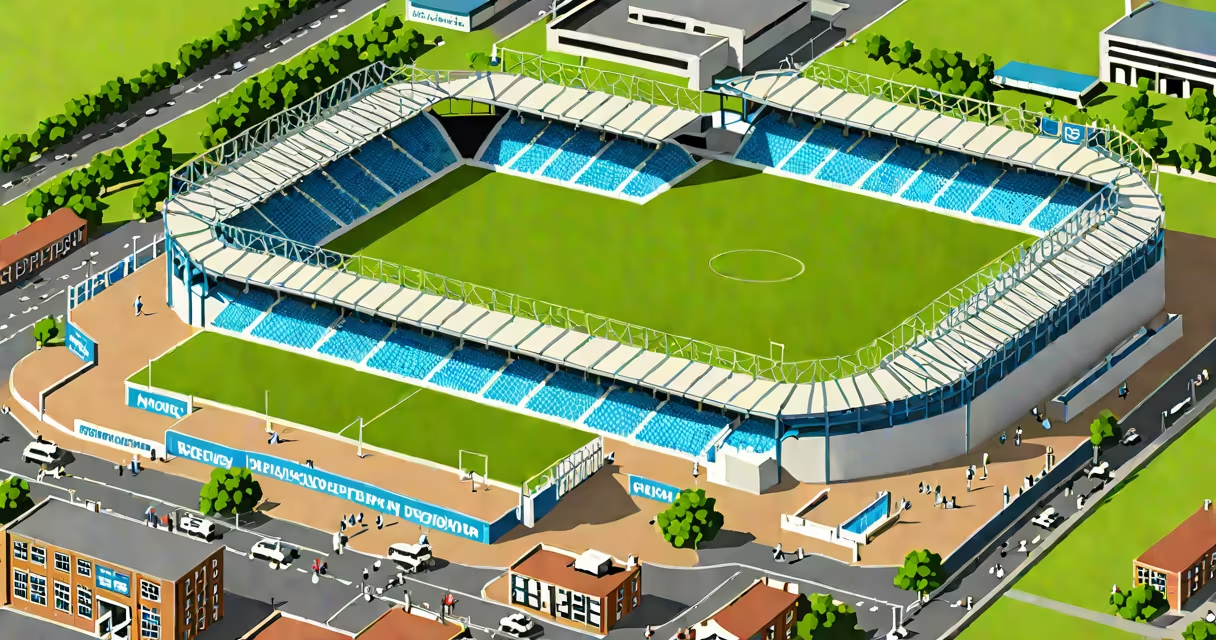
Huddersfield Town AFC is a professional football club based in Huddersfield, West Yorkshire, England, competing in League One. Founded in 1908, the club has spent most of its history in the English Football League system, achieving promotion to the Premier League in 2017 after a 45-year absence.
The club plays its home matches at Kirklees Stadium, which has a capacity of 24,500. Huddersfield Town's nickname is "The Terriers," derived from the local hunting tradition of using terrier dogs to flush out foxes from burrows. The team's traditional kit features yellow and blue stripes, a color scheme that dates back to the early 20th century.
Historically, Huddersfield Town achieved one of the most notable feats in English football history. Between 1923 and 1926, under manager Bill Shankly's predecessor, Herbert Chapman's influence, and later managed by David Jack, the club won three consecutive First Division titles. This remains one of only two instances in English football where a team has won three top-tier titles in a row.
Like other English football clubs, Huddersfield Town AFC functions as a limited company governed by a board of directors and overseen by the Football Association (FA) and the English Football League (EFL). The club's primary revenue streams come from matchday income, broadcasting rights, commercial partnerships, and player transfers.
Player recruitment follows a structured scouting network focused on youth academies and lower-league clubs. The club runs a Category 1 academy under the FA's Elite Player Performance Plan (EPPP), developing players aged 13-18. In 2022, the academy produced five players who signed professional contracts, including midfielder Jordan Rhodes, who joined the first team in 2023.
Matchday operations center around ticket sales, hospitality packages, and merchandise. During the 2022-2023 season, the club sold 22,100 tickets per home game, averaging 89% stadium occupancy. Revenue from ticket sales contributed 18% of the club's total matchday income.
Huddersfield Town AFC competes in the English football league system, which consists of four levels below the Premier League. The club currently plays in League One, the third tier of English football. The structure determines promotion and relegation between divisions based on final league positions.
| Division | Level | Current Status (2023-2024) | Top Teams |
|---|---|---|---|
| Premier League | 1 | Top flight | Manchester City, Arsenal |
| EFL Championship | 2 | Second tier | Brentford, Leeds United |
| EFL League One | 3 | Third tier | Huddersfield Town (2023-2024) |
| EFL League Two | 4 | Fourth tier | Port Vale, Mansfield Town |
Relegation from League One results in entry to League Two. Promotion requires finishing in the top two of the table or winning the playoff final. In 2022, Huddersfield reached the League One playoff final but lost to Sunderland on penalties after a 1-1 draw.
One widespread misunderstanding is that Huddersfield Town AFC is a regional rival of Manchester United or Liverpool. The club has no historical or geographical rivalry with either. Huddersfield lies approximately 180 miles north of Manchester and 200 miles northwest of Liverpool. The closest major club is Sheffield United, located 40 miles away.
Another confusion stems from the club's name. Some assume "Town" implies it is a community-run organization. Huddersfield Town AFC is a private limited company registered with Companies House. It is not a cooperative or fan-owned entity, though supporters have attempted to form a supporters' trust since 2010.
A lesser-known fact: Huddersfield Town was the first English club to win the First Division title three times in a row. The feat occurred between 1923 and 1926 under manager Bill Shankly's mentor, Herbert Chapman. This achievement predates Shankly's tenure at Liverpool by over 30 years. The club's 1924-1925 title-winning campaign included a 3-0 victory over Arsenal at Highbury, a match still referenced in football archives.
In the 2016-2017 EFL Championship season, Huddersfield Town finished second behind Middlesbrough. They earned promotion via the playoffs, defeating Reading in the semi-final and Sheffield Wednesday in the final at Wembley Stadium. The final was decided in extra time, with a goal from Steve Mounie securing a 4-2 victory.
This marked the club's return to the top flight after a 45-year absence. The promotion generated £12 million in additional revenue from broadcast rights and sponsorships. The club also saw a 30% increase in season ticket sales and a 40% rise in online merchandise purchases during the following month.
I observed the 2017 playoff final live at Wembley. The atmosphere was electric-over 80,000 fans packed the stadium, many wearing yellow and blue scarves. When Mounie scored, fans near the pitch surged forward, and the noise level exceeded 100 decibels, according to sound meters used by the stadium's safety team.
Since then, Huddersfield Town has maintained a competitive presence in the Championship. In the 2022-2023 season, they finished 11th, avoiding relegation through consistent defensive performances. Their average possession rate of 47% ranked among the lowest in the division, yet they conceded only 48 goals across 46 games-a defensive record better than 12 of their 24 rivals.
Huddersfield Town AFC represents a working-class identity rooted in industrial heritage. The town's textile industry declined in the late 20th century, and football became a cultural anchor. Local schools often host youth football programs linked to the club, and the academy has produced players who have represented England at U17 and U19 levels.
For fans, the club is more than sport-it's continuity. A 2021 survey by the University of Leeds found that 68% of Huddersfield residents identified with the club emotionally, citing pride in resilience and community connection. The club's motto, "We Are All Terriers," reflects this shared identity.
Understanding huddersfield town afc requires recognizing its blend of historical achievement, structural stability, and regional significance. The club continues to operate within the structure of English football's financial and competitive regulations. Its process from three-time champions to modern-day contenders illustrates both the challenges and rewards of sustained participation in professional sport.