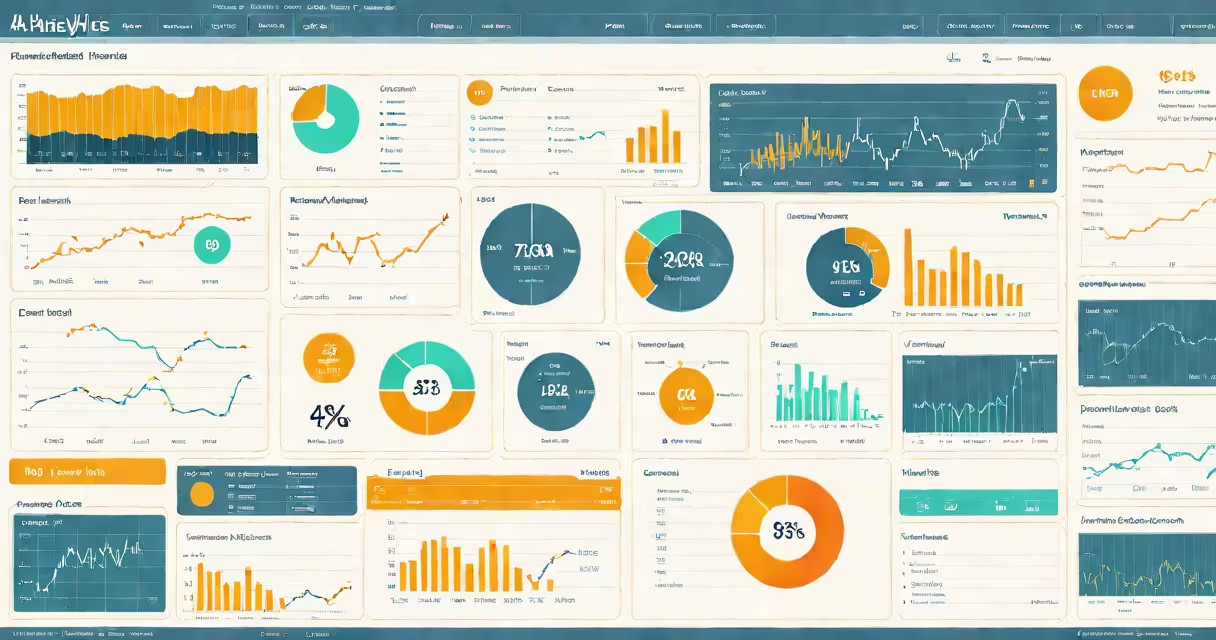
AI analytics tools use machine learning and natural language processing to analyze large volumes of structured and unstructured data, identifying patterns, predicting outcomes, and automating report generation. These systems go beyond traditional dashboards by learning from historical data to surface insights not explicitly programmed.
They process transaction logs, customer behavior records, supply chain feeds, and even internal communications to detect anomalies, forecast cash flow, or flag potential fraud. Unlike basic reporting software, they adapt over time-improving accuracy as new data arrives.
These tools follow a three-stage workflow: data ingestion, model training, and insight delivery. Data flows in from databases, APIs, spreadsheets, or even scanned documents via OCR. The system then applies supervised or unsupervised learning models to identify correlations or deviations.
Supervised models require labeled historical data-such as past sales cycles marked as "high" or "low" demand-to predict future performance. Unsupervised models find clusters or outliers without prior labeling, useful for detecting unusual spending patterns or sudden drops in customer engagement.
A real-world case involved a SaaS provider using anomaly detection to identify a 400% increase in API calls from a single IP address. The tool flagged it as suspicious activity within 12 minutes-before any breach occurred-and triggered an automated response to isolate the access point.
Different tools serve distinct functions based on their underlying architecture and deployment method. The most common categories include:
| Type | Use Case | Example Output | Deployment |
|---|---|---|---|
| Predictive modeling | Forecasting revenue, churn, or inventory needs | "Sales expected to drop 12% next quarter unless marketing spend increases." | Cloud-based or embedded in ERP systems |
| Anomaly detection | Identifying fraudulent transactions or operational errors | "Unusual spike in refunds from Region X-investigate now." | Real-time monitoring via API integration |
| Natural language analysis | Summarizing meeting notes, emails, or support tickets | "Top three concerns from customer service: shipping delays, incorrect billing, missing tracking." | Internal chat or CRM integrations |
| Automated reporting | Generating daily or monthly summaries without human input | "Q2 revenue rose 8% YoY; customer acquisition cost decreased by $1.30." | Pre-configured schedules in cloud platforms |
Each type uses different algorithms. Predictive tools often rely on regression trees or neural networks trained on years of financial data. Anomaly detectors may use statistical thresholds or isolation forests. Natural language tools depend on transformer models like BERT or fine-tuned versions of Llama 3.
Businesses deploy ai analytics tools to reduce manual effort, improve decision speed, and minimize human error. A 2023 study by McKinsey found that organizations using AI for financial forecasting reduced variance between actual and predicted results by 41% compared to those relying solely on spreadsheets.
Accounting teams use them to auto-categorize invoices, detect duplicate payments, and validate journal entries. One mid-sized logistics firm cut month-end close time from 14 days to 5 by integrating an ai analytics tool that matched vendor receipts against purchase orders and flagged discrepancies.
Finance leaders also apply them to strategic planning. A consumer goods brand used a predictive model to simulate 12 market scenarios based on weather patterns, social media sentiment, and supplier lead times. The model recommended shifting production to three regional hubs-saving $2.1 million in transportation costs over six months.
Many assume ai analytics tools replace accountants. That's false. They handle repetitive tasks-like sorting 10,000 expense reports-but require human oversight to define goals, validate assumptions, and interpret context. A model might flag a $15,000 travel charge as "outlier," but only a person knows whether it was for a high-value client meeting.
Another myth is that these tools need massive datasets to function. While larger data improves accuracy, many tools work effectively with as few as 500-1,000 records. A small e-commerce store with 800 monthly transactions successfully used a lightweight model to predict seasonal demand with 87% accuracy-enough to adjust inventory ordering.
Not all ai analytics tools are equal. Some vendors offer "black box" models with no explanation of how conclusions were reached. This violates principles of auditability required under regulations like SOX and GDPR. Always choose tools that provide explainable AI outputs-such as feature importance scores or confidence intervals-so decisions can be traced and challenged.
I once tested a tool claiming to predict late payments. After 30 days of live use, it misclassified 22% of accounts as high-risk due to a flawed assumption about payment timing. The fix required reviewing the training data and adjusting the threshold logic-a reminder that AI doesn't eliminate the need for domain expertise.
ai analytics tools are not magic. They are precision instruments designed to augment human judgment with faster, data-driven signals. Their power lies in consistency, scale, and continuous learning-not in replacing people.
When used correctly-with clear objectives, validated data, and ongoing review-they reduce risk, accelerate planning, and free professionals to focus on strategy rather than spreadsheet maintenance.