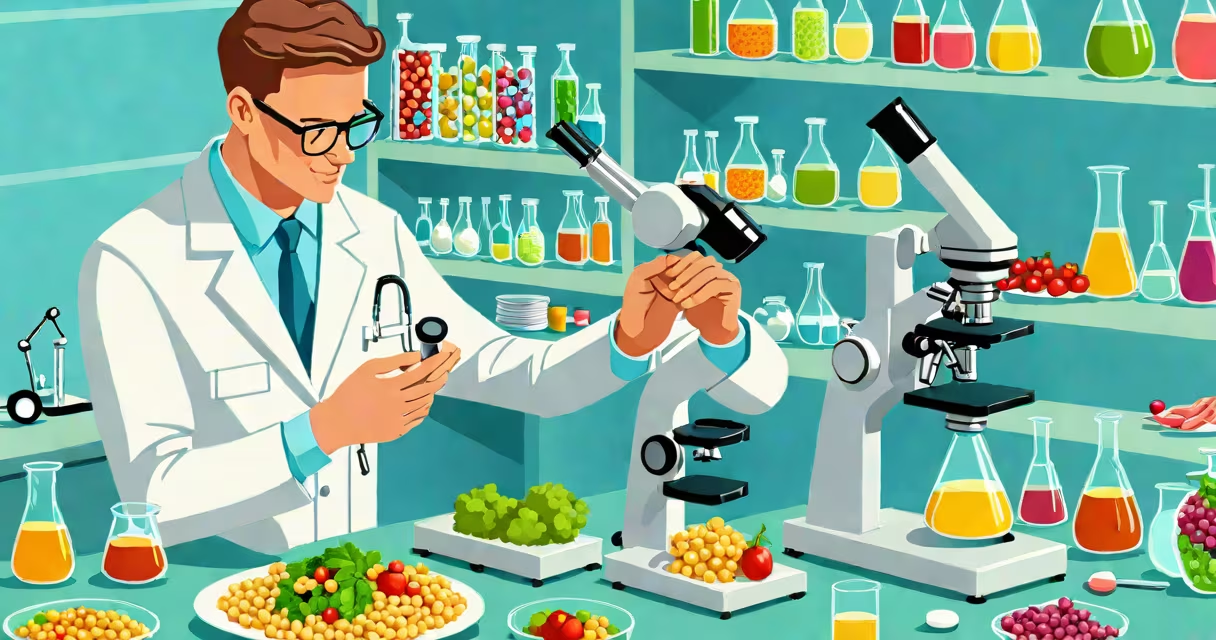
A master in food science and technology is a graduate-level academic program that trains students in the scientific principles behind food production, safety, quality control, and innovation. The degree integrates chemistry, microbiology, engineering, and nutrition to develop solutions for modern food systems, preparing graduates for careers in research, regulatory affairs, product development, and manufacturing.
This program typically requires a bachelor's degree in a related field such as biology, chemistry, chemical engineering, or food science. Students complete coursework in food chemistry, food processing, sensory evaluation, food safety regulations, and statistical analysis. Many programs also require a thesis or capstone project involving original research or applied industry work.
Graduates often pursue roles in large food corporations, government agencies like the FDA or USDA, academic institutions, or consulting firms focused on food system sustainability and public health. The degree is especially valuable for those aiming to lead teams developing new products, ensuring compliance with international food standards, or improving shelf life and nutritional content.
Master in food science and technology programs follow a structured curriculum designed around three pillars: foundational science, applied practice, and independent research. Courses in food chemistry cover molecular interactions in ingredients-such as how proteins denature during cooking or how fats affect texture. Food microbiology focuses on pathogen control, fermentation processes, and spoilage mechanisms.
Applied courses teach students how to design pilot-scale production systems. For example, a student might learn to model heat transfer in retort processing to ensure canned foods meet sterilization standards. These skills are validated through hands-on lab sessions using equipment like high-performance liquid chromatography (HPLC) machines and gas chromatographs to detect contaminants or measure nutrient levels.
Most programs culminate in a research project. One student at the University of California, Davis, developed a plant-based meat alternative using pea protein and enzymatic cross-linking techniques. The project included consumer taste testing, stability analysis over time, and cost modeling-results published in a peer-reviewed journal and later licensed to a startup.
While all master in food science and technology degrees share core competencies, they differ in focus areas. Some programs emphasize food safety and regulatory compliance, others prioritize novel food formulation or sustainable processing methods.
| Type | Focus Area | Typical Career Path | Example Institution |
|---|---|---|---|
| Research-Oriented | Novel ingredient development, functional foods | Academic research, biotech R&D | University of Wisconsin-Madison |
| Industry-Focused | Process optimization, scale-up, automation | Food manufacturing, plant operations | Purdue University |
| Regulatory & Safety | HACCP planning, allergen control, labeling compliance | FDA, USDA, private certification bodies | Michigan State University |
Students may also choose dual concentrations, such as combining food science with environmental science to study the carbon footprint of packaged goods. A 2022 study by the Institute of Food Technologists found that 68% of food science graduates with dual specializations secured jobs within six months of graduation-compared to 49% without.
Industries rely on master in food science and technology graduates to reduce waste, improve nutritional profiles, and meet evolving consumer demands. For example, in 2023, Nestlé launched a new line of low-sodium soups developed by a team led by a graduate from the University of Minnesota. The formulation reduced sodium by 35% while maintaining flavor intensity-achieved through targeted use of umami compounds like yeast extract.
Regulatory bodies also depend on this expertise. The U.S. Food and Drug Administration (FDA) employs food scientists to evaluate new food additives and assess risks associated with emerging technologies like cultured meat. According to the FDA's 2023 annual report, 72% of new food product approvals involved input from individuals holding advanced degrees in food science.
A common misconception is that this degree leads only to lab work. In reality, many holders work in sales, marketing, or supply chain management-using technical knowledge to inform business decisions. One alumnus from Cornell University transitioned from a research role to become a product manager at General Mills, where he led the launch of a gluten-free cereal line based on consumer preference data and shelf-life testing.
The term "food science" is often conflated with "nutrition." While both fields study food, nutrition focuses on human dietary needs and health outcomes. Food science addresses the physical, chemical, and biological properties of food materials during processing and storage. A master in food science and technology is not equivalent to a dietetics or clinical nutrition degree.
Another confusion arises between this degree and a master in food technology. Though similar, the former emphasizes scientific understanding and analytical methods, while the latter may lean toward industrial application and production efficiency. The distinction matters: a food scientist might determine why a yogurt separates during shipping; a food technologist would redesign the packaging and distribution process to prevent it.
This degree is not interchangeable with a master in science in general. Programs labeled "MS in Science" are broad and may lack discipline-specific rigor. A master in food science and technology requires specialized training in microbial control, rheology, and thermal processing-skills not covered in generic science programs. As noted by the American Council on Education, only 32% of MS degrees in science are accredited specifically for food-related disciplines.
During my time teaching food processing at a regional university, I observed that students who entered the program with prior lab experience in biochemistry were more likely to complete their capstone projects on schedule. Those without foundational lab skills struggled with basic techniques like titration and spectrophotometry-highlighting the importance of prerequisite knowledge.
Graduates of this program play a important role in shaping the future of food. From reducing foodborne illness outbreaks to designing climate-resilient crops, the impact extends beyond the lab. The degree equips professionals to address complex challenges-from reducing plastic packaging in fresh produce to creating affordable fortified foods for underserved communities.
Understanding the master in food science and technology reveals its role not just as academic training, but as a practical tool for advancing public health, economic resilience, and environmental sustainability in the global food system.