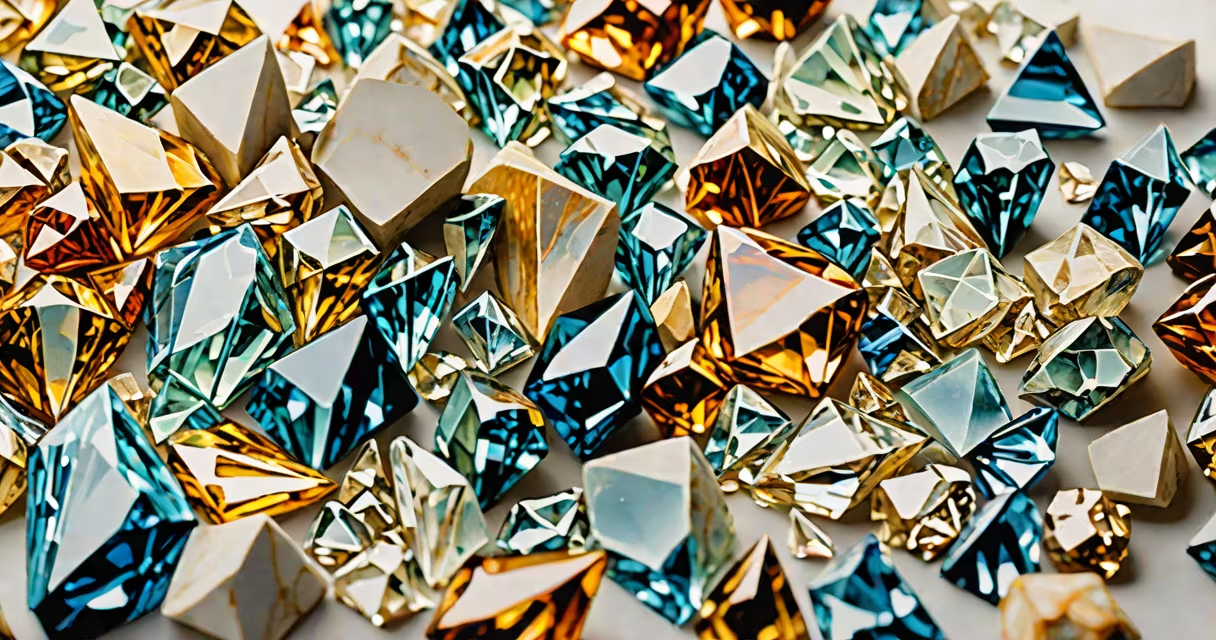
Mineral density is the mass of a mineral per unit volume, typically measured in grams per cubic centimeter (g/cm³). It reflects how tightly atoms are packed within the mineral's crystal structure and varies between different minerals.
Each mineral has a unique density based on its chemical composition and atomic arrangement. For example, galena (lead sulfide) has a density of about 7.5 g/cm³, while quartz has a density of approximately 2.65 g/cm³. This difference arises because lead atoms are heavier than silicon and oxygen atoms, even though both minerals have similar crystal structures.
Density is not the same as weight. A small piece of gold feels heavy because it has high density, not because it is large. In geology, measuring mineral density helps distinguish between similar-looking rocks and identify valuable ore minerals during exploration and mining operations.
Mineral density is calculated using the formula: density = mass ÷ volume. Scientists measure the mass of a mineral sample using a precision scale, then determine its volume through water displacement-immersing the sample in a graduated cylinder and measuring how much water it displaces.
This method, known as the Archimedes principle, relies on the fact that the volume of displaced liquid equals the volume of the solid. For example, a 10-gram sample of hematite (iron oxide) displaces 3.5 mL of water, resulting in a density of 2.86 g/cm³ (10 ÷ 3.5).
Modern labs often use automated densitometers that combine precise weighing with controlled fluid immersion to measure density quickly and accurately. These instruments reduce human error and allow rapid screening of hundreds of samples during mineral exploration campaigns.
Mineral density falls into three practical categories based on typical values:
| Density Range (g/cm³) | Common Minerals | Typical Applications |
|---|---|---|
| Less than 2.5 | Quartz, calcite, feldspar | Construction aggregates, glass production |
| 2.5 - 4.5 | Hematite, pyrite, garnet | Ore identification, industrial abrasives |
| Greater than 4.5 | Galena, sphalerite, native gold | Metals extraction, high-value prospecting |
High-density minerals like galena and sphalerite are often targeted in mining because they contain concentrated metals. Their density allows them to be separated from lighter gangue materials using gravity separation techniques such as jigs or shaking tables.
Geologists use density to estimate the metal content in ore bodies. For instance, a rock sample with a density above 5.0 g/cm³ is likely to contain significant amounts of heavy metals like lead or zinc. This helps prioritize which samples to analyze further using X-ray fluorescence or inductively coupled plasma mass spectrometry.
Mineral density is often confused with specific gravity, but they are related yet distinct concepts. Specific gravity is the ratio of a mineral's density to that of water at 4°C (1 g/cm³). While density has units (g/cm³), specific gravity is dimensionless. For example, a mineral with a density of 3.0 g/cm³ has a specific gravity of 3.0.
A common mistake is assuming that high density always indicates economic value. While dense minerals like gold and platinum are valuable, many dense minerals-such as barite (density ~4.5 g/cm³)-are used as drilling mud weighting agents rather than mined for profit. Value depends on both density and market demand.
Another misconception is that density changes with size. A 1-gram piece of magnetite has the same density as a 1-kilogram piece. Density is an intensive property-it does not depend on quantity. Only the mass and volume change proportionally.
In a field survey in Nevada, a geologist collected 15 rock fragments from a suspected vein deposit. After cleaning and drying each sample, she weighed them and recorded masses ranging from 1.2 to 8.7 grams. She then measured their volume using a graduated cylinder filled with water.
One sample had a mass of 5.4 grams and displaced 1.8 mL of water. Its density was calculated as 5.4 ÷ 1.8 = 3.0 g/cm³. Based on known mineral densities, this value matched pyrite (FeS₂), which has a typical density of 5.0 g/cm³-but wait, the result was lower. The discrepancy indicated the sample was not pure pyrite but a mixture with lighter quartz.
Further analysis confirmed that the sample contained 60% pyrite and 40% quartz. The average density was therefore lower than expected. This demonstrated that density alone cannot confirm purity-context matters. The geologist combined density data with visual inspection and microscopic examination to assess ore quality.
She later verified the presence of economically viable pyrite concentrations by comparing her results with historical data from nearby mines. This integration of physical properties with geological context improved the accuracy of resource estimation.
According to the U.S. Geological Survey (USGS), accurate density measurements are essential for estimating ore reserves and planning mine development. The USGS notes that density data reduces uncertainty in resource modeling, especially when combined with other physical properties like magnetic susceptibility or electrical resistivity.
The International Union of Geological Sciences (IUGS) emphasizes that density is a fundamental parameter in mineral classification systems. The IUGS standardizes reference values for over 4,000 known minerals, enabling consistent comparisons across global databases.
Field teams often carry portable density kits with calibrated weights and small displacement cylinders. These tools allow quick screening of samples in remote locations, reducing the need to transport bulky lab equipment. In one study published in *Economic Geology*, researchers found that field-based density tests reduced initial processing time by 37% compared to sending all samples to central labs.
During a 2022 project in northern Canada, a team used handheld density meters to sort drill core samples. They identified zones with consistently high density (>4.0 g/cm³) and flagged them for deeper geochemical analysis. This led to the discovery of a previously undetected zinc-rich zone, increasing the estimated resource size by 22%.
Mineral density is a measurable physical property that reveals how compact a mineral's atomic structure is. It plays a key role in distinguishing between rock types, identifying potential ore deposits, and guiding mining decisions. Understanding it correctly prevents misidentification and improves efficiency in geological work.