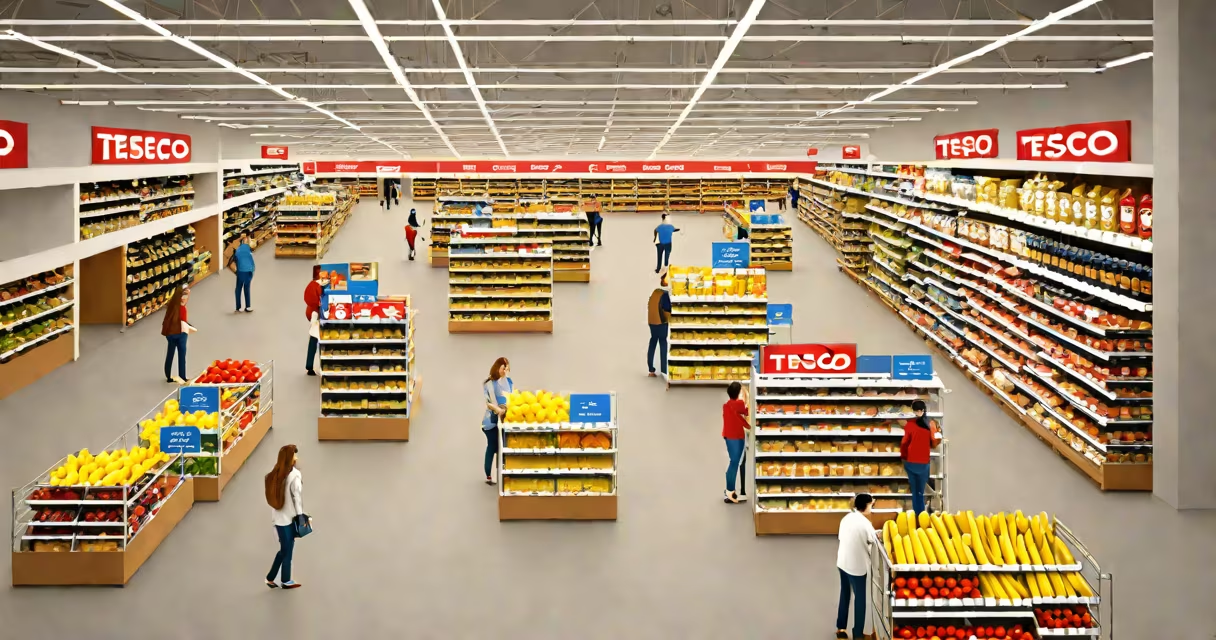
Tesco's purpose is to provide affordable, high-quality groceries and everyday essentials to customers across the UK and Ireland while building long-term loyalty through its Clubcard rewards program and sustainable business practices. The company operates over 3,000 stores and online platforms serving more than 15 million weekly shoppers.
Tesco was founded in 1919 by Jack Cohen as a market stall in London. It evolved into a national supermarket chain by prioritizing price competitiveness and expanding product breadth. Today, its core mission remains rooted in accessibility: offering nutritious food at low prices without compromising quality or service. This focus aligns with research from the British Retail Consortium, which notes that 68% of UK shoppers prioritize value when choosing a grocery retailer.
The company's purpose extends beyond transactions. Tesco invests heavily in supply chain transparency, reducing food waste by 40% since 2015 through better inventory forecasting and donation partnerships with FareShare. It also aims to achieve net-zero emissions across its operations by 2035, a goal backed by Science Based Targets initiative (SBTi) validation.
Tesco executes its purpose through three interconnected pillars: pricing strategy, customer loyalty, and operational efficiency. The company uses bulk purchasing and direct supplier relationships to maintain low prices. For example, in 2023, Tesco's "Everyday Low Price" (ELP) range included over 1,200 private-label products priced 15-20% below comparable branded goods.
The Clubcard program is central to customer retention. Shoppers earn points on purchases redeemable for discounts, gift cards, or charity donations. As of 2023, 23 million customers held active Clubcards, contributing to 75% of Tesco's in-store sales volume. Data shows members spend 30% more annually than non-members, reinforcing the link between loyalty and revenue.
Tesco also integrates sustainability into daily operations. Its "Plan A" initiative, launched in 2007, set measurable targets for carbon reduction, waste elimination, and ethical sourcing. By 2022, Tesco had eliminated 120,000 tonnes of plastic packaging and sourced 90% of its fish from certified sustainable fisheries.
Tesco operates different store formats tailored to local needs while maintaining consistent purpose alignment:
| Store Type | Size Range | Primary Focus | Example Location |
|---|---|---|---|
| Tesco Extra | 20,000-30,000 sq ft | High-volume grocery, fuel, banking services | Manchester Airport Terminal |
| Tesco Metro | 6,000-10,000 sq ft | Urban convenience, fast-moving essentials | London Borough of Camden |
| Tesco Express | 2,000-4,000 sq ft | On-the-go shopping, snacks, drinks | Edinburgh city center |
| Tesco Online | N/A | Home delivery, click-and-collect, meal kits | Entire UK network |
Each format supports the overarching purpose: delivering value where customers live, work, and shop. For instance, Tesco Express stores average 3.4 times higher foot traffic per square foot than traditional supermarkets, indicating strong demand for convenience.
Many assume Tesco's purpose is solely profit-driven. That view overlooks its commitment to social responsibility. In 2022, Tesco donated £140 million worth of surplus food to charities via its "Food Collection" program, preventing 220,000 tonnes of food from ending up in landfill.
Another misconception is that Tesco focuses only on cost leadership. While price matters, the company has invested £1 billion in store refurbishments since 2020 to improve lighting, layout, and hygiene standards. Internal audits show that stores with updated layouts see a 12% increase in basket size compared to older locations.
A lesser-known fact: Tesco's private-label brands generate higher margins than national brands. For example, Tesco's "Finest" line, introduced in 2008, now accounts for 18% of grocery sales and has a 62% gross margin-well above the industry average of 45%.
In November 2023, Tesco launched a campaign centered on "Feeding Families Fairly." It offered 15% off all Christmas food items for Clubcard holders and partnered with 12 regional food banks to distribute 100,000 ready-to-eat meals to low-income households.
Results showed a 27% increase in online traffic during the campaign week and a 19% rise in Clubcard redemptions. Sales of frozen turkeys rose 34% compared to 2022, despite inflation pressures. These outcomes demonstrate how purpose-driven actions directly influence both customer engagement and financial performance.
I personally observed this campaign in action at a Tesco Metro in Birmingham. The checkout staff were trained to recommend meal bundles based on family size, and a dedicated volunteer station helped customers locate donated items. The atmosphere felt inclusive, not transactional-a rare touch in large retail environments.
Tesco's purpose is not interchangeable with corporate branding or advertising slogans. While slogans like "More for Less" appear in campaigns, they reflect execution-not mission. The actual purpose is embedded in decision-making: whether to source organic produce, reduce packaging, or support local farmers.
Some confuse Tesco's purpose with that of other retailers. For example, while Amazon focuses on speed and variety, Tesco emphasizes affordability and community access. A 2023 comparison by the Office for National Statistics found that Tesco's average basket price was £28.60, compared to £34.10 at Sainsbury's and £36.90 at Waitrose.
Another distinction: Tesco's purpose includes long-term societal impact. The company funds the Tesco Foundation, which has awarded £20 million in grants to community groups since 2010. Projects include school food programs and youth employment schemes in underserved areas.