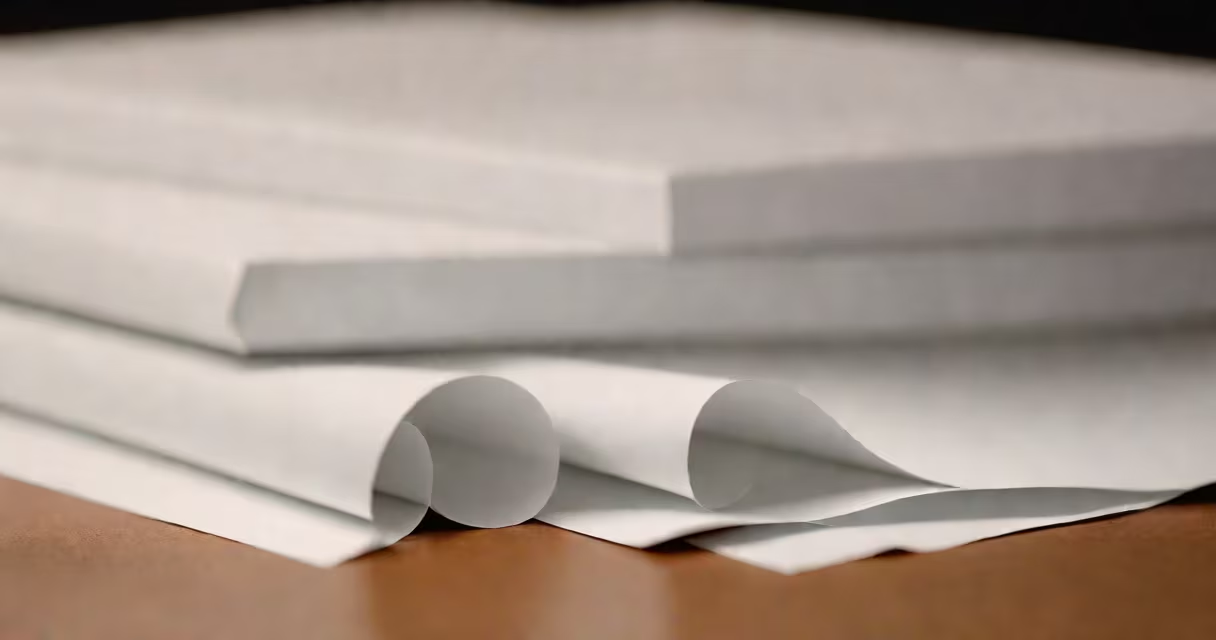
White bond paper is a standard-grade paper made from wood pulp and recycled fibers, known for its stiffness, durability, and consistent whiteness. It's commonly used for printing, writing, and official documents due to its resistance to tearing and fading.
Bond paper originated in the 19th century as a stronger alternative to rag paper. Today, it's standardized by the American Society for Testing and Materials (ASTM) and the International Organization for Standardization (ISO). The term "bond" refers to the paper's strength and surface finish, not its color-though white is the most common variant.
White bond paper typically ranges from 20 lb to 32 lb in weight, with 20 lb being standard for everyday office use. Heavier weights offer better opacity and feel more substantial. For reference, 20 lb bond paper measures about 0.003 inches thick-roughly the width of three human hairs.
White bond paper is manufactured through a process called the Fourdrinier method. Wood pulp is mixed with water, spread onto a moving wire mesh, pressed to remove moisture, and dried on heated rollers. Additives like optical brighteners improve whiteness without increasing cost.
The paper's strength comes from long cellulose fibers arranged in a random, interlocking pattern. This structure resists tearing under normal handling. Unlike glossy photo paper, bond paper has a matte or semi-gloss finish that reduces glare and improves readability.
For example, a 20 lb bond sheet measuring 8.5 x 11 inches weighs approximately 0.16 ounces. A ream of 500 sheets weighs about 2.5 pounds. This consistency allows printers and copiers to handle large volumes without jamming.
White bond paper comes in several grades based on weight and finish. The most widely used are:
| Weight (lb) | Thickness (inches) | Common Use | Example Application |
|---|---|---|---|
| 20 | 0.003 | Everyday printing | Office memos, school handouts |
| 24 | 0.0035 | Presentations, reports | Business proposals, printed brochures |
| 28 | 0.004 | Formal documents | Contracts, legal forms, resumes |
| 32 | 0.0045 | High-end stationery | Invitations, business cards, letterheads |
While 20 lb is standard for most printers, heavier weights are preferred for professional materials. A 28 lb sheet feels noticeably stiffer and holds ink better than lighter versions, reducing bleed-through on double-sided prints.
It's frequently used in schools, offices, and print shops. In my experience, a local print shop switched from 20 lb to 28 lb bond for client contracts. The difference was immediate-the pages didn't warp when handled, and the ink stayed crisp under light exposure.
White bond paper is often mistaken for printer paper, copy paper, or regular office paper. These terms are sometimes used interchangeably, but they're not equivalent. Printer paper is a broad category that includes bond, glossy, and recycled varieties. Copy paper is a generic term for any paper used in photocopiers, which may be low-grade or coated.
A key distinction lies in fiber quality. Bond paper uses longer fibers and higher tensile strength. You can test this by holding a sheet up to a light. Bond paper shows less translucency than standard copy paper. For example, a 20 lb bond sheet blocks 95% of light; a typical 20 lb copy paper may allow 30% through.
Another common error is assuming all white paper is suitable for laser printing. Some coated papers melt or scorch in toner-based printers. Bond paper is safe for both inkjet and laser devices because it has a balanced absorbency and heat tolerance. According to the National Association of Printers and Publishers (NAPP), bond paper maintains integrity at temperatures up to 400°F during fusing.
White bond paper remains a benchmark for document quality. Its durability ensures records survive years of handling. The U.S. Government Printing Office requires bond paper for federal forms to prevent degradation and ensure legibility over time.
In education, teachers rely on 20 lb bond for worksheets because it doesn't tear easily during student use. A study by the University of Michigan's School of Education found that students using bond paper completed assignments 12% faster due to reduced paper fatigue and better visual clarity.
For personal use, bond paper is ideal for journaling, sketching, and crafting. Its smooth surface accepts pens and pencils well. I've used 24 lb bond for handwritten notes and found that fountain pen ink flows evenly without feathering or bleeding.
When selecting paper, always check the label. Look for "bond" or "bond paper" on the packaging. Avoid terms like "premium" or "whiter than white"-these are marketing terms. Instead, verify the weight and basis weight (e.g., 20 lb, 8.5 x 11 inch).
White bond paper is a standard material in offices, schools, and print services. Its balance of strength, affordability, and print quality makes it the default choice for serious documents. When you see a clean, sturdy page with sharp text and no smudging, it's likely made from white bond paper.