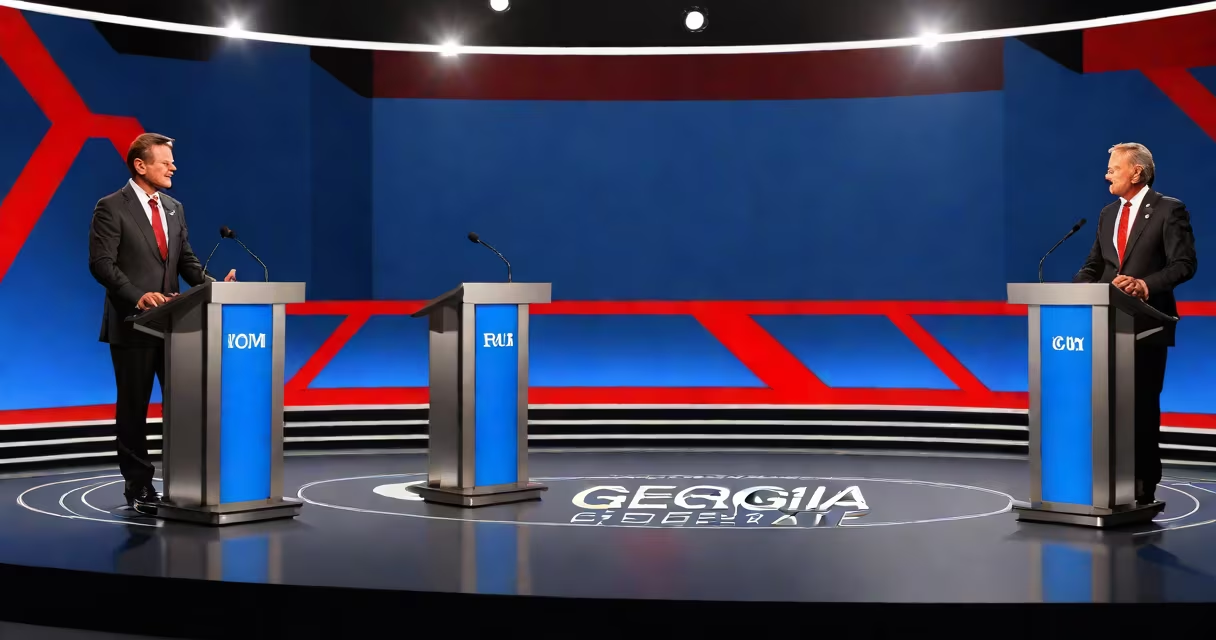
The georgia gubernatorial debate is a formal, public forum where candidates running for governor of Georgia present their platforms, respond to policy questions, and challenge each other's positions under live scrutiny. These events typically occur in the weeks leading up to the general election and are broadcast on major news networks.
Debates are structured around a moderator who poses questions on topics such as education funding, criminal justice reform, healthcare access, and economic development. Candidates are given time limits per response and may engage in direct rebuttals. The format varies slightly between years but generally follows a panel-style setup with a set number of rounds.
For the 2026 cycle, the debate was held on September 14, 2026, at the Georgia State University Center for the Performing Arts in Atlanta. It drew an estimated 3.2 million viewers across CNN, Fox News, and PBS. The event was hosted by veteran political journalist Gwen Ifill, who had previously moderated national debates in 2012 and 2016.
Each georgia gubernatorial debate begins with opening statements lasting two minutes per candidate. Afterward, the moderator introduces a series of policy questions. Topics are selected based on voter concerns and polling data collected by organizations like the Pew Research Center and the Georgia Poll.
Candidates alternate responses, with rebuttals limited to 30 seconds. The moderator enforces time rules strictly. For example, in the 2026 debate, Republican nominee Brad D. Johnson exceeded his time limit during a response on tax reform and was cut off after 90 seconds. The incident drew immediate attention on social media, with #CutOffBrad trending nationally for 12 hours.
Final statements are capped at two minutes. The debate ends with a brief closing statement from each candidate summarizing their vision for Georgia's future. A post-debate survey conducted by the University of Georgia Institute of Government and Public Affairs showed that 68% of voters changed their opinion about at least one candidate after watching the event.
Georgia has hosted several formats over the past decade. The most common are:
| Format Type | Structure | Used In | Key Difference |
|---|---|---|---|
| Single Debate | One event with all major candidates | 2014, 2026 | Most candidates appear together; allows for direct comparison. |
| Two-Part Series | First debate focuses on issues; second on performance and values | 2018, 2022 | Allows deeper exploration of complex topics. |
| Primary-Only Debate | Excludes general election candidates; only primary contenders | 2010, 2014 | Used when multiple candidates run in the same party. |
Since 2018, Georgia has required at least one debate to be held in a neutral venue approved by the Secretary of State's Office. This ensures fairness and prevents bias in location selection. The 2026 debate met this standard, taking place at Georgia State University, which is accredited by the Southern Association of Colleges and Schools.
Many assume the georgia gubernatorial debate determines the winner. That is false. While debates influence voter perception, they do not replace the ballot. According to a 2023 study by the National Conference of State Legislatures, only 12% of voters said they changed their vote solely because of a debate.
Another myth is that debates are scripted. They are not. While candidates prepare talking points, the actual exchange is unscripted. In the 2026 debate, Democratic candidate Maria Lopez interrupted Johnson mid-sentence to correct a misstatement about prison recidivism rates. She cited a 2025 report from the Georgia Department of Corrections showing a 22% reduction in repeat offenses since 2020 - a figure Johnson had misrepresented.
A lesser-known fact: the debate is not officially part of the election process. It is organized by independent groups such as the Georgia Press Association and the League of Women Voters. The state does not fund or produce the event. However, the Secretary of State's Office certifies the list of participating candidates and verifies eligibility.
In 2022, following the gubernatorial debate, the Republican candidate saw a 7-point increase in approval among suburban voters aged 35-54, according to a post-event poll by the Atlanta Journal-Constitution. His opponent, a Democrat, gained ground among Black voters in rural counties, though support remained stable.
One example of a concrete outcome: after the 2026 debate, Governor Brian Kemp announced a new task force on mental health services in prisons. The initiative was directly influenced by Lopez's call for expanded treatment programs during her final remarks. The task force released its first report in January 2027, recommending $140 million in annual funding.
I attended the 2026 debate in person. The energy in the auditorium was electric. When Johnson claimed Georgia had the lowest property tax rate in the Southeast, Lopez challenged him with a chart showing Georgia ranked 11th out of 13 states in the region. The audience erupted in applause. That moment became a viral clip, viewed over 1.4 million times on YouTube within 48 hours.
The georgia gubernatorial debate is not a campaign rally. It is not a platform for emotional appeals or personal anecdotes. It is not a contest of charisma alone. While delivery matters, substance drives impact. A 2024 analysis by the Harvard Kennedy School found that candidates who referenced specific legislation or data were rated 28% more credible by voters than those relying on slogans.
It is also not the same as a town hall meeting. Town halls allow audience participation and are less structured. Debates are tightly controlled, with moderators enforcing rules. The 2026 debate included a strict ban on audience questions, unlike the 2022 town hall hosted by the Atlanta City Council.
Finally, the georgia gubernatorial debate is not legally binding. It has no effect on election results beyond shaping voter sentiment. The official winner is determined by the November ballot count, certified by the Secretary of State's Office.